
Threads from 2025 H2: Stitching together the AI story across China and the US
“different races” to shared diffusion, I retrace the second half of 2025 — AI as cloud catalyst, 2C app battles, “six dragons” in Wuzhen, AI-as-OS, and what's next

Hi all,
It’s the end of the year, and I bet everyone’s starting to wind down. I’ve been thinking about whether to do a year-end reflection piece. If you have any questions or ideas for what the piece should focus on, let me know.
A wise man said at a dinner last week (his wife is even wiser and reminded him), “quantity time is quality time” when it comes to your family, and sometimes you just need to sit around and do nothing together. So I will be offline next week to spend some time with my girls.
For those of you who have been following the AI space closely this year, it’s been a wild ride. And it sounds like most of you have wrapped up earnings for the year, so I hope you really let yourself breathe this month and get some TLC with family, too.
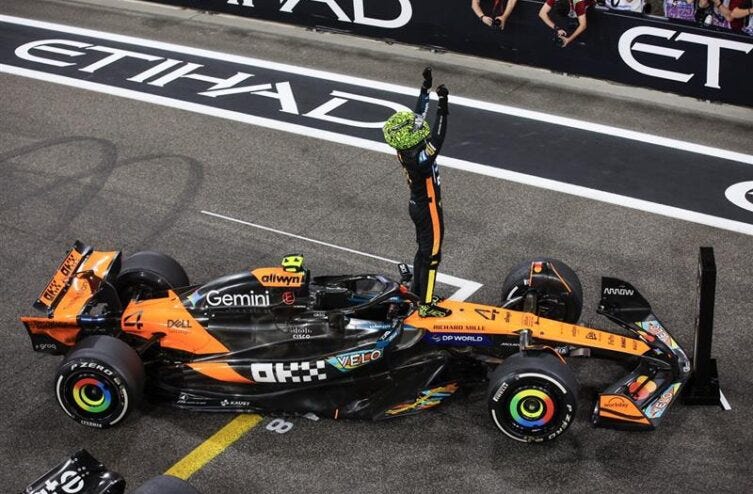
Is it a bit like the F1 championship this year, right? Max Verstappen can still win yesterday’s race, and Lando Norris will still walk away with the championship. In AI, one benchmark weekend doesn’t decide the season.
In the meantime, a few pieces I want to resurface to show how my thinking has evolved over the second half of this year:
In July, I wrote about how China and the US are running a different race due to their differences in capital structure, philosophy on diffusion and deployment, and digital ecosystem.
That digital ecosystem mentioned above applies not only to the software adoption rate, the ubiquitous 2C super apps, but also to what’s at the foundation - the infrastructure. In August, I wrote about how the focus on growing AI may be a catalyst for the country’s cloud industry.
In October, I realized that there were signs that the two sides are coming together and finding some commonality in their goals of AI development. The reasons were that diffusion as an economic driver is becoming more of a reality. There were increasingly blurred lines between the enterprise vs consumer playbook in the AI era. Top-down policy has turned into pressure in both systems to turn AI into a real growth/ diplomacy tool.
Then we saw the 2C AI space heat up in China with Alibaba renaming its app to Qwen, the same name as its models. The question then arose, who will be the ChatGPT of China in 2026 as Doubao, DeepSeek, Kimi, Yuanbao, and Qwen battle it out.
In November, the six dragons met in Wuzhen in a rare public meeting and shared their challenges, visions, and ambitions. Speculation about IPOs for many of these startups has also been circulating among investors. Zhipu, one of the OG four tigers, was the first to announce its listing plans and wait and see - I think I have something exclusive for you here coming up.
And as these AI labs continue to push out new models, apps, and tools, what we’re seeing is that they’re more and more looking like operating systems. From OpenAI’s app within apps to ByteDance’s AI system for ZTE. Is this where the market capture will be?
December, a personal reflection from meetings with the big techs in Singapore. It made me think deeply about the intricate relationships between innovation and regulation, safety and risk, organic diffusion and industrial planning.
Last but not least, my podcast Differentiated Understanding was launched in September this year, and I’ve been so grateful for the positive feedback. I keep my conversations basically as they are with the guest, so the conversations are organic and real. The show features a roster of influential and insightful guests spanning tech, media, investing, policy, and industry.
Recent (and a few upcoming) episodes include Jing Yang, Asia Editor at The Information; Wency Chen, tech reporter at the South China Morning Post; George Chen, Partner at The Asia Group; AI anthropologist and writer Jasmine Sun; investors Rui Ma, Kevin Xu, James Wang and Kevin Zhang; academics such as Professor Brian Wong and industrial policy scholar Kyle Chan; industry leaders such as Diana Wu David, Director of Future at ServiceNow, and supply chain expert Cameron Johnson; energy expert David Fishman; industrial policy expert Chim Lee of the EIU; tech policy expert Tom Nunlist of Trivium; e-commerce expert Sharon Gai; product and operations leads at Qoder of Alibaba, and foreign policy expert Natalia Cote-Munoz.
Together, they offer a nuanced, multidimensional view of the technology and AI landscape unfolding right before our eyes.