Differentiated Understanding Podcast Guests
AI 360: Culture, talent, tech, investment, business, supply chain, geopolitics, we'll cover it all
Hi all, I am incredibly excited to share a project I’ve started recently, which is the podcast Differentiated Understanding, powered by AI Proem.
Spotify | YouTube | Apple
What does Differentiated Understanding mean?
In a world where there is no longer a massive barrier to obtaining information, diverse knowledge and perspectives are no longer rare. But what makes an insight or a way of doing things unique is differentiated understanding. Piecing together scattered information, parsing through noise and clout, and then succinctly forming your own understanding of the situation, event, business, or person. That is insight.
The theme of Season 1 is AI 360, where each episode features a guest discussing AI’s development from a different perspective, with a particular focus on China’s AI development.
The guest lineup is truly phenomenal, if I may say so myself. The podcast is available on Substack, YouTube, Spotify, and Apple.
Ep. 1 Our very own Substack star Jasmine Sun on AI Culture in SV vs. China (Sept. 9)
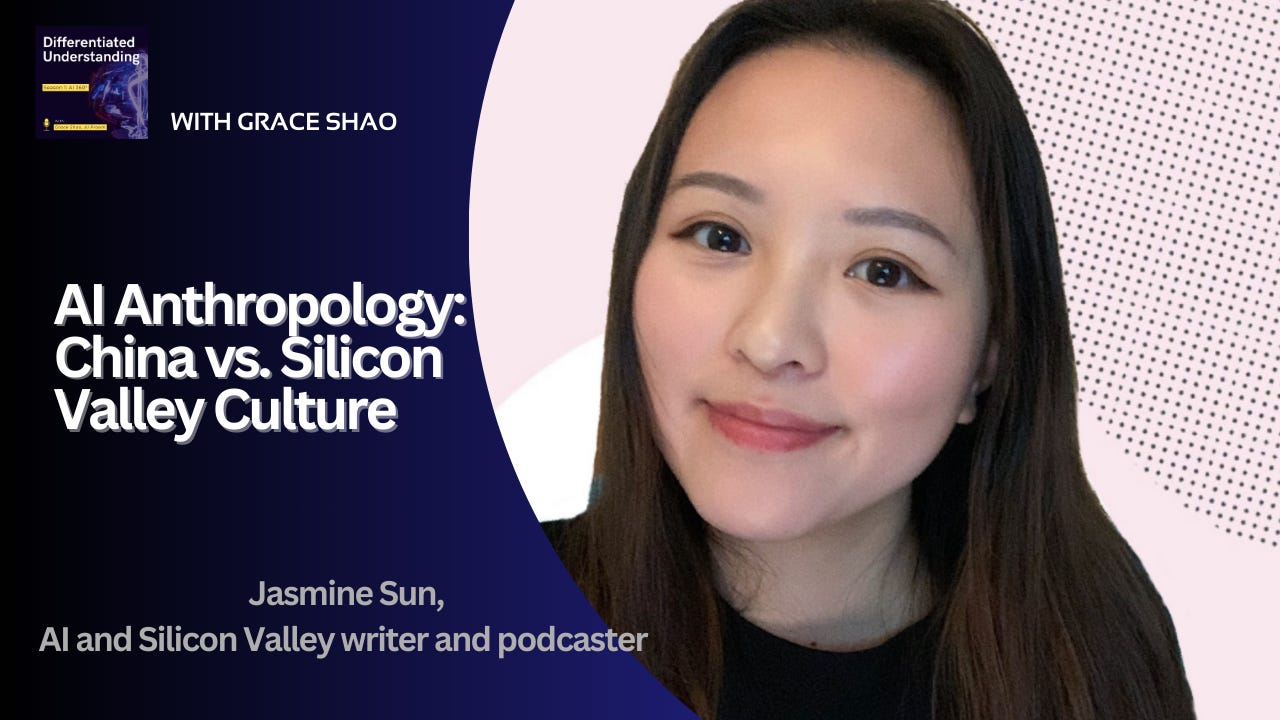
In this conversation, I talk to Jasmine, an independent writer and podcaster, about her journey into writing, her experiences in Silicon Valley, and her reflections on the culture of the tech and AI community in both the US and China. We discuss the evolution of AI, the different approaches and mentality when approaching tech development, the shift in Silicon Valley's relationship with government, and the implications of AI psychosis. Jasmine shares insights on writing for Substack, her recent trip to China, the importance of community, and her unconventional belief in the benefits of AI for writers.
Ep. 2 Cameron Johnson, who writes at Authors of Decoupling on trade and supply chain disruption (Sept. 16)
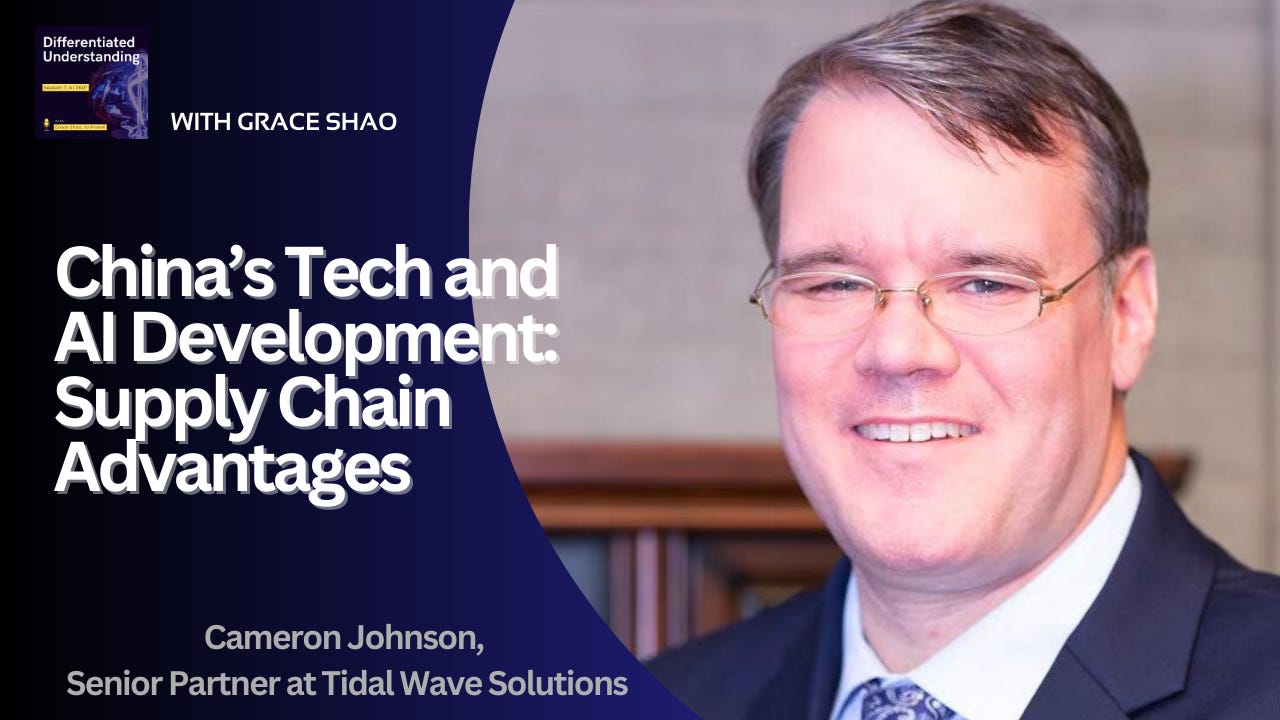
In our second episode, I speak to Cameron Johnson, Senior Partner at Tidal Wave Solutions. Based in Shanghai, he is a seasoned expert on China’s economy and industry with over 25 years of experience in supply chains, manufacturing, and technology. A regular on Bloomberg, he dissects the advantages and disadvantages China has in physical AI and tech talent along the supply chain.
Ep. 3 Professor Brian Wong, Assistant Professor at HKU, on China’s tech diplomacy and its role in SEA
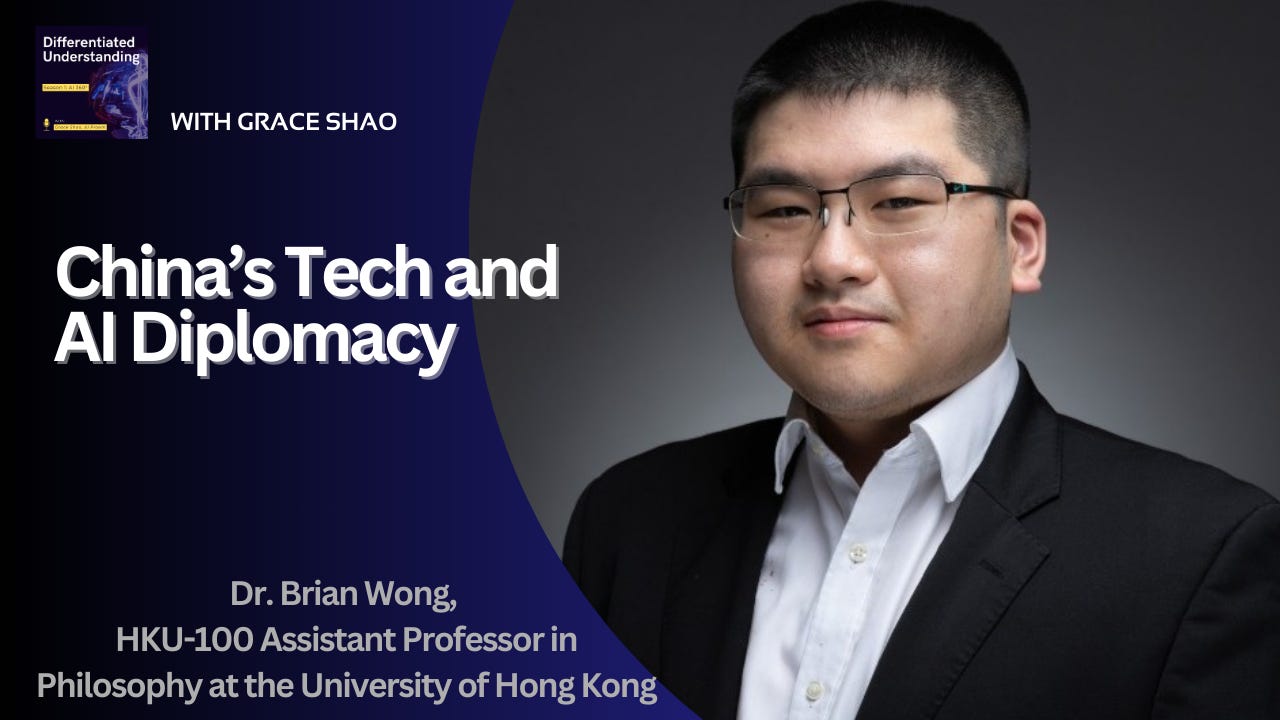
In this conversation, Dr. Brian Wong discusses his research at the intersection of moral philosophy, technology, and geopolitics. He emphasizes the importance of understanding AI's impact on employment and the need for academia to adapt to teach AI effectively. Dr. Wong also explores China's tech diplomacy, highlighting its focus on self-sufficiency and global partnerships. He argues that Hong Kong's unique status is crucial for its role in global tech and governance, and he concludes with a reflection on the future of technology and humanity, stressing the importance of human values in the tech race.
Ep. 4 Diana Wu David, Director of Future, Service Now, on the future of work
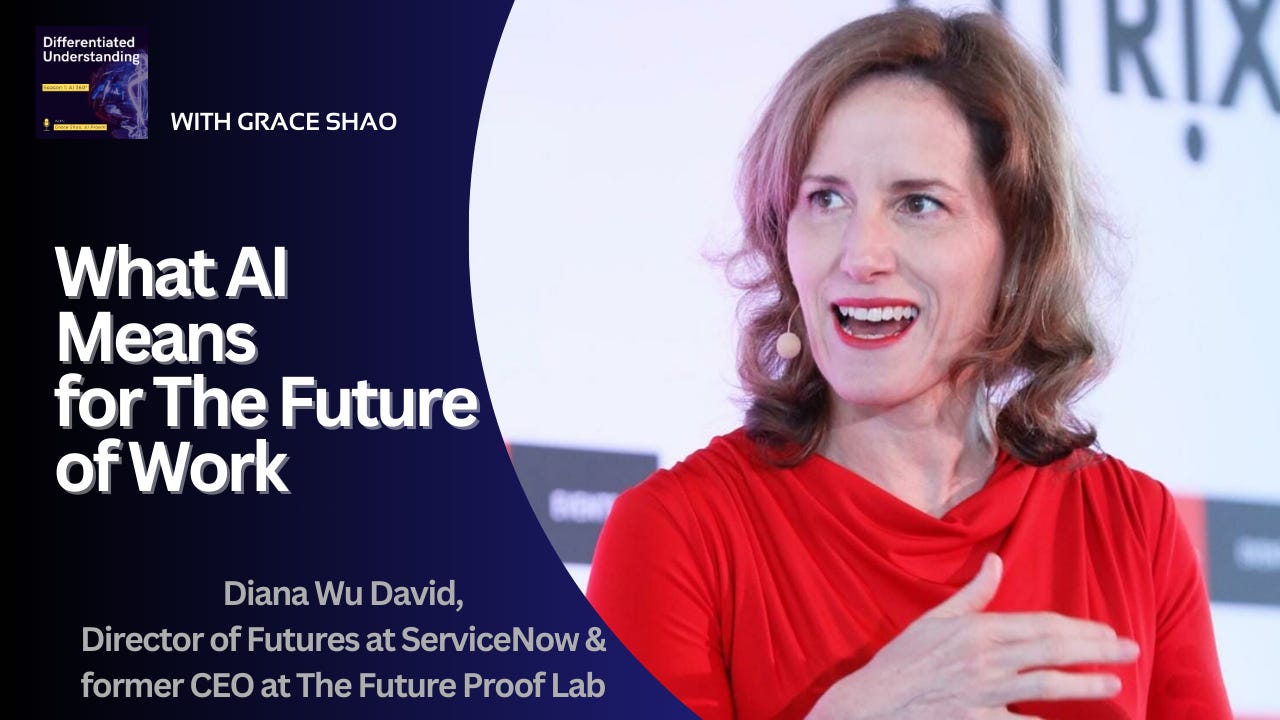
In this conversation, I speak to the Director of Futures at ServiceNow, Diana Wu David explore the transformative impact of AI on the future of work, discussing how organizations can adapt to this change. Diana was ranked number #2 futurist in the world by Global Gurus. She ran her own business for nearly a decade called Future Proof Lab where she worked with C-suite executives and boards to help them create future-focused, resilient organizations. In this episode, we delve into the challenges and opportunities presented by AI, the importance of measuring its effectiveness, and the cultural differences in technology adoption between the US and Asia. Diana emphasizes the need for a shift in organizational structures and the importance of preparing future generations for a rapidly evolving workforce. The discussion also touches on the necessity of fostering critical thinking and creativity in education to equip individuals for the future.
Ep. 5 Rui Ma, founder of TechBuzz China, investing in China’s internet and AI space
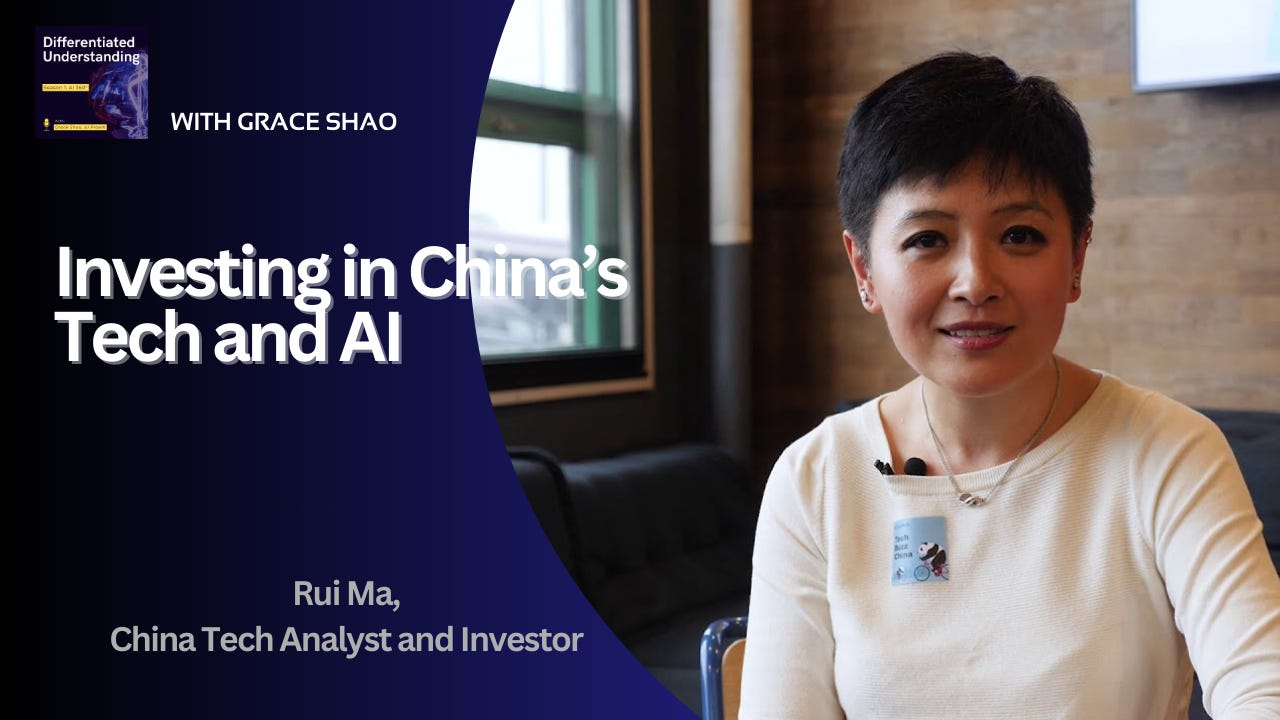
In this episode, we talk about China’s evolution from the internet era to the hyper-AI era. For most China tech investors and journalists, she needs no introduction. Rui is the founder of TechBuzz China and has long been a trusted go-to source for in-depth analysis on China’s internet businesses. She began her career in early-stage investing and, in recent years, has also advised AI companies, as well as established an AI school to prepare the next generation.
Spotify | YouTube | Apple | Substack
Ep. 6 Wency Chen, China AI and tech reporter, on the startups and VCs ecosystem
In this episode, Wency delves into the details of her journey, from working at a leading Chinese-language tech publication to joining an international VC firm, and now writing about China’s AI and tech ecosystem for a global audience.
She highlights the significant trends in AI, the startup culture characterized by hustle and competition, and the differences between tech events in China and the US. Wency provides a holistic view of the different players from the LLM startups to the leaders in consumer applications and to the rising domestic Nvidia challengers. She also addresses misconceptions about Chinese startups and emphasizes the importance of understanding the unique dynamics of the Chinese tech landscape.
Ep. 7 Jing Yang, Asia Editor at The Information and former WSJ tech Reporter
In this conversation, Jing Yang, Asia Bureau Chief of Information, a former WSJ reporter, discusses the evolution of China's tech landscape over the past decade.
In the conversation, Jing explores the corporate strategy and positioning differences between established tech giants like Baidu, Alibaba, and Tencent and newer entrants like Pinduoduo and Shein. Jing also talks about her reporting on Shein and Temu and their attempts to be listed in the West. She delves into the regulatory challenges faced by these companies both domestically and internationally, and how that has led to a belief shared amongst Western investors that “China is uninvestible.”
And finally, it discusses the major players and their unique playbooks, as well as the noticeable shift in dynamics within the venture capital landscape in China. She explains the differences between RMB-denominated funds and US-dollar-denominated funds, as well as how the VC ecosystem has evolved over the last few years.
Ep. 8 Kevin Zhang, investor at a family office leading AI investments across asset classes
In this conversation, Kevin Zhang of East Wind, who has had a career across New York, Silicon Valley, and Asia. He’s worked as a software engineer, an early-stage venture capitalist, a startup founder, and now leads AI-focused private and public investment for a family office. He shares his insights on the evolving landscape of AI investments, the implications of hyper-scaler capital expenditures, and the future of AI model training.
Kevin discusses the cultural differences between investment ecosystems in the US and China, the valuation of private market companies, and the new dynamics between Neoclouds and the traditional cloud providers amid the AI boom. Kevin emphasizes the importance of capital and distribution in determining the success of AI companies and reflects on the future of work in the context of AI adoption.
Ep. 9 Natalia Cote-Munoz of Artificial Inquiry, former senior advisor for diplomacy in Biden’s administration & writer and former educator
Natalia Cote-Muñoz is an expert in foreign affairs, East Asia-Pacific, China, and the Western Hemisphere. She served in the Biden-Harris administration as the acting Deputy Special Representative for City and State Diplomacy in the State Department’s Subnational Diplomacy unit. Prior to her time in government, Cote-Muñoz worked extensively as a policy analyst, conducting research at the Council on Foreign Relations, Inter-American Dialogue, and Carnegie-Tsinghua Center.
In this conversation, Natalia discusses her unique upbringing as a third-culture kid and how it has influenced her decision to pursue a career in foreign policy. Her observations of the evolution of US-China relations in the tech sector. Natalia reflects on her recent return to Beijing after nearly a decade, sharing insights on the rapid technological advancements in China, particularly in AI and digital payments. The conversation also delves into the differences in education systems between the US and China, the role of AI in productivity, and the cultural perceptions surrounding technology and creativity.
Ep. 10 AI Plus: Understanding the Intersection of AI and Economic Growth with Tom Nunlist, Trivium
In this conversation, I spoke with Tom Nunlist from policy consultancy Trivium about China’s AI Plus plan and its implications for the economy and society. We discussed the role of digital infrastructure in AI adoption, the transformation of production relations, demographic challenges, and the government’s role in connecting academia and industry.
The conversation also explores the complexities of navigating China’s regulatory landscape, including municipal and provincial implementations of AI policies, as well as the measurement of AI’s economic impact.
Tom shares insights on how MNCs can better align corporate strategies with government objectives during the AI growth era, and talks about the emerging AI pilot zones and how China balances between innovation and regulation.
Ep. 11 The Visible Hand: China’s Strategic Economic Planning with EIU Chim Lee
Chim Lee leads research on China’s advanced technologies, Climate change, Energy, Semiconductors, and Artificial intelligence, and also covers how China’s industrial policies link up with the broader diplomatic and macroeconomic dynamics.
In this conversation, we start by explaining why China’s newly announced 15th Five-Year Plan proposal is so important to China’s innovation ecosystem, economy, society, and its trade relations with the rest of the world.
We then dove into the current involution 内卷 issue, particularly zooming in on the solar and EV sectors. Then we look at the data center build-out driven by the AI boom and how local and regional governments are making sure involution does not hamper this sector.
Ep. 12 E-Commerce Evolution: AI and Live Streaming in Retail, with former Alibaba executive Sharon Gai
In this conversation, Sharon Gai, an expert in AI and innovation, with a focus on retail, shares her journey from working at Alibaba to becoming a consultant in AI technology for global companies. She discusses her experiences in e-commerce, particularly the evolution of live streaming and innovative marketing strategies in China. Sharon emphasizes the importance of AI integration in retail operations and the future of shopping with AI avatars. The conversation concludes with insights on simplifying retail to focus on core selling principles.
Sharon was selected as a RETHINK Retail’s Top Retail Expert and a LinkedIn Community Top Voice in 2024. She has two books, E-commerce Reimagined and How to Do More with Less Using AI. For more of her work, go to sharongai.com.
Ep. 13 Alibaba’s Qoder team on agentic coding, Qwen and international ambitions
In this conversation I am joined by two guests from the Qoder team at Alibaba: Hang Yu, Head of Product, and Christian Hu, Head of Global Marketing and Operations. The Qoder team launched just over two months ago, joining the likes of Cursor, Warp, and Copilot to make coding more agentic, so today we get to learn from them directly about their unique positioning being part of the Alibaba ecosystem.
Hang discusses the thinking behind designing Qoder, how it differentiates itself from peers currently available on the market, the future of agentic work, his fears and excitement about the pursuit of AGI, and finally, challenges the notion that the future of AI may not be based on Transformers.
Christian walks us through Qoder’s business positioning, global ambitions, how it fits into the Alibaba ecosystem, and why they route between models beyond Qwen.
Ep. 14 David Fishman on China’s Energy Capabilities and the AI Boom
David Fishman is a Principal at The Lantau Group who advises on energy development, infrastructure, and electricity markets across East Asia, with a focus on China. His expertise spans power-sector policy and economics, grid development, project bankability, and transaction support, backed by regulatory and economic intelligence across China’s solar, wind, coal, nuclear, hydro, transmission, and power markets. He has led work on policy forecasting and tariffs, renewable-asset due diligence, China business matchmaking, and green-power procurement for multinationals.
In our conversation, David unpacks how China’s decades-long planning underpins its energy transition and how renewables, storage, and grid build-out are looking to be able to meet AI-era compute demand. We also touch on China’s East Data West Compute and how it leveraged strong geographical planning, as well as discuss the cultural and commercial reasons behind the global retail adoption of solar energy.
For me, the most interesting point he brought up is that electricity used to be bound to scarce resources, but as the saying goes, the sun shines, wind blows, and water flows everywhere. Access to reliable power will become more evenly distributed, which can raise living standards in places left out of prior industrial revolutions - and Chinese technology is driving that change.
Ep. 15 Unlocking the Future of Startups and Super Individuals with Tanka AI Bei Zhang
In this episode, I speak with Bei Zhang, VP of Growth at Tanka, about the company’s mission to empower AI-native founders. The conversation covers why persistent, organization-wide memory is the missing ingredient for truly proactive agents, how Tanka stitches together chat, email, calendars, and documents into a single “remembering” teammate, and what agentic work could look like over the next 12 to 18 months. We also take a closer look at the future of founding teams and how agent tools can enable a super-individual way of working without losing control, auditability, or taste.
Tanka sits inside a three-layer stack incubated by Shanda Group. EverMind is the AI infrastructure arm that builds a long-form memory orchestration platform. MiroMind is the research lab, built on Qwen models, focused on long-term memory and reasoning. Tanka is the consumer-facing agentic workspace that applies those capabilities to help startup founders run their day-to-day.
Ep. 16 Why American Investors Should have a Pulse on China with James Wang
In this episode of Differentiated Understanding, I talk with James Wang, general partner at deep-tech fund Creative Ventures, author of What You Need to Know About AI: A Primer on Being Human in an Artificially Intelligent World, and writer of the newsletter Weighty Thoughts. James has sat on nearly every side of the table — Bridgewater investor, startup founder/CTO in healthcare, engineer at Google — and now backs “real-world AI” from semiconductors and interconnects to diagnostics and industrial systems.
We start with how the AI investing landscape has evolved since 2016: why “AI” used to be a dirty word in pitch decks, how the post–ChatGPT boom funneled capital into a small set of model companies, and why so many AI startups shot up to tens of millions in ARR only to fall back as incumbents absorbed their features. James explains where he still sees real opportunity — especially in vertical AI built on hard-to-replicate proprietary data — and why moats in healthcare and industrial AI look very different from the “GPT wrapper” era.
From there, we zoom out. We compare China vs. the US on AI pragmatism, industrial policy, and consumer vs. enterprise strengths; unpack the open-source vs. closed-source model debate; and talk about how agentic AI is already furthest along in developer tools. James also breaks down the energy reality of AI: why GPUs turn power into intelligence, how much additional load AI really adds to the grid, and what the Inflation Reduction Act and its partial rollback actually changed (and didn’t) for data centers and renewables.
Ep. 17 AI Governance From Brussels to Beijing with George Chen
Most AI policy conversations still orbit around Washington and Brussels, but Asia-Pacific is already writing a very different rulebook. In this episode, I talk with George Chen, Digital Partner at The Asia Group and former Meta policy executive, about how AI is actually being governed, built, and deployed across APAC, China, and the global south.
George traces his own path from journalism to big tech to advisory work, and uses that vantage point to explain why APAC is not “one market”—and why the EU analogy breaks down almost immediately. Countries like Japan, Korea, Singapore, and China are leaning into AI as a tool for economic recovery and industrial upgrading, often taking a much more pro-innovation, pro-growth stance than the EU’s more precautionary approach. At the same time, Southeast Asia is becoming the physical backbone of the AI build-out: Singapore as HQ and regulatory hub, with Malaysia, Indonesia, Thailand, and the Philippines hosting the data centers, power, and connectivity—along with all the local tensions that come with that.
We also get into what “responsible AI” actually looks like inside a company. Beyond the buzzwords, George breaks it down to three pillars—security, safety, and privacy—and talks through how mature players like Microsoft or Meta build these into product design from day one, versus the reality for startups trying to ship fast with one lawyer and a single policy person supporting multiple markets. He also makes the case that fragmented regulation and the lack of international standards are becoming a real tax on innovation, especially outside the US and EU.
Ep. 18 What the U.S. Misreads About China’s Tech Rise with Kyle Chan
In this episode, I sit down with Kyle Chan (Brookings Institution) to unpack the thinking behind his provocative New York Times op-ed, “In the Future, China Will Be Dominant, the U.S. Will Be Irrelevant.” We start with the DeepSeek moment and why it surprised the West, why it didn’t surprise many China-watchers, and why Kyle sees it as only “the tip of the iceberg.”
From there, we zoom out into the bigger story: China’s rise isn’t just one breakthrough model or one champion company. It’s a system of interlocking capabilities: EVs, batteries, renewables, industrial automation, robotics, and AI, advancing in parallel and reinforcing each other through spillovers, supply chains, and fast-moving “Swiss Army Knife companies” like Xiaomi and Huawei.
We also dig into what people often get wrong about China’s state role: not pure top-down command, but a mix of industrial policy + private-sector experimentation, including practical mechanisms like compute vouchers and local-government support. Finally, we cover India’s trajectory, geopolitical constraints, and Kyle’s “hedges”—scenarios in which today’s narratives (in both China and the U.S.) could still break in unexpected directions.
Ep. 19 Zhipu/ Z.ai, the first Chinese LLM to Go Public with Zixuan Li
In this episode, I sit down with Zixuan Li, who leads the chat API and global partnerships at Z.ai, one of China’s leading LLM labs (one of the four tigers) and now one of the first to head toward an IPO.
We talk about what it actually means to be an “independent” lab in a market dominated by platform giants like Alibaba, ByteDance, and Tencent, why Z.ai pivoted from SOE-heavy infrastructure projects to a product-led GLM stack, and how they landed on a different business model, and the creation of the GLM Coding Plan, instead of charging by tokens. Zixuan is very candid about pricing (“If Anthropic charges $200, we charge 200 yuan”), the realities of on-prem-first China vs cloud-first West, and what it’s like to race against Minimax and Moonshot with fewer GPUs and less cash.
We also zoom out and look at China’s AI talent pipeline (and the meme that the AI race is “Chinese in China vs Chinese in the US”), how he thinks about AGI as self-learning agents that live on your phone, why he’s comfortable being a white-label backbone in the Global South, and where he sees China’s AI landscape in the next 6–12 months. If you want a ground-level view of how a Tsinghua spinout is trying to survive, and maybe win, in the LLM wars, this one’s for you.
Ep. 20 EVs taking on AI OS and the Delivery War. The Chinese Tech Winners Beyond BAT with Alan Zhang
In this episode, I sit down with Alan Zhang (Principal & Portfolio Manager at Ox Capital Management) to map China’s tech landscape through an investor’s lens. We break down how Alibaba, Tencent, and ByteDance are approaching AI, and why the “AI OS” is the real endgame. Finally, we analyze what’s changing in China’s consumer internet, EV ecosystem, and embodied AI pipeline. We also unpack China’s delivery wars (Alibaba vs Meituan vs JD), why quick commerce is structurally different from traditional e-commerce, and how markets price geopolitical risk into China tech valuations.
Alan Zhang is a Principal and Portfolio Manager at Ox Capital Management, a boutique investment firm focused on emerging market equities that he co-founded in 2021. At OxCap, Alan leads investments across Asia; previously, he spent years as an investment analyst on the Asia team at Platinum Asset Management.
He studied Actuarial Science and Commerce at the University of New South Wales, and he’s even taught advanced econometrics. So if you like the intersection of fundamentals, market structure, and Asia platform businesses, well then, this one’s for you.
Ep. 21 (Coming) Sovereign AI, Open Source, and the Gulf’s Big Bet with Interconnected Kevin Xu
Every panel on AI and geopolitics seems to default to the same cliché: “the US–China race.” In this episode of Differential Understanding, I wanted to sit with someone who has actually lived inside DC, Silicon Valley, and the US–China tech corridor, and ask whether that framing still makes sense.
My guest is Kevin Xu, founder of Interconnected Capital – a global hedge fund focused on the picks and shovels of AI – and author of the Interconnected newsletter, which sits at the intersection of tech, business, and geopolitics. Kevin’s path runs from Obama campaign staffer and White House / Commerce Department comms to GitHub’s international expansion lead, and now to full-time investor–writer with a very explicit geopolitical lens.
We start with why he insists on “thinking in public” as an investor, and why he believes no idea is worth locking in a vault. From there, we dive into his critique of the “race” narrative and his alternative concept of US–China co-opetition – a messy mix of competition, cooperation, and outright co-opting of each other’s models and research. That leads naturally into China’s open-source AI ecosystem, the Manus–Meta deal, and what he would need to see before feeling comfortable owning the upcoming MiniMax and Zhipu IPOs in Hong Kong.
In the second half, we zoom out to sovereign AI: why South Korea might be one of the few countries outside the US and China with a shot at true full-stack AI sovereignty; how to read OpenAI’s Stargate initiative as an explicit American export play; and why the Gulf – particularly the UAE – is emerging as an AI “swing vote”, combining abundant energy, sovereign wealth, and a 1.5 million-strong construction workforce into a potential global compute hub. We close with Kevin’s differentiated view on China: AI diffusion is far more visible there, but the economic impact is not necessarily greater – and Beijing may end up being the first government forced to confront AI’s social fallout at scale.
More guests to come… and feel free to suggest/ nominate/ introduce!


Wow this sounds incredible. Really looking forward to this.
Just listened to all the episodes (so far)... loving them!