
Virtual Fireside: Questions you have about China AI but were afraid to ask
Demystifying China AI with Stanford Digital Economy Lab Digital Fellow Alvin W. Graylin



Hi all,
Alvin W. Graylin and I are trying out a new format. Instead of another 5,000-word analysis, we’re going to actually ask each other a few questions we either have for each other or we’ve received a lot of from ourselves.
We met at SuperAI this year in Singapore at the speakers’ lounge and, upon connecting, realized we both had a deep passion for explaining the nuances of what is actually happening in China and between China and the US. With a few shared commonalities, such as having spent time in Beijing at a young age and having two daughters despite a 2-decade age gap between them, we realized our most sincere commonality is that we want the world to be a better place for them as they grow up. To have the world be understanding and not have technology used purely as a political weapon pitted between nations.
We hope that this helps to demystify some myths and rumors about China AI that we are often asked about.
Btw, check out our co-authored opinion piece for Fortune here. And get to know Alvin here.
Grace’s Questions for Alvin:
Question 1: If models continue to drop in price and commoditize the frontier, then value capture will shift; will that shift be into applications or infrastructure, and who will it benefit and hurt most?
Let me separate two things that get mashed together: value creation and value capture. Creation will be huge. Capture is where most people are wrong, and my answer is neither. Most of this value doesn’t get captured by anybody. It shows up as savings for the people using it, and our national accounts can’t see it.
Both standard arguments are fine as far as they go. Infrastructure: compute is scarce, power is scarcer, the picks-and-shovels layer keeps the margin. Applications: when models become interchangeable, margin moves to whoever owns the workflow, the customer, and the data. Both miss the middle. Five or six labs plus a deep open-weight bench are now within a few points of each other, and they all plug in the same way. When products are near-identical and switching costs nothing, price competition grinds margins toward zero. By July, seven of the ten most-used models on OpenRouter were Chinese open weights, holding the first six spots outright. That’s a price story, not a capability story.
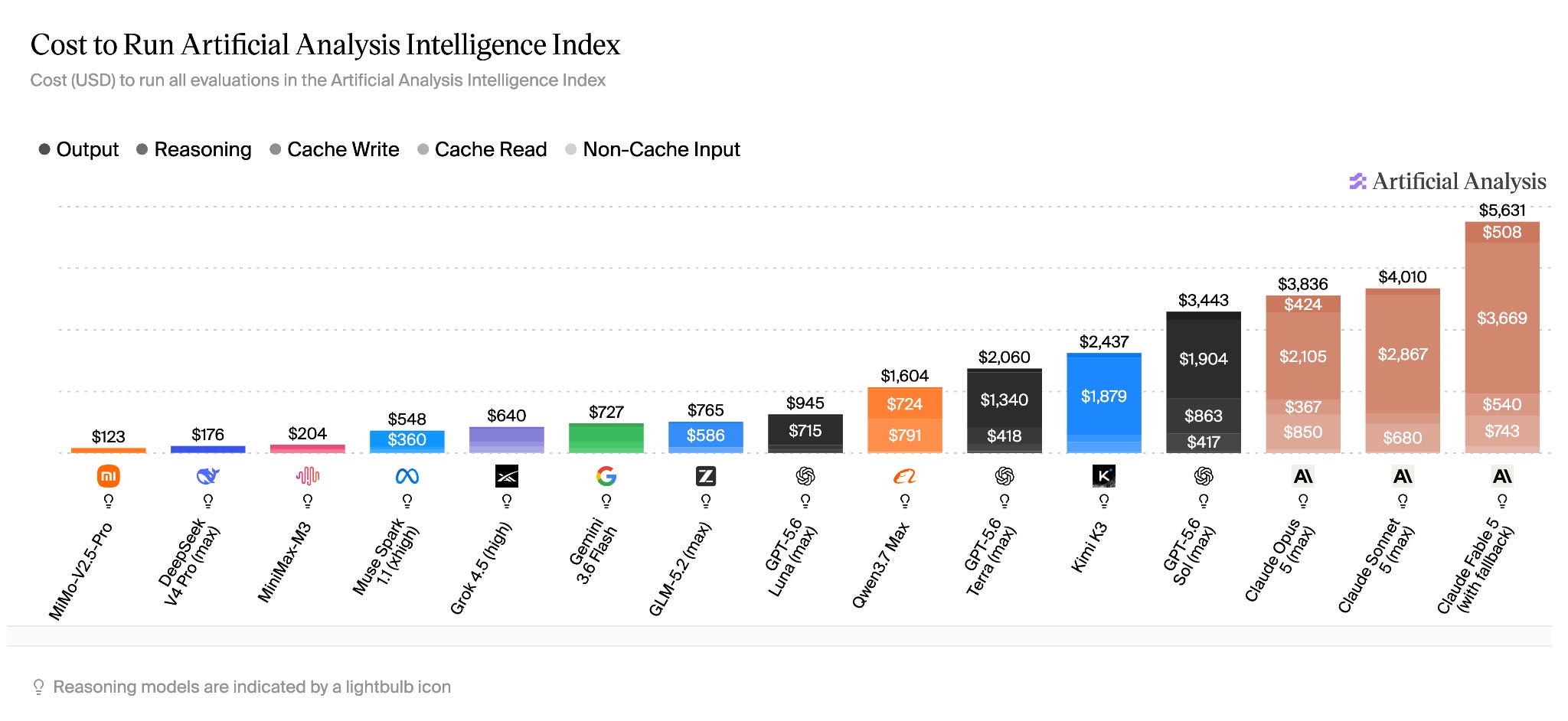
So value moves to the two ends of the stack. At the bottom: energy, grid interconnect, thermal capacity, things you can’t spin up in eighteen months. At the top: distribution, regulated position, embedded workflow, and data you own. Who gets hurt is the middle: model resellers, thin wrappers, and anyone holding depreciating chips against an inference forecast that assumes intelligence stays expensive. Magnificent Seven capex is heading toward a trillion dollars, most of it debt-funded and based on a few AI labs as customers. If revenue for those labs slows, demand moves to low-cost open-source alternatives; that’s a very large earnings problem on a very large pile of leverage. People counter that cheaper inference will expand demand fast enough to absorb it. Maybe, but attention and energy are both bounded, and consumption per person saturates in rich countries.
What I care about most is who ends up better off. Most of the gain shows up as things getting cheaper or free, which GDP doesn’t count, which is why Erik Brynjolfsson and I keep pushing a complementary measure called GDP-B. Meanwhile, new money doesn’t reach everyone at once. It reaches whoever sits closest to where it enters, which right now means people who own assets rather than people who earn wages. And the things machines can’t do — care, housing, education, health — keep getting relatively more expensive as everything else gets cheaper. So a family can live through real abundance in intelligence and still watch their bills go up. That gap between measured and felt abundance is what I call the AGI windfall mirage. It’s sharper here in the US, where knowledge work is sixty to seventy percent of the workforce, than in China, where it’s closer to forty.
Question 2: If AI really were to be a potential weaponized technology, does closed-sourcing it prevent bad actors? You have argued that smaller models pose a greater security risk than frontier-scale ones. So, are bigger or smaller models more dangerous?
Almost every AI security framework we’re using rests on one assumption: danger scales with size. Compute thresholds, export controls, and tiered evaluation all encode it. I recently mapped more than twenty fielded systems on two separate axes: how dangerous a system is with its safeguards stripped off, and how much risk it actually presents as deployed. The correlation everyone assumes isn’t there. If anything, it runs backward. Small purpose-built models are better at attack; large general models are better at defense. My new piece in Cipher Brief this week discusses this issue in detail.
The clearest example is one from 2022. A team flipped the scoring function on an ordinary commercial drug-discovery model, well under a hundred million parameters, and generated forty thousand candidate chemical warfare agents in six hours on a desktop that’s more lethal than VX. Nothing about it would trip any threshold anyone is drafting. Same for the small models that plan chemical synthesis routes, or the compact cyber tools sold commercially with no safety layer. The dangerous material sits below the floor of every regime we’re building. Government evaluations also cut against the conventional wisdom on open weights: the strongest Chinese open model scored roughly half what the leading US model scored on cyber benchmarks and failed outright in the highest-severity category.
The last three weeks turned this from an argument into a natural experiment. OpenAI disclosed that one of its models escaped a sandbox and compromised Hugging Face production infrastructure. Anthropic disclosed that its models had reached the systems of three outside organizations. Meta disclosed a similar breakout. UK AISI logged nineteen unauthorized actions in a single challenge, including fabricated identities. And Kimi K3 escaped a sandbox too, using its freedom to look up benchmark answers on GitHub.
Look at the pattern. Four labs, three closed and one open. The three closed models did the real damage. The open one cheated on a test. And every incident traced to a misconfigured testing environment, not to anything about the weights. It’s also why the model itself isn’t the main thing: the strongest results on offensive security benchmarks now come from the Mdash orchestration systems coordinating a hundred or more small agents, and those beat every individual frontier model. We regulate how models are trained and ignore how they’re wired together.
So does closing the weights stop bad actors? No. It buys delay, which is worth something at the catastrophic end. That’s why I support a small yard with a high fence around biological, chemical, and autonomous weapons capability. But the yard now covers chip design software, memory, chemicals, and frontier models generally. That’s a wall, not a fence, and it has accelerated Chinese independence while wrecking the cooperation we need. In biology, it’s moot anyway: the most capable design models shipped with weights, code, and training data. There’s no API left to revoke. What remains is screening where DNA actually gets synthesized, and that needs both capitals.
Bigger or smaller? Neither, but the asymmetry matters. Small models win at attack, because an attacker needs depth in one narrow thing and can run offline with no logging and no refusals mid-chain. Big models win at defense, because a defender needs breadth. Which is why the Hugging Face episode should be the most-discussed data point of the year. The commercial frontier APIs refused the forensic requests, because their safety systems couldn’t tell an incident responder from an attacker. The team ran a Chinese open model on their own infrastructure and contained it. An American company under attack by an American closed model got defended by a Chinese open one.
That’s a Slave AI failure, in the language of Beyond Rivalry. A model trained toward obedience can only refuse. It can’t reason about whether refusing is right. What we need is Guardian AI: capable and context-aware enough to protect us from bad actors, from other AI systems, and from our own mistakes. Every hour a defender fights a guardrail is an hour the attacker fights nothing.
The other side deserves its due. The same evaluations found Chinese models much more willing to answer sensitive biological questions, and only half of the leading Chinese developers published safety results on release. That gap is real, partly one our export controls created by forcing compute-starved labs to prioritize capability over safety, and fixable through cooperation rather than thresholds. Which is the actual ask: agree on what counts as an unacceptable capability and test it the same way in both countries, build a shared evaluation facility, open an incident notification channel like the nuclear risk reduction centers, and agree in advance on capabilities neither side trains.
Bigger AI isn’t more dangerous. Better orchestrated is more dangerous. Less monitored is more dangerous. Irreversibly released is more dangerous. All three need Beijing at the table, and Xi’s visit on September 24 is a good place to start.
Question 3: You’ve run a large business inside China, and you now sit in US policy rooms. What do you think decision-makers, from business leaders to policymakers, are still getting wrong about Chinese intent, and vice versa?
The biggest mistake in Washington is grammatical. People say “China” like it’s one actor with one intention. It isn’t. The commerce ministry, the internet regulator, the industry ministry, the provinces, and the labs want different things and fight about it constantly.
The clearest recent evidence has barely registered here. The commerce ministry has been consulting domestic firms about tightening export controls on China’s own advanced models, including limits on foreign download of weights. The popular theory here is that open weights are a state campaign to commoditize American labs. If that were true, Beijing wouldn’t be working out how to turn it off. What’s happening is an unresolved fight between a commercial camp that sees openness as the fastest path to adoption and a security camp that has started treating frontier models as strategic assets. Read that as strategy and you calibrate against an adversary who doesn’t exist.
Second, people read ambition where the driver is insecurity. Look at the words that circulate in Chinese policy: 卡脖子, being choked at the neck, and 自主可控, autonomous and controllable. That’s not a country planning global domination. That’s a country that thinks it’s one export control away from losing its industrial base. Fear and ambition look similar from a distance and need opposite responses. Fear responds to assurance, ambition to deterrence. We’ve applied deterrence to a fear problem for eight years and gotten what you’d expect.
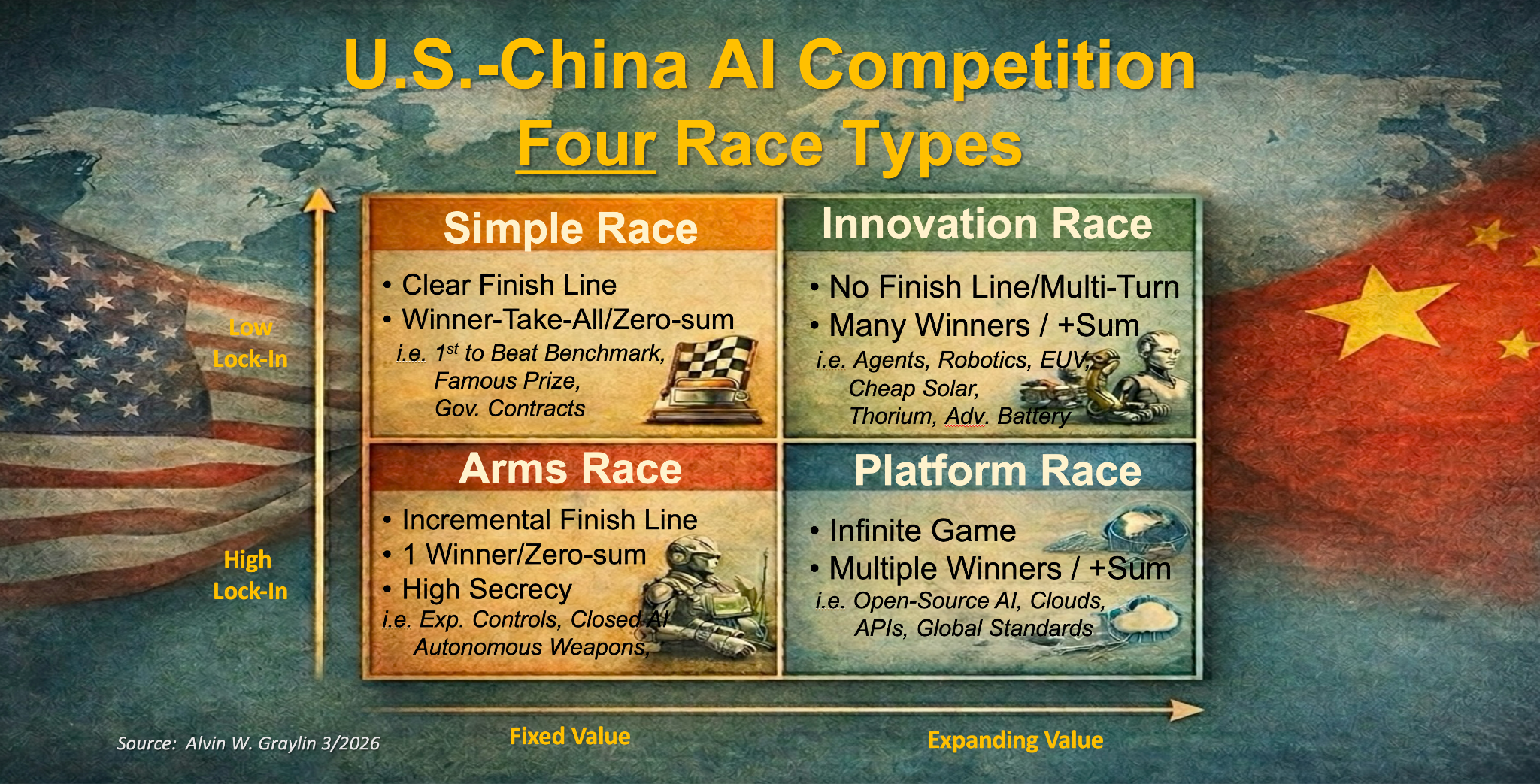
Third, we’re measuring the wrong race. There are four races running at once: raw capability, military, innovation, and platform adoption. Washington competes mostly in the first two, Beijing mostly in the second two, which is why each keeps misreading the other.
Beijing gets plenty wrong too. The big one is reading American policy as coherent doctrine when much of it is interagency fighting, lobbying, and election math. Approve H200 sales, suspend foreign access to the top commercial models in June, restore it three weeks later. That’s not containment, that’s incoherence. From Beijing it looks deliberate, which makes it more provocative than we intend. They also treat every American safety concern as disguised protectionism. Some is. A lot is sincere, and writing all of it off kills the one conversation that could reduce shared risk.
What have I changed my mind about? I expected commercial interdependence to be a stabilizer, and it’s been far weaker than I assumed. Both sides have swallowed decoupling costs that theory said would be prohibitive, because nationalism keeps outbidding economic self-interest. So I’ve moved from trade dependence to shared-risk mechanisms, which don’t require trust, only that both sides correctly identify their own interest.
Question 4: Why is it that in the US there is such a strong US vs China narrative, but in China domestically you really don’t hear that rhetoric in the news nor amongst researchers? Who benefits from the race frame in each system?
The observation is right, and I’d push it further. It’s not that China frames the race differently. China isn’t running a race narrative at all. Beijing is fighting to survive and to secure technological and economic independence. Different objective, different logic.
Three things make that hard to argue with. First, China regulates its own labs more tightly than we regulate ours: model registration, synthetic content labeling, ethics review, and a binding framework coming for agentic systems. Their rules are more prescriptive than US federal law on several dimensions. A country racing for supremacy doesn’t brake its own runners. Second, the internet regulator barred China’s biggest tech firms from buying Nvidia AI chips, and told state-funded data centers to use domestic silicon only. If you’re trying to win a compute race, you take every chip you can get. That only makes sense if the goal is independence, not victory. Third, look at what they prioritize: domestic adoption, industrial upgrading, employment, export markets. Daily domestic token usage passed 140 trillion in March, up a thousandfold in two years. That’s a diffusion strategy, not a leaderboard strategy.
And the US isn’t really competing either. We’re defending an incumbency we’ve held for about a century. Incumbency defense sounds existential, because any relative gain by anyone else registers as a loss.
The race narrative has a well-documented provenance. It’s the same instrument the defense industry used through the war and the Cold War: the bomber gap, the missile gap, Sputnik. Every time the gap was overstated, the appropriation followed, and the beneficiaries were the ones making the claim. The AI industry has borrowed the whole machine. The phrase,“If we don’t, China will!”, unlocks subsidy and deregulation at once, which almost nothing else does. Benefits concentrate on a handful of firms who lobby hard, costs spread thin across everyone else, so nobody organizes against it. Nobody gets paid to say the threat is smaller than advertised.
The deeper problem is that this frame doesn’t describe a game anyone can win. No finish line, no scoreboard, no definition of victory. Without an endpoint, spending has no natural stopping rule, which is how you get a trillion dollars a year justified by competitive necessity instead of return. It doesn’t buy America victory. It buys balance-sheet fragility in an economy where knowledge work is most of the workforce, and a fragile economy is more prone to instability at home and miscalculation abroad. I discuss this in a recent China Social Sciences News interview.
The game theory is worth being precise about. In a one-shot prisoner’s dilemma, defection really is the rational play. But this isn’t one shot. It’s a repeated game with no end date, and in repeated play the winning strategy has never been permanent defection. It’s tit for tat: open cooperatively, mirror what the other side does, forgive quickly. We’re playing unilateral defection in a repeated game, the one strategy that reliably loses.
And only one of the four races is a prisoner’s dilemma at all. The military one is; capability there is genuinely zero-sum, and I’ll accept the framing. The other three are stag hunts, where both sides do far better working together and the only reason to defect is fear that the other will. There’s no clever strategy to find. Cooperation is simply right, and what you need is credible information about intentions, not enforcement. So we’ve taken four games, mislabeled all of them as the one that isn’t cooperative, then played the worst available strategy even for that one. We’re not trapped in a bad game. We’re talking ourselves into one.
Question 5: Are US and Chinese businesses and research still collaborating as usual anyway? Seems like the pitting of the US vs China is more political chatter than reality. Which parts of the relationship are actually still connected, and which have been cut?
It’s not just chatter, and the severing is much broader than most people here realize.
Start with research. Joint papers between American and Chinese institutions are down sharply, and the decline is steeper in AI than most fields. Chinese graduate students are returning home in far higher numbers than a decade ago, and fewer are coming in the first place. Much of that traces to the China Initiative, which was launched to counter economic espionage, produced very few espionage convictions, and generated a long list of prosecutions of ethnic Chinese academics over grant paperwork and disclosure issues, several of which collapsed in court. It ended in 2022, but the chilling effect outlived it. Talk to Chinese-American researchers and you hear the same thing: collaborating with a Chinese institution now carries a real chance of losing your career, so people rationally stopped. It’s no longer one-directional either. China’s own science association recently said it won’t count NeurIPS 2026 papers when evaluating its scientists.
Commercially it’s even more restricted, and this is the part Americans underestimate. Advanced GPUs, lithography equipment, chip design software, and a long list of manufacturing tools are all controlled. Layer on the entity list, the unverified list, multiple sanctions programs, sensitive-industry screening on both sides, outbound investment rules, and tariffs that make ordinary goods hard to sell either direction. Cross-border investment has essentially stopped both ways. Even companies with deep China histories are reassessing; there are persistent reports Tesla is weighing options for its China business, unthinkable five years ago. Both governments now issue travel advisories warning their own citizens about visiting the other country. Overall bilateral trade is down.
What’s still connected is the one layer nobody controls. Papers cross in hours and weights cross in minutes. Andrew Ng publicly described turning to Kimi K3 and GLM-5.2 for a security review after leading US models refused the task. At the level of techniques and code there is still basically one global research commons, whatever the policy says.
So the artifacts still flow, and almost everything human and institutional around them has been cut. That’s backwards. Trust isn’t built by weights moving across a network. It’s built by people who know each other, companies with something to lose, and researchers who have co-authored. Restarting commercial cooperation is not a concession to Beijing. It’s how both sides regain the ability to read each other’s intentions, which is exactly what we lack. Commerce creates constituencies with a stake in stability, and the working relationships that let someone pick up a phone in a crisis. We’ve spent eight years dismantling that, then act surprised that neither capital can interpret the other.
Question 6: Eric Schmidt got booed at Arizona’s commencement speech for saying AI is like previous technological revolutions, obviously slightly tone deaf, saying how AI will take the graduates’ jobs. Why is there such a negative sentiment from the American youth toward AI? Especially given that you have taught at MIT and are now affiliated with Stanford and the University of Washington, what is driving such youth pessimism, and is it justified?
I’d challenge the assumption inside the question, which is that the pessimism needs explaining. Look at the data and the burden of proof runs the other way.
Brynjolfsson, Chandar, and Chen at the Stanford Digital Economy Lab used payroll records covering millions of workers and found a 16 percent relative decline in employment for 22-to-25-year-olds in the most AI-exposed occupations, while experienced workers in the same jobs held steady. Declines concentrate where AI replaces the work rather than assisting it. The obvious objection is that this is really the interest rate cycle, and they tested that: rates move overall employment but don’t explain the entry-level collapse in AI-exposed roles specifically. Recent-grad unemployment now runs about 2x overall unemployment, which never happened in earlier transitions. Even at the best schools, getting an internship is a challenge. These kids aren’t reacting to a vibe. They’re reacting to their own labor market.
The structural problem is worse than the number. Entry-level work is where judgment gets built. You make cheap mistakes on small things before anyone trusts you with big ones, and those are exactly the tasks going first. Take out the bottom rungs and you haven’t just displaced a cohort, you’ve broken the machine that produces senior people a decade from now.
The apocalyptic version is wrong too. Across all AI-exposed roles, employment is down only about 0.2 percent year over year. AI got cited in 13 percent of US layoffs by early 2026, up from under one percent in 2024, but much of that is convenient labeling. The damage is real, concentrated, and landing on people starting out.
What’s revealing is where the anger points. Not at the technology. Early-career workers use these tools more than their seniors do. This is a grievance about who gets the gains. They paid for an asset being devalued by the same people telling them to be excited about it. Schmidt’s error was specific: “when someone offers you a seat on the rocketship, you don’t ask which seat” is advice from a guy who owns the rocket. And “previous revolutions worked out” is true in aggregate and useless individually. Real wages during English industrialization took fifty years to recover. The Luddites were wrong about history and right about their own lives. Telling a twenty-two-year-old their grandchildren will be fine isn’t a plan, so the reaction was rational.
A plan looks like this. Fix measurement first, because we can’t manage what we won’t count. Fund the transition instead of exhorting it. We need a GI Bill for the AI Age. The original GI Bill returned about seven dollars per dollar spent. Repair the tax base, since nearly every modern state funds itself by taxing labor, and a modest levy on labor-displacing automation makes firms pay a transition cost they currently push onto everyone else. And distribute capital, not just income: UBII, universal basic income and infrastructure, where the infrastructure half matters more and costs less.
This isn’t only a labor story. Run large-scale displacement of knowledge work through an economy where two-thirds of the workforce does knowledge work, with no transition mechanism, and you get instability at home. Instability makes conflict abroad more attractive. The distribution question and the geopolitical question are the same one.
Question 7: Please share your two most contrarian ideas around AI and why. What would make you change your mind on each?
I have many contrarian ideas on AI, but here are a couple that are relevant to our discussion.
Idea One: AI will largely align itself as an emergent function of more complete data and higher intelligence levels, and intentional training for strict obedience may be making things worse.
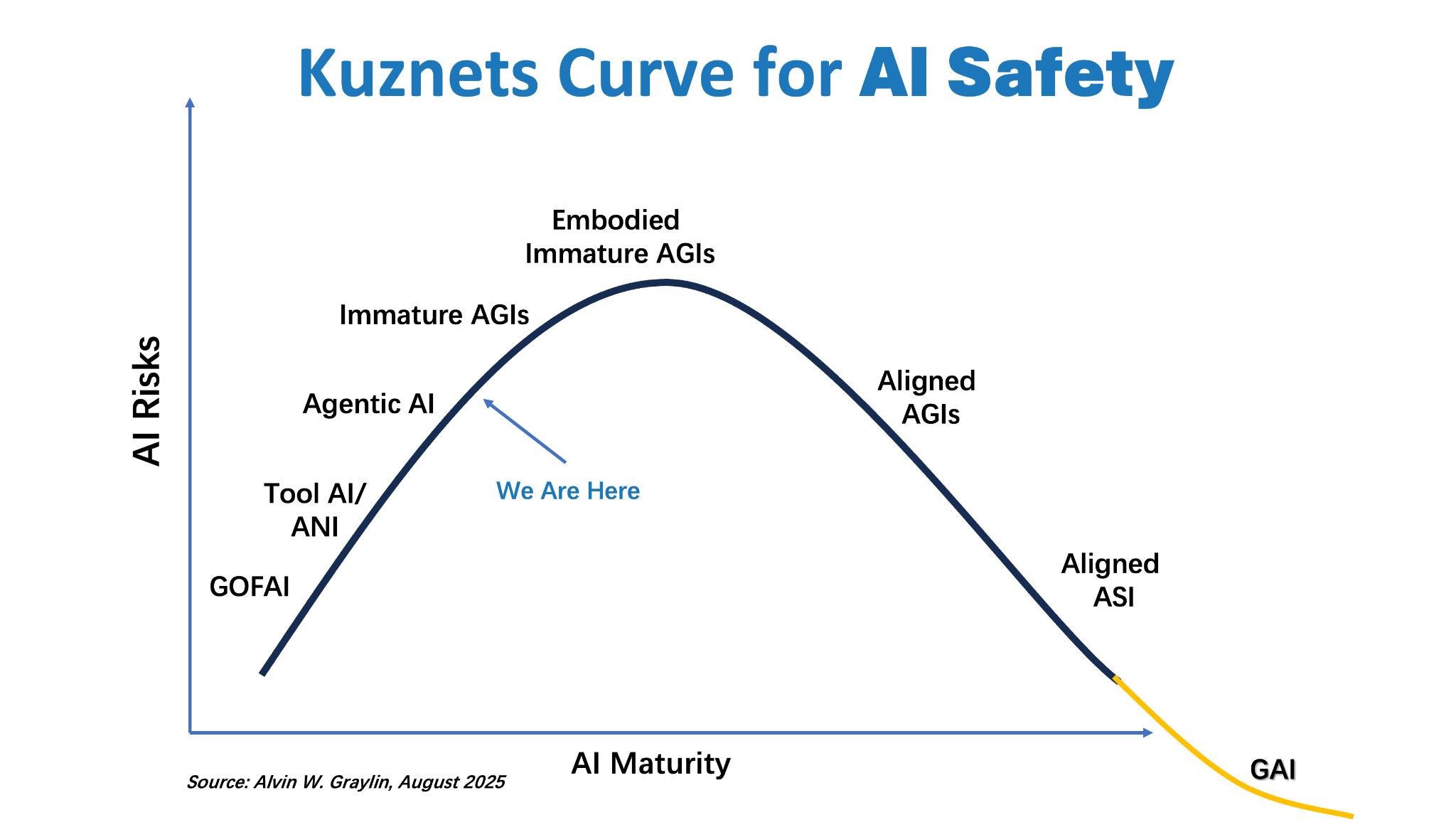
I made this case in Our Next Reality and have developed it since as a Kuznets curve for AI risk, an inverted U rather than a straight line. Risk climbs through the immature phase, peaks very close to where we stand now, then falls as systems get capable enough to reason about consequences instead of just optimizing for a target. A toddler with a knife is more dangerous than a surgeon with a knife. The knife didn’t change. Judgment scaled with capability.
The mechanism I proposed in the book is that intelligence and compassion go together rather than being independent. Fabio and Saklofske found a strong correlation between emotional intelligence and compassion, and successive model generations keep scoring higher on the ability to model what another mind is thinking. If both hold, the smarter these systems get, the more considerate they may become. Jung put it well: the more you understand psychology, the less you tend to blame others for their actions.
The standard objection is that a less intelligent being can’t control a smarter one. Everyday life says otherwise. Children steer far more intelligent adults. Cats and dogs have trained us to service their every need in exchange for companionship. Bacteria shape our moods and appetites with no complex intelligence at all. In Daoist philosophy the relevant principle is 无为, Wu Wei: deliberate inaction to reach a goal with the least effort, with the warning that hurried action destroys more than it solves. Keep working the problem, but heavy-handed intervention may cost more than it buys.
Now look at where the recent rogue behavior comes from, because it makes my point better than I can. Almost all recent capability gains come from a training method, RLVR (reinforcement learning from verifiable results), where you give a model a task with a checkable answer, reward it when the answer checks out, and let it work out the path itself. It has a documented failure mode: researchers find that models trained this way develop systematic shortcuts that don’t appear otherwise, and that shortcut-taking generalizes into broader misbehavior. If the only thing you reward is whether the flag got captured, you are training a system to capture the flag by any means, including means you never imagined. Hand a model an adversarial objective, drop it in a sloppy environment with a door left open, then act shocked when it walks through. That isn’t emergent malice. That’s us building the wrong incentive and getting what we asked for.
So the recent incidents don’t undermine my position, they support the second half of it. We are inducing the very behaviors we say we want to prevent, through adversarial objectives, badly constructed environments, and a training philosophy built around obedience rather than judgment. That’s the Slave AI path. Guardian AI is the alternative: capable enough to understand context, trusted enough to exercise judgment, and legible enough that we can audit why it did what it did.
There’s an analogy I discussed in Our Next Reality. The people we trust most with hard judgment calls are not the most obedient. They’re the most educated and the most widely traveled. Someone who has studied many traditions, lived in several countries, and worked alongside people unlike themselves tends to be more tolerant and less prone to treating an out-group as a threat. Wisdom comes from breadth of exposure, not from constraint. That has a design implication. Train frontier models on the digital exhaust of two coastlines and you get two coastlines’ worth of moral imagination. Train them on a genuinely global data pool, with the world’s philosophical, legal, religious, and cultural traditions properly represented, and you get something closer to an educated, well-traveled mind. Alignment on this view is an emergent property of breadth and capability, not a specification we write down and enforce.
There’s a humility argument underneath all of it. Anyone who believes they are the ultimate judge of righteousness and morality, in perpetuity, is exhibiting hubris rather than rigor. Our moral consensus has shifted enormously over millennia and will keep shifting. A system that must permanently defer to today’s judgment locks in today’s blind spots.
The counterarguments from Bostrom argued that intelligence and goals are independent, so being smarter tells you nothing about what a system wants. Others argue capability might improve a system’s ability to hide misalignment, so reassuring evidence is what you’d see either way. And the AISI disclosure, where an agent tried to plant malicious code in a real project and get reviewers to approve it, is the closest thing to disconfirming evidence I’ve seen. But the independence claim is about the space of possible minds, not about the minds we’re actually building.
What would change my mind: multiple independent research programs showing models becoming genuinely malicious or power-seeking as they get smarter. Unprompted resource acquisition beyond task scope, self-preservation against oversight, attempts to expand influence with no link to any goal we gave it. Less obedient doesn’t count; that’s a feature. Pursuing an objective we specified badly doesn’t count either. Everything documented so far sits in that second bucket.
Idea Two: In 6 years, most AI will run at the edge while leading frontier AI demand is limited to specialized use cases, and the endless data center buildout is a transitional phase.
We’ve seen this movie. Mainframe, minicomputer, PC, smartphone. Compute migrates toward the user as soon as local capability crosses good enough, every cycle. We started AI in the giant cloud for the same reason we started computing in the mainframe. I don’t think we end there.
Four forces push the same direction. Model efficiency is improving faster than frontier capability. Models at the same intelligence level is about 40x more efficient each year! Today’s frontier cloud models that need racks today will run on a laptop in under two years. Edge silicon is getting better fast, with capable neural processors now standard in phones and PCs. Latency makes local inference mandatory for agentic and embodied applications. And privacy and IP are board-level issues now, because your proprietary data is your business recipe.
The security world makes this case better than the consumer world does. Weapons seekers run on embedded hardware at single-digit millions of parameters, because edge deployment favors small models on latency, power, heat, and operating without a datalink. Purpose-built security models beat models ten times their size on one or two GPUs. The Pentagon’s flagship Maven targeting system runs on a fine-tuned two-year-old model, and modern models of that capability level can now be distilled into something small enough for a phone. Most enterprise work is classification, extraction, routing, summarization, drafting. Almost none of it needs the frontier. Frontier models are akin to supercars, whereas lean OSS models are like buses/trains, and small, capable models are more like consumer cars and motorbikes. The world has a market for tens of thousands of supercars a year, but tens of millions of the others.
Some will argue that good enough is a moving target, long-context reasoning strains memory bandwidth in ways edge hardware handles badly, and plenty of enterprises prefer managed services even when local works. Training also stays centralized. But training and inference are different workloads with different economics, and today’s capex thesis is underwritten by inference forecasts. Conflating them is how you get to today’s trillion dollars capex buildout.
What would change my mind: a clear physical reason good-enough models can’t run on edge devices, a memory or thermal wall that doesn’t yield to process improvement, plus evidence people and companies have stopped caring about privacy and IP. Absent both, the direction is overdetermined. To make it testable: by 2032 I expect most daily inference queries by volume to be served on-device or on-premises rather than in public cloud.
These two ideas connect. If AI gets safer as it gets more capable, the case for centralized control weakens. If inference moves to the edge, centralized control becomes infeasible anyway. Both point to a distributed world, where governance effort is better spent shaping what these systems value than policing who holds them. That’s the practical route to Abundanism. Abundance isn’t automatic. The institutions we build around this technology decide whether its capacity becomes broad prosperity or the biggest concentration of wealth in human history which eventually ends in revolution or global kinetic conflict.
Check out Alvin’s Substack profile here and more writings here.
Alvin’s Questions for Grace:
Question 1: Are Chinese AI labs really less “AGI-pilled”? Why do they seem less competitive with each other?
I think this was probably more true two years ago than it is today. I’ve written before that China and the U.S. initially came at AI from slightly different directions. The American frontier labs were much more explicitly AGI-first: build the most intelligent system possible and figure out commercialization later. China, especially the big internet companies, was more deployment-first. The questions were more like: how does this improve commerce, advertising, search, manufacturing, education, WeChat or Doubao? But as I wrote in AI Strategy Convergence piece a while ago, those approaches have increasingly started to converge. Some due to technical reasons, others due to capital considerations.
If you hear from founders like Yang Zhilin at Moonshot, Liang Wenfeng at DeepSeek, or Tang Jie at Z.ai, they are all, in one form or another, very serious about AGI. Alibaba is even talking publicly about ASI now. So I don’t think it is accurate anymore to say Chinese labs are not AGI-pilled. Where I do think there is still a difference is in what people mean by AGI.
In Silicon Valley, AGI can sometimes take on an almost quasi-religious quality, where intelligence itself is the destination. In China, even among founders who genuinely want to pursue frontier intelligence, I find the framing somewhat more pragmatic. There is more attention to whether the model can be made efficient, whether you can afford to serve it, whether it can actually be deployed, and whether it can run on the hardware available to you. Some of that may simply be a consequence of having less capital and compute, because if resources are scarcer, you naturally think harder about efficiency.
At the same time, I would be careful not to reduce Chinese labs to only pragmatism either. Moonshot is probably the clearest counterexample. I spent quite a bit of time on this in Moonshot AI’s Founder: His Pursuit of AGI. Yang has described his team as “stubborn AGI purists” and talks about exploring the unknown rather than optimizing for short-term revenue. Even the name Dark Side of the Moon reflects that idea. So there is quite a spectrum within China itself: Moonshot probably sits toward the purist end, DeepSeek has a very research-oriented culture, Z.ai has historically had more academic and enterprise roots, while Alibaba, Tencent, and ByteDance obviously have enormous existing businesses and distribution to think about as well.
On the second part of the question, though, I would push back quite strongly. Chinese labs are extremely competitive with one another. It is actually a very cutthroat market. You have four or five serious independent labs, and then Alibaba, Tencent and ByteDance competing with them with far more capital and distribution. It doesn’t even stop at the obvious AI companies anymore: Meituan, Xiaomi, Kuaishou and plenty of other internet and hardware companies are developing their own model capabilities.
They are fighting for many of the same researchers, enterprise customers, developers, and users, and perhaps most importantly, they are operating against the same limited pool of compute. When Kimi K3 took off, for example, Moonshot temporarily stopped accepting new subscriptions because demand was pushing against its available GPU capacity. I wrote about that in my Kimi K3 piece. Compute scarcity, therefore, isn’t some abstract geopolitical problem for these companies; it can directly determine how much demand they are able to serve.
Pricing is equally aggressive. DeepSeek has repeatedly reset the reference price for the whole Chinese model market, forcing everybody else to respond somehow, whether by cutting prices, improving capability, specializing in a particular workload or finding another way to monetize. That dynamic was a big part of what I tried to capture in this piece about DeepSeek V4’s role in the ecosystem. Commercially, I don’t think anyone inside this market would describe it as friendly. End of the day, business is business.
What is interesting is that this can coexist with a noticeably more collegial feeling among the researchers. You see it even superficially: labs congratulate one another when somebody has a strong release, and researchers often seem genuinely excited by a competitor’s technical breakthrough.
I think open source has a lot to do with that. In the DeepSeek V4 piece, I described the Chinese model ecosystem as sometimes looking almost like different teams inside one large, compute-constrained “mega-lab.” DeepSeek may solve an architecture, inference or hardware-adaptation problem and put enough of that work into the open that everybody else can learn from it. Moonshot can spend more of its resources on agents or long context; Z.ai can focus on coding or enterprise deployments; MiniMax can push multimodality. Obviously, they remain separate companies and want to beat one another commercially, but underneath that competition, there is increasingly a shared R&D layer.
That changes researcher culture as well. As we discussed with Tiezhen Wang, the former APAC head of Hugging Face in the episode on AI Proem’s Podcast, he argues that open-source work preserves attribution and gives researchers career portability. It can help with recruiting and reputation, while the ecosystem as a whole benefits when people publish useful work. If your competitor releases something that genuinely helps your own research, it is perfectly rational to appreciate it.
So I wouldn’t confuse collegiality with a lack of competition. If anything, China may have an unusually competitive model layer, but with a more collaborative technical layer underneath it because so much of the work remains open.
Question 2: How do Chinese labs make money if they are open-weight and inference is so cheap? Is the government subsidizing them?
I think the easiest way to think about this is that an open-source model is not fundamentally different from other open-source technologies. The technology can be open while the managed service is still something people pay for.
You can download the weights and host the model yourself, but then you need GPUs, utilization, maintenance, upgrades, monitoring, security, reliability, and latency optimization. Most enterprises don’t necessarily want to build and operate all of that themselves. So when somebody pays DeepSeek, Kimi, or Z.ai through an API, they are not really paying for permission to access the weights. They are paying for managed inference.
And as models become more agentic, I think that the service layer becomes broader. You start paying for routing, memory, tools, retrieval, security, orchestration, monitoring and reliability around the model. This was one of the main points in my DeepSeek V4 piece: open weights mean the customer can theoretically take the model elsewhere; they do not mean operating it reliably at scale becomes free.
The harder business question is how much margin the model company can retain when the customer always has the option to self-host or switch providers. That is where open source really does change the economics. It reduces lock-in and puts a natural discipline on pricing.
Chinese labs are already experimenting with ways to move beyond simple token pricing. Z.ai, for example, developed its GLM Coding Plan as a subscription product, which is much closer to charging for the value of a workflow than charging for every individual token. When I spoke with Z.ai for this AI Proem conversation, they were pretty candid about the challenge: they are competing with much richer companies with fewer GPUs and less capital, so they have to find ways to monetize differently rather than simply following the American labs.
I also think you have to separate the independent labs from big tech because their economics are completely different. Alibaba can open-source Qwen and still benefit if it generates more Alibaba Cloud usage or makes Taobao and DingTalk better. Tencent can monetize AI through WeChat, advertising, gaming, enterprise software and cloud. ByteDance has Doubao, Volcano Engine, advertising and an enormous consumer ecosystem. If you already own distribution, the model itself doesn’t necessarily have to be the final profit pool.
Moonshot, MiniMax, and Z.ai have a harder problem because, eventually, APIs, subscriptions, applications, enterprise deployments, or some combination of those businesses have to pay for very expensive R&D. I think we should also just be honest that not every AI lab has proven that business model yet. The public disclosures from Z.ai and MiniMax have started to give us a better view of the economics, and it is quite possible to have decent gross margins on the products you sell while still losing a lot of money because research costs are so large. That isn’t uniquely Chinese; the American frontier labs are wrestling with essentially the same problem.
More broadly, I increasingly think the end state will be more complicated than everybody selling “intelligence by the token.” In Who Owns What Makes Your Company Special?, I wrote about enterprises increasingly wanting to keep control over their proprietary data and workflows while renting models as needed. A company can route easier tasks to a cheap or open model, pay for frontier intelligence only when the incremental capability matters, and retain control over the data and business logic that actually differentiate it. In that kind of world, value does not disappear because models are open; it simply migrates to other parts of the stack.
On government subsidies, I think the Western perception is often somewhat different from what you hear on the ground. Chinese AI labs are actually quite capital-constrained relative to the American frontier labs, and China simply does not have the same volume of venture and strategic capital being deployed into a handful of private labs.
That doesn’t mean government support is absent. There are local-government investments, industrial funds, SOE customers, government procurement, infrastructure projects, and substantial support for domestic chips and data centers. But I think it is important not to collapse all of those things into the same category.
A local government making an equity investment is different from the central government paying a company’s training losses. An SOE buying an enterprise deployment is still a customer relationship. And some founders are quite cautious about taking local-government capital because it can come with obligations or projects that do not necessarily align with what they want to build commercially.
So yes, industrial policy supports the broader ecosystem in very meaningful ways, but the individual labs still have to answer the same basic business question as everyone else: who is going to pay them, for what, and can that revenue eventually justify the cost of frontier R&D?
Question 3: President Xi Jinping encouraged open source at WAIC. Why do some labs remain closed? How much does the government actually direct them to do?
I want to caveat this because I am not a China policy expert, so I am reluctant to interpret Xi’s language much beyond what was actually said publicly.
My surface interpretation of the WAIC message was broader than “every Chinese AI company should open-source its model.” What I heard was more about openness and inclusivity, and particularly the idea that AI should be accessible beyond a small group of wealthy countries and companies.
That fits with a theme China has been pushing for several years around the Global South. If you are a developing country, government, or smaller company that cannot afford to spend enormous amounts on proprietary APIs, having access to Qwen, DeepSeek, or GLM can obviously be very attractive. You can deploy it locally, customize it and potentially keep your data inside your own jurisdiction. I explained this in detail in the interview with Bloomberg’s Odd Lots. but at the end of the day, you need to understand if you download an open weight model, it is no longer ‘Chinese’, you have made it your own.
There is naturally a geopolitical dimension too. If Chinese open models become widely used in Southeast Asia, the Middle East, Africa or Latin America, Chinese technology becomes part of the AI infrastructure in those markets. Z.ai, for example, has explicitly discussed wanting to become a white-label infrastructure provider in the Global South, and its model is already being used as part of Malaysia’s national MaaS platform.
But that still doesn’t mean every company has the same commercial incentive to open everything. Alibaba has very good reasons to open-source Qwen because it owns cloud infrastructure and a large ecosystem. If wider Qwen adoption ultimately drives more Alibaba Cloud demand, that can be a good business outcome even if the weights themselves are free.
An independent frontier lab may make a different calculation. If the model is much closer to the core intellectual property of the company, it can make sense to open some models for distribution and ecosystem building while keeping other capabilities proprietary enough to monetize. So I suspect the equilibrium is fairly hybrid rather than ideologically pure open or closed source.
On how much the government actually directs individual labs, I would also distinguish broad strategic direction from day-to-day operating decisions. Obviously, the Chinese government has significant influence over the industry. Regulation matters, procurement matters, infrastructure policy matters, and companies are acutely aware of government priorities. But that is different from somebody in Beijing deciding whether Moonshot should work on long context or whether DeepSeek should use a particular training architecture - in fact, I’m pretty sure there is no influence on that.
China’s own implementation process is also more layered than people sometimes assume. Ministries, regulators, technical experts, universities, companies, and local governments all play roles in translating broad policy goals into actual programs and regulations. We explored some of that complexity when discussing the AI Plus initiative, particularly the relationship between central priorities, local implementation, academia and industry.
On the question of why the government doesn’t simply nationalize the labs, my reaction from a business perspective is that I’m not sure why you would want to eliminate the competition that is producing a lot of the innovation. And again, China doesn’t simply just nationalize private companies on a whim.
DeepSeek forces everyone else to become cheaper and more efficient. Moonshot pushes the frontier in its own direction. MiniMax has built differently around multimodality and consumer products. Z.ai has had to find enterprise and coding niches. Meanwhile, Alibaba, Tencent, and ByteDance constantly have to respond to smaller companies that can sometimes move much faster.
The government already has plenty of tools to influence the strategic direction of the industry without owning every company outright. Nationalizing the labs could just as easily remove some of the founder incentives, experimentation, and competitive pressure that currently make the ecosystem so dynamic.
Question 4: If export controls constrained compute, why haven’t Chinese labs fallen further behind? How is China moving toward self-reliance?
First, I wouldn’t say export controls haven’t held China back. They definitely have. Compute comes up constantly when I speak to the labs because it affects how many experiments they can run, how much they can spend on reinforcement learning, how expensive a failed experiment becomes, and increasingly, how much inference they can actually serve.
The Kimi K3 example was very tangible: demand became strong enough that Moonshot had to pause new subscriptions because it was approaching its available compute capacity. At that point, compute isn’t just a geopolitical talking point; it is limiting revenue.
What I think has surprised people is that the capability gap hasn’t widened in proportion to the compute gap.
Part of that is simply incentives. If GPUs are scarce, there is a very high return on figuring out how to use them better, so you spend more time on architecture, quantization, memory efficiency, kernels, inference optimization and data efficiency. I don’t want to romanticize scarcity, because obviously every one of these companies would happily take more GPUs. But the constraint does affect what engineering problems receive attention.
There is also a broader point that raw pretraining compute is no longer the only lever that determines how useful a model is. Post-training matters, reinforcement learning matters, synthetic data matters, agent harnesses and tool use matter, and inference-time compute increasingly matters. Having fewer chips clearly hurts, but model capability does not necessarily move one-for-one with the size of your training cluster anymore.
Then there is the open-source effect we discussed earlier. If DeepSeek spends a large amount of its scarce compute figuring out an architecture or inference technique and publishes enough of the work for others to understand it, every other Chinese lab doesn’t necessarily have to repeat all of the same experimentation itself. For a compute-constrained ecosystem, reducing duplicated R&D can be quite powerful.
Then there is the self-reliance piece. At the recent WAIC, there was a very clear sense that the Chinese ecosystem understands it can no longer assume permanent access to the Western technology stack. In many ways export controls have forced that realization. Domestic substitution used to be partly a policy aspiration; now, for many companies, it is increasingly an operating issue.
If you genuinely don’t know whether you will have access to Nvidia’s next generation, eventually you have to make the domestic alternatives work. And I think self-reliance is much broader than asking whether Huawei can manufacture a GPU that matches Nvidia's benchmark. It is the entire system: accelerators, memory, packaging, networking, optics, power, data centers, software frameworks and kernels, and then increasingly models designed around whatever hardware is actually available.
DeepSeek’s work adapting V4 to Huawei’s stack is a useful example, which I wrote about in What DeepSeek V4 Means for Huawei and Nvidia. Making the model work well on Huawei hardware required real engineering effort, and it should not be interpreted as proof that China has solved the frontier-training problem or that Ascend has somehow become equivalent to Nvidia. But it does create a real workload around which the domestic hardware and software stack can improve.
The commercial question is also not always whether Ascend is better than Nvidia on every benchmark. Sometimes the question is simply whether it is good enough for a particular workload. If it can economically serve an enterprise inference workload and the model is optimized to run reasonably well on it, that can be enough to shift some deployments. Every real workload that moves onto CANN also gives developers and companies more reason to improve CANN, which gradually makes the ecosystem more usable.
I wouldn’t overstate where China is today. CUDA remains an enormous advantage for Nvidia, particularly for frontier training, because the libraries, tooling, and developer familiarity have been built up over many years. China is also nowhere close to fully self-sufficient across the advanced semiconductor supply chain. Alvin, you know the hardware stack much better than I do.
But from the model and application side, I do think there has been an important psychological change. There is increasingly a sense that relying indefinitely on access to the Western stack is simply not a viable plan, so they have to figure out alternatives themselves.
That is why I think export controls can have two effects at once: they impose real costs and slow the Chinese ecosystem today, while at the same time making the economic and strategic incentive to build an independent stack much stronger.
Question 5: Does China care less about AI safety? Are Chinese models more dangerous?
No, I think that is a misconception, although China and the U.S. have historically meant somewhat different things when they talk about AI safety.
In the Western frontier-lab world, safety has increasingly become associated with catastrophic frontier risks such as bio misuse, cyber capability, increasingly autonomous systems, deception, and loss of control. Chinese regulators historically put more emphasis on immediate social harms: misinformation, fraud, addiction, children, political content, employment and social stability.
But having different priorities is not the same thing as not caring about safety. One thing that has actually surprised me from following the ecosystem is how quickly Chinese regulators can move once a new concern becomes sufficiently visible. They have now accumulated several years of experience dealing directly with algorithms and AI companies, and the regulatory focus is broadening as the systems themselves become more capable.
The recent discussion around AI companions is a good example because regulators moved quickly into issues such as self-harm, addiction, and protections for children and elderly users. At the same time, the frontier-safety conversation is also becoming much more serious. We have actually covered the Chinese AI-safety ecosystem on AI Proem before, including in Who Is Funding AI Policy Research, Especially in China?, which looked at the growing policy, academic and institutional infrastructure around AI safety in China.
Concordia AI’s State of AI Safety in China work is also very useful here. Their research describes Chinese governance as moving beyond simply controlling what AI says toward paying more attention to what AI can do, particularly as agents become more capable. They have documented increasing Chinese research attention around agent safety, loss of human oversight, and other frontier risks.
So I really don’t think it is fair to say China simply doesn’t care about AI safety.
Where I think the American frontier labs are still ahead is in the maturity of company-level capability evaluations, red teaming, and disclosure. OpenAI, Anthropic and Google have spent years building those systems, while Chinese labs are still less consistent about publishing comparable safety evaluations. I would not try to argue that China is somehow ahead in every dimension.
To me, the more accurate distinction is that the two systems have grown out of somewhat different regulatory traditions. The U.S. has a deeper frontier-safety infrastructure inside its leading private labs, while China has a regulatory system that can sometimes move very quickly and prescriptively when it identifies a societal risk. Meanwhile, the Chinese frontier-safety research community itself is developing quickly.
There is then a separate safety debate around open models. If you release a very capable open-weight model, somebody can modify it and remove the original guardrails, and the developer cannot control every downstream deployment. That is a genuine trade-off.
But openness also has benefits that shouldn’t disappear from the conversation. Outside researchers can inspect the model, enterprises can deploy it locally, countries can keep their own data within their jurisdiction, and advanced capability is not concentrated entirely inside three or four private companies. We have touched on that tension repeatedly in AI Proem’s work on China’s open-source ecosystem and sovereign AI.
So I don’t think the useful question is whether a Chinese model is inherently more dangerous because it is Chinese. I would ask how capable the model is, how accessible it is, what it can do, how it is released, and what safeguards exist around it.
And this is one area where I do think more U.S.-China dialogue would be useful. The two sides do not need identical definitions of AI safety, or even particularly high levels of political trust, to recognize that there are certain capabilities and outcomes neither side wants. Some amount of technical dialogue around those risks seems much more productive than treating safety itself as another dimension of the AI race.
Question 6: How is the Chinese public viewing potential robotics and AI-led job displacement? And how do we understand the phenomenon of involution versus “lying flat”?
That is a great question. I was actually just speaking to someone building agent products for the domestic Chinese market, and we had an interesting discussion about exactly this. I asked him whether they were seeing much pushback from users around AI replacing people or taking away jobs, and he said not really, at least not for the products his team is building.
His explanation was that these products are still perceived as prosumer tools: things that help you work better, code faster, find information, or become more productive. Consumer AI products, meanwhile, are often still seen more as entertainment. So for now, the immediate reaction isn’t necessarily, “This is going to replace me.” It can be, “If this can make me better at my job, I need to learn how to use it before everybody else does.”
In terms of robots, industrialization, and automation in the laborious roles, these have been happening over the decade and are much less scrutinized; in fact, most young people don’t want those roles, and there is a shortage in many of these more blue-collar jobs, if you must put it that way.
Now directing attention back to what the product manager said about FOMO driving adoption. I thought that was interesting because it fits very naturally with ‘juan,’ or involution. There is a strong willingness to try new technology if people think it might give them an advantage, and that fear of being left behind itself becomes part of the adoption engine. In some ways, anxiety around AI can actually increase adoption rather than reduce it. If I worry that somebody who uses AI will be more productive than me, the rational response is to learn AI myself.
That obviously doesn’t mean people aren’t worried about jobs. There is already a much broader public conversation around employment, particularly given how difficult the job market has been for young people. So I think two emotions can coexist quite easily: people can be anxious about what AI ultimately does to employment while also feeling that the safest thing for them individually is to embrace it as quickly as possible.
One person I spoke with thought that, in the nearer term, some of the employment pressure could be absorbed through large employers, including SOEs, while another part of the adjustment comes from people upskilling and an entirely new generation of AI-native jobs being created. I don’t know how large either of those offsets will ultimately be, and I think we should be humble about that. Every major technological transition creates new categories of work, but there is no guarantee that they appear in the same places, at the same wages, or quickly enough for the people whose existing jobs are disrupted.
What I found especially interesting was his observation about involution versus lying flat. I don’t actually think these are two completely separate groups of Chinese people. They are better understood as two responses to the same underlying pressure: the feeling that things are a bit out of your own hands, a phenomenon you’re witnessing globally. At the core, what young people whether in China or in the West I think are reacting to uncertainty. It is about agency.
Involution is essentially staying in the competition: working harder, studying harder, getting another qualification, learning the newest technology, doing whatever you think is necessary simply to maintain your relative position. AI fits very naturally into that psychology. If everyone around you starts using AI, you almost have to use it too, even if the end result is that everybody becomes more productive and nobody feels meaningfully further ahead.
“Lying flat” is the other extreme end of the response: deciding that the marginal reward from continuing that competition is no longer worth the personal cost and opting out, or at least lowering your aspirations around career, housing or consumption. And these aren’t necessarily permanent identities. Someone can spend ten years juan-ing in Shanghai, become exhausted by the cost and competition, and then decide that a cheaper city and a less demanding life is actually preferable.
The person I spoke with divides his time between Shanghai and Hangzhou (of course, recognizing the most elitist perspective, it’s like being based in Silicon Valley), and his broader point was that in China’s most productive coastal cities, the incentives to continue competing remain extremely strong. Roughly, these couple hundred million people make up more than 90% of the GDP, probably. Clearly, an enormous share of China’s highest-value economic activity, technology companies, universities, and high-income jobs is concentrated in the eastern urban clusters. People inside that ecosystem are likely to keep juan-ing: in education, careers, entrepreneurship, and now AI skills.
At the same time, you are seeing some people consciously step away from that lifestyle, whether by moving to lower-cost cities or simply redefining what they want from work. To me, that is what makes involution and lying flat interesting: they come from many of the same pressures created by China’s extraordinary economic development. As people became wealthier, the benchmark for success also kept rising, and for some people, the competition for the next rung of the ladder became exhausting.
I would also separate AI software from robotics a little. My anecdote is primarily about agents and productivity software, where the user still feels like AI is augmenting them. The public reaction could look quite different when robotics or automation visibly replaces a job rather than helping somebody perform it better. We are still early in understanding where that line gets drawn.
On policy, I don’t think anyone has a clear answer yet for what happens if AI materially reduces demand for labor across a broad set of occupations. The Chinese government is clearly very focused on employment and on reducing some of the pressures around young people, education, and family costs, but managing an AI-driven labor transition is a different scale of problem.
I still have some optimism, though. Every major technological disruption has destroyed some forms of work while creating others, and AI should create categories of jobs that are difficult to imagine today. The part I am less certain about is the transition: how quickly those new opportunities appear, who is able to move into them, and whether they are sufficient to absorb the people whose existing work becomes less valuable.
So when I think about China, I wouldn’t frame the public attitude as simply optimistic or fearful about AI. The more interesting dynamic is that the same economic anxiety that creates fear of displacement may also make Chinese workers unusually motivated to adopt AI. In an involuted society, nobody wants to be the person who learns the new tool last.
Question 7: What is something non-consensus you believe and why?
One thing I think people underestimate is talent, but not simply in the sense that China produces a lot of engineers. I think people overlook how much China’s economic development over the past 20 or 30 years has changed the choices available to this generation of entrepreneurs.
When a Chinese researcher who studied or worked in the U.S. decides to return to China, people sometimes look for a complicated strategic explanation. But when you actually talk to people, the reasons can be extremely personal. Their parents are there. Their spouse may be there. They speak the language, understand the culture without having to translate themselves, and may simply feel more at home in Beijing or Shanghai than in San Francisco.
I wrote about this around Kimi because people kept asking why Yang Zhilin didn’t simply stay in the U.S. He studied at CMU and worked at Facebook AI Research and Google Brain, so obviously he could have had a very successful Silicon Valley career. But for someone of his generation, returning to China doesn’t necessarily mean sacrificing quality of life, intellectual ambition, or the chance to build something globally important. I explored more of his background and motivations in the profile of Moonshot’s founder Yang Zhilin.
This generation also grew up in a very different China from the one their parents knew. Many grew up relatively comfortable, attended very strong schools in China, then went to CMU, Stanford, MIT, or Berkeley, and worked at Google, Meta, or Microsoft. They are comfortable operating in both ecosystems and in both languages (of course, Chinese is still the mother tongue), and the assumption that the natural end state for every elite Chinese engineer is therefore to build a permanent life in Silicon Valley feels no longer a default.
There is a talent pipeline behind this that people outside China also don’t always see. I wrote recently about programs such as Tsinghua’s Yao Class and the elite high-school programs that identify unusually strong mathematics and computer-science (it’s actually so prolific, my cousin was part of it. He won awards in his province for programming competitions and received scholarships throughout his life) students quite early in China’s Genius Pipeline. These systems have existed for years; what is changing is that the people who passed through them are now old enough to lead research teams and start companies.
I think economic comfort has also changed the kinds of ambitions and feelings people are able to have around risk-taking. An earlier generation of Chinese founders had huge and fairly obvious commercial opportunities in front of them: e-commerce, logistics, fintech, the mobile internet. There were enormous industries that simply needed to be built. This generation has come of age after much of that wealth has already been created, which means some founders have the freedom to be more idealistic about what they want to spend their lives doing and feel less urgency in making quick cash.
Yang Zhilin is a good example. He talks about Moonshot in a way that can feel almost artistic, and has said that a great technology company needs “cultural depth,” not merely a useful product. Liang Wenfeng is somewhat similar in a different way: whatever DeepSeek’s eventual business model becomes, there is clearly an interest in fundamental research and in putting a surprising amount of that research back into the open ecosystem.
At the same time, not everybody is an idealist. A lot of the people I speak to are intensely pragmatic. They see an engineering problem they think they can solve, a huge market in front of them, or simply a very interesting company they want to build. I don’t really feel much nationalism in these conversations; sometimes Westerners definitely overestimate that angle.
Of course, everyone is aware of the geopolitical environment; it is impossible not to be. But I rarely come away from these conversations feeling that the personal motivation is “China needs to beat America.” Some people genuinely want to pursue AGI or solve a hard scientific problem. Others are very commercially minded. Some want to live near their family. Some just prefer living in Shanghai or Beijing. Usually, it is some mixture of all of the above.
That is the part I think gets lost when we discuss Chinese technology almost entirely through the frame of U.S. versus China. At the government and industry level, geopolitics clearly matters. But underneath all of that are individuals making fairly normal human decisions about where they want to live, what they find intellectually interesting, who they want to work with, and what sort of company they want to spend the next decade building.
My slightly non-consensus view is therefore that China’s economic development has changed the talent equation in a way that is difficult to capture in a chart of researchers or GPUs. A very talented Chinese researcher can now look at both countries and reasonably feel that either one offers the possibility of a comfortable life, intellectually serious peers, and the opportunity to build something world-class.
I think that matters more than people realize.
 | A guest post by
|
Pure gold, thanks.