

The talk of the town is obviously Kimi K3.


Have Chinese open-weight models collectively caught up with the frontier U.S. closed models? Not across every task, and not quite yet. Kimi K3 still trails the strongest OpenAI and Anthropic models overall, even as it appears to outperform them in some areas, particularly frontend coding. Its full open-weight release is also not expected until July 27, so some of the claims still need independent verification. For a detailed look at its performance and a closer look at the question “Have Chinese AI Models Caught Up to the US Frontier?” see here.
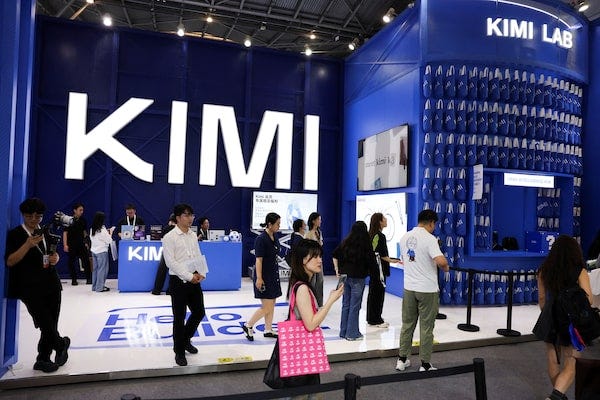
But can we stop calling every major Chinese model release another “DeepSeek moment”? When something keeps happening, it is no longer a moment.
Kimi K3 is the latest evidence that the AI frontier is becoming more contested, more global and potentially less proprietary. Chinese models may not consistently hold the absolute number-one position, but they are now close enough, cheap enough, and improving fast enough to change the economics of the entire market. And leaning into that shared R&D base, they’re able to iterate faster and learn from each other. But seroiusly, read this one below:

Kimi is not necessarily the cheapest Chinese model. But everything is relative. Moonshot’s reported pricing still comes in materially below Anthropic’s flagship Fable 5, which costs $10 per million input tokens and $50 per million output tokens.
That matters because the central risk to frontier labs is not that their models suddenly become useless. It is that frontier-level capability becomes increasingly difficult to monetize at premium prices when open-weight alternatives can perform most tasks at a fraction of the cost.
Now Kimi has received a lot of loving, and is now creating tiered pricing options and trying to scramble up more compute. But they’re not the only ones who have had to face this problem. At one point, GLM was also selectively choosing who they serve first; I'm pretty sure DeepSeek had this constraint too. Ultimately, enterprise users probably have the first pick (because they pay the bills), and consumers are just going to be prioritized until there is compute abundance. This is also really putting pressure on the domestic chip makers to step up and fill in this gap.
Token-maxxing meets budget backlash
It has been widely reported recently that OpenAI is exploring possible price cuts and facing growing pressure on model pricing.
Enterprises and startups are increasingly routing workloads toward cheaper open-source and Chinese models, including DeepSeek, Kimi, Zhipu GLM, Alibaba’s Qwen and, increasingly, Nvidia’s Nemotron.

Customers are no longer treating Anthropic and OpenAI as the default infrastructure for every task. Instead, they are building orchestration layers that select the cheapest model capable of doing the job and adopting the hybrid model approach we have written about extensively before. The most expensive frontier models are increasingly being reserved for difficult reasoning, coding, and other high-value workflows.
DeepSeek has been the most-used AI company on OpenRouter since mid-May. Among OpenRouter’s highest-spending customers, open-source token usage grew four times faster than closed-source usage between autumn 2025 and spring 2026. OpenRouter has also seen more than 500 organizations switch from proprietary to open-source models.
But I still do not think this spells the end for frontier labs at all.
Anthropic and OpenAI could retain the highest value share of tokens because their expensive models will continue to be used for the most complex and economically valuable work. Open-source and Chinese models could take the highest volume share, handling the much larger number of routine tasks.
Think Apple versus Android, rather than a winner-takes-all outcome.
For AI infrastructure suppliers, the read-through could still be positive. Lower inference costs should expand consumption. As AI becomes cheap enough to embed into every workflow, the number of tokens generated could rise much faster than the cost per token falls.
That is the Jevons paradox argument again.

Where is the moat?
For enterprises, the long-term use case may be less about renting access to the single smartest general-purpose model.
It may be about owning what makes the company special: its proprietary data, industry knowledge and workflows, and then choosing, customizing or fine-tuning whichever models best support them.
We wrote about this recently: who should own what makes a company unique and where value could migrate in a future of self-hosted, fine-tuned open-source models.

Why Didn’t Yang Zhilin Stay in the U.S.?
Finally, I want to address some of the commentary asking: why didn’t Yang Zhilin simply stay in the U.S.?
Honestly, it is a pretty ridiculous question.
Maybe it was personal reasons. Maybe it was lifestyle, family, familiarity, or simply a desire to build something in China. There is also something to be said for wanting to make it in your home market, in your native language, and within a culture you understand deeply.
For more on his personal philosophy and outlook on AGI, you can revisit this piece from a year ago.
Moonshot AI's Founder: His Pursuit of AGI and the Company’s Potential Viable Business Model

“For us, it’s about exploring the unknown. Just like AGI, you usually only see the illuminated side of the moon, but the dark side remains mysterious. It’s challenging, yet full of potential. That aligns with our mission.” — Zhilin Yang, Founder and CEO of Moonshot AI (Kimi)
Anyway, I read a good thread on X making this point. It is strange to suggest that China is somehow the easier place to build a leading AI company, or to assume that he must have left because he could not get a visa.
China’s venture-capital pool is much smaller. Competition is cut-throat. Monetization is difficult. The market is hardly an easy option.
At the same time, it would be naïve to pretend that rising Sinophobia does not create additional discomfort for Chinese researchers and founders living in the U.S. That may not be the main reason someone chooses to return, but it probably does not help.
Sometimes people simply want to build at home. That should not be so difficult to understand.
Ultimately, training these models remains part of a capital-intensive, energy-intensive, and increasingly politically contested infrastructure cycle.
Kimi K3 does not kill the AI trade. It does, however, make the distribution of value much less straightforward.
Frontier labs may capture fewer dollars per token. Hyperscalers may capture more of the orchestration layer. Enterprises may retain more value through proprietary data and workflows. Open-weight models may dominate token volumes. And the suppliers of chips, power, and physical infrastructure may continue benefiting as cheaper intelligence produces much more demand.
The frontier race is not disappearing. It is simply adding a few more players.
Coming up on the podcast is an exclusive sit-down interview with Pony.ai’s CEO, James Peng. Thanks for all the positive feedback on the episode with Meitu’s CFO, Gary Ngan. More to come in this series! CHECK IT OUT.
Low token consumption is built into China's AI policy. This is why it's more cost effective to use chinese LLMs than any others. GLM was about as good as 80% as Claude 4.8 and cost a lot less. That might make it a curiosity to an individual but to an organization that is trying to implement them organization-wide, it makes financial and social sense.