

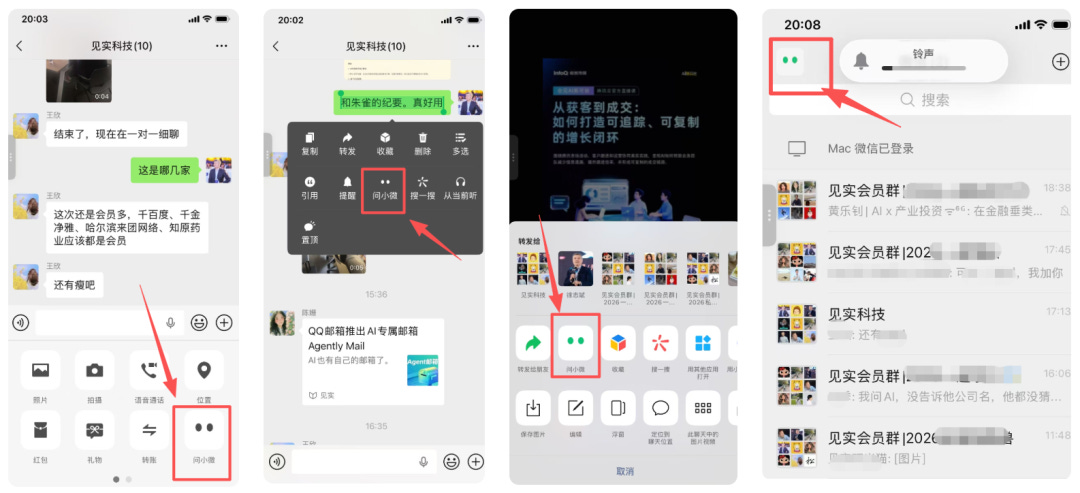
I’ve had Xiaowei’s Beta version sitting inside my WeChat for almost three months. Grateful for early access, I was very excited when I first got it. Tencent put an AI assistant inside the app that already contains most of my social life in China, with Mini Programs, payments, and hundreds of millions of services just a few taps away. That is the thinking…
But the truth is, I barely use it. At first, the novelty of swiping right on the WeChat interface to chat with the chatbot felt cool. I’d ask random questions that popped up in my head while commuting or going about my day. I’d ask about a street sign or slogans I saw while traveling in Mainland China. At times, I’d ask it to make my Chinglish write-up more ‘native’ for my WeChat Moments posting or search for nearby restaurant recommendations. It wasn’t exactly the ‘a-ha’ I expected.
That’s been bothering me more since Muse hit No. 1 on the US App Store and I got invited to try Instinct a few weeks ago…
In Muse’s first 12 days in the US and Canada, its downloads and daily active users reportedly already exceeded where ChatGPT was during the first 12 days of its mobile launch.
Naturally, there has been a lot of excitement around it, and much of the conversation has quickly shifted toward the idea that the next major consumer AI product will be some form of personal assistant.
But if that’s the case, why didn't Xiaowei and Qwen take off in China? Then I realized it’s about the products themselves but also about the ecosystems they are built in…
Of course, a good personal assistant starts with context.
This is obviously not a new insight. Everyone has been talking about context and memory in one form or another. We talked about it with the Miora interview as well, where persistent memory is part of the whole pitch. WorkBuddy is also largely built around capturing work context. Alibaba talked a lot about enterprise context at Apsara in Hangzhou. Even Bernstein’s latest China Internet report frames the next battleground as “AI Harnesses and the Battle for Context.”
The logic is pretty straightforward. A chatbot only needs to know what you are asking it right now, while a real assistant needs to know much more about your life. It needs to know where you are going, what is on your calendar, which airline you usually fly, what credit cards you have, what you bought, what subscriptions you forgot about, maybe who you are meeting and what happened the last time you met them.
But once you start thinking about personal agents this way, the differences between the US and China become pretty interesting.
Why something like Muse makes a lot of sense in the US
One thing that is easy to overlook is how fragmented the average North American consumer’s digital life has become.
Everyone pretty much has some version of a combo of Gmail, Outlook, Amazon, Uber, DoorDash, Netflix, Spotify, Apple, Google, multiple banks, multiple credit cards, airlines, hotel accounts, insurance, gyms, newspapers, and another bunch of random subscriptions. You end up with dozens, potentially hundreds, of different accounts spread across different websites and services (and different password safety requirements- don’t get me started). And they all send you invoices to your email inbox.
There is actually a very obvious commercial value buried in this mess: helping people organize their subscriptions and potentially save money.
Once you have that many accounts, you honestly don’t remember what you are paying for anymore. Most people probably don’t know which subscriptions they could cancel, whether their insurance quietly went up, whether they are using all the benefits that come with their credit cards, whether some service has a cheaper tier that would work just as well, or whether they have been paying $12.99 a month for something they haven’t opened in two years.
This is where something like Muse or Instinct can become much easier for consumers to adopt, in theory. If you charge me $20 a month and consistently save me $100, I don’t need to understand agents or benchmarks or context windows. The ROI in that sense can seem pretty obvious.
This is also why I think the “saving money” part of the personal agent assistant use cases matters more than people initially realize. A lot of the early examples were some version of looking through accounts, checking bills, identifying subscriptions, finding savings, or helping consumers manage financial services that are otherwise scattered across all these different providers.
Because ultimately, I don’t actually think consumers are paying for “efficiency.”
Companies pay for efficiency all the time because employee time has a measurable cost, and this is something we’ve written about. If you make 1,000 employees 10% more productive, there is a CFO somewhere who can turn that into a spreadsheet and justify the software budget.
If an AI saves me eight minutes booking a flight, that is nice, and I may pay for that, but I’m not sure how many people would pay for it and frankly at a high price. This is something we raised when we had the demo from Alibaba’s Qwen app team — the agentic shopping app too.
But for the sake of the US, the structural advantage of why personal agents have been very popular (maybe a fad like Sora?) is that a lot of the internet still runs through the browser, but that is not the case in China — which we’ll go into later. (em dashes are my own)
Search, email, shopping, hotels, airlines, media, and even a huge amount of enterprise software remain accessible through websites. Google, Amazon, Netflix, Booking, and a million other companies obviously have very different business models, but underneath all of them is this common infrastructure of the open internet, URLs, browsers, and web standards.
So if an agent can operate a browser well, suddenly it can interact with a pretty broad section of your digital life without needing every company in the world to build a bespoke agent API. That's also why I think compute-use agents are a big thing in Silicon Valley right now, but not in China, btw. A researcher at one of the leading labs asked me, ‘Do you think the computer has to have a human experience? Why does a CUA have to click through a browser and go through the process as a human would?’ — food for thought.
It’s about mimicking how a human interacts with a computer PC, click open a web browser and go through a series of third-party APIs to actually get the transaction done, only to wait for the confirmation to be emailed to a third party email inbox which likely has an app - Gmail/ Outlook.
Think about it. Receipts go there, airline bookings go there, hotel confirmations go there, calendar invites go there, bills go there, random communications go there. The beauty of this is that it is one single box where all the context and memory are stored, but it's often overwhelming, disorganized, or left unread.
So this is where Muse or Instinct, if given access and permission, can seem very useful, because they have enough context and ability to act that they can genuinely manage a meaningful part of your digital life. And this explains the first half- why personal agents seem to have blown up in the US.
China is almost the opposite
Once you understand that, it also becomes easier to understand why I don’t think you can simply take Muse or Instinct and recreate it in China.
The Chinese internet developed very differently.
Email does exist but its often someone’s phone number @163 or @126 or something random like that and no one I swear no one I meet knows what their email password is. Because they log in with WeChat QR code scanning or the one-time password attached to their phone.
Anywho, Chinese email is nowhere close to being the organizing layer of daily consumer life in the way Gmail often is in the US. Most personal communication is still through WeChat, while work can be spread across WeChat, DingTalk, Lark, Outlook, and whatever internal tools your company happens to use.
If you need to refund an airline ticket, the process probably happens inside the airline app - think C-trip, a Mini Program or through customer service. Your receipts and transactions are not necessarily being conveniently forwarded into one inbox — often stored in a Mini Program within WeChat. Payments sit in WeChat Pay or Alipay. Services increasingly live inside apps or directly via customer service accounts on WeChat, rather than the browser.
China effectively skipped much further ahead into a mobile-first internet where a small number of giant platforms control a lot of the important consumer activity, and those platforms have pretty clear boundaries around them. Just like it skipped the credit cards. It’s not like it’s more futuristic, it's because the underlying PC digital infrastructure actually wasn’t there, so the internet era was able to build from scratch on mobile.
This creates a very different environment for an independent agent.
In the US, an Instinct or Muse can potentially connect to Gmail and calendars, then use the browser to fill in many of the remaining gaps. It doesn’t need Google, Amazon, United Airlines, and every random subscription company to explicitly decide that they want the agent in the middle.
In China, a lot more of those actions happen inside closed apps and platforms, which understandably have very little incentive to let some outside agent come in and take over the consumer relationship.
Chinese apps simply say no when third-party apps try to control it via APIs — I mean, pre-anti-monopoly probe days, they were even more blatant.
But I think this is where the comparison requires a bit more nuance, because this does not mean China cannot have powerful personal agents. It means that the advantage shifts even further toward agents being built by the owners of those ecosystems themselves.
Tencent owns WeChat, WeChat Pay, and Mini Programs. Alibaba has Taobao, Alipay, Gaode, and relationships across commerce, travel, and local services. ByteDance has an enormous amount of consumer distribution through its own products. That is a pretty important structural asymmetry.
Technically, Tencent shouldn’t have to persuade WeChat to give Xiaowei access - though obviously that is an internal battle with Allen Zhang’s team right now.
Alibaba doesn’t have to persuade Alipay to cooperate with Qwen - as we have seen, they have quite literally been told to go all in on AI and open up all the backend across the platforms for Qwen.

In China, the major platforms already own much more of the underlying stack, so the natural shape of an agent is probably much more platform-native. So while we’re seeing the debate play out in the US, where an independent agent and the apps underneath platforms are at war over who controls the customer and monetizes that intent, that doesn’t seem to be a thing in China right now.
And yet this is also where I start to question some of the excitement around personal agents as a category and whether it is sustainable for independent/ standalone agents.
If China has all the ingredients, why hasn’t it already happened?
We have written quite a bit about WorkBuddy and why it took off, but I haven’t really talked about Xiaowei in much detail.
Part 2: Tencent has picked its super AI product: WorkBuddy

I have been trying to persuade the WorkBuddy team to join our podcast for a while now. wink. Whenever you’re ready, hola.*
Honestly, the reason is that I haven’t figured out what I need it for.
When I first got access, I assumed the functional adjacency advantage would be huge, and we even wrote about this a year and a half ago. You have an AI assistant sitting inside WeChat, arguably the most important consumer app in China, surrounded by your social graph, Mini Programs, payments, and all the other services that have accumulated inside the ecosystem. Bernstein has similarly written that Xiaowei inside Weixin has the potential to become the dominant consumer agent. So you can say, and I agree, conceptually, that makes sense.
But right now, you can still tell that many of the really important transaction and payment permissions haven't been fully opened up, so in practice it still feels more like a chatbot or search function than an AI that is genuinely running your life.
Qwen has actually gone further in some respects. When I visited Alibaba’s campus around two months ago, one of the agentic demos they showed me was very similar to what Instinct founder Noah Shinn later talked about on Patrick O’Shaughnessy’s podcast: helping you sort out travel, flights, and itinerary based on the context it already knows about you.
Qwen even has payment rails and direct partnerships in areas such as airlines, while Alibaba also owns Gaode - the ride hailing app, and has obvious connections into a massive commerce ecosystem. It is said to be able to plan your whole itinerary by simply providing the agent with your destination and preferred form of transportation.
But that isn’t everything, right? Clink’s CEO spoke to me earlier on the AI Proem Podcast that the issue with payment systems right now is that they’re not designed for agents to use. Payment solutions in the West are still very fragmented, unlike in China, and even in China, where digital payment is largely dominated by two players, there is still an immediate challenge: making existing fiat rails work safely for agents — and getting the ecosystem to align around clearer standards.
The Future of Agentic Payments with Clink Founder Patrick Wu

In this episode, I spoke with Patrick Wu, Founder and CEO of Clink, about what payments need to look like in an agentic commerce world. Patrick previously worked on payments infrastructure at Amazon and AWS Payments, and later led global payments at Temu as the company expanded market by market. His view is that payments today are largely built for huma…
If context, distribution, and the ability to transact make a personal agent useful, Chinese internet companies already have many of those advantages. Yet we still haven’t seen a personal assistant blow up in China the way people expect.
Maybe that is simply product maturity and permissions, and maybe Xiaowei will look completely different a year from now once WeChat opens up more to it.
But I also think it raises another possibility, which is that we are overestimating how much consumers actually want this. And this was echoed by the big tech companies and labs I met with in Beijing (think all the ones in Haidian) last week. The sentiment is that consumers simply do not want to pay for applications, and the idea of a personal assistant is a very ‘privileged’ and ‘uncommon’ need.
BUT, I don’t think consumers really pay for efficiency
The whole agent understanding your location and travel plans, figuring out when you need to leave, then proactively arranging the ride to the airport thing sounds good in theory, again.
I completely understand why this is compelling. The first time it happens, it probably feels pretty magical. BUT how many people are willing to pay for that, and how often does the average person fly? If only say 10 million people are willing to pay, is that a big enough market? WHAT IS THE TOKEN CONSUMPTION FOR SUCH TASKS?
If most of what my “personal assistant” does is remind me to leave for the airport at the right time, I already have a calendar and Google Maps. There isn’t necessarily a reason to put an expensive AI reasoning layer behind every reminder.
If I am trying to research a complicated trip, find something unusual, or think through a difficult decision, I would still trust human judgment, or I’d assume a relatively technical user can already do that with Claude or ChatGPT and probably get a better result with those tools.
So maybe the ideal user for the personal assistant is actually someone less technical, who wants all of this abstraction to disappear and just wants the AI to do things for them?
But that is also probably the user who is going to have a much higher bar before handing an unknown company access to Gmail, calendars, credit cards, and permission to transact.
That creates a weird chicken-and-egg issue not just with context, but also with who actually needs the product.
The most tech-forward early adopters are the people most willing to connect everything, but they are also probably the people most capable of doing these things themselves.
Then, one layer below the tech evangelists, you have a much bigger group of users who are tech-forward enough to understand the appeal but also expect things to work reliably. For them, hallucination, misunderstanding an instruction, or making one bad transaction becomes a much bigger issue.
Then when you get to the general public, they may not trust Meta (or any big tech) enough to hand over a credit card, or they may have never heard of Instinct in the first place. This could be argued the same way for PayPal in its early days.
And thus my question following this is: WHO WILL PAY? AND IF THEN YOU WANT TO PLACE ADS, WHO WILL PAY FOR ADS IF NO ONE IS LOOKING AT ADS? I think consumers forget that, as much as ads are annoying af, they are a form of tax that enterprises pay so we can pay less.
IF THERE ARE NO ADS, WHO IS PAYING FOR THE GOODS? THAT EXTRA COST ON THE PRICE TAG IS GOING TO GO TO CONSUMERS.
Instinct has said that a surprisingly high share of its users were willing to provide credit-card access within the first few weeks, which I think is genuinely peculiar and probably says something about how much trust consumers are willing to extend when the value proposition is clear enough. But I’d also assume Instinct's early adopters are much more pro-tech than the average consumer.
The context chicken-and-egg problem
For any of these products, the more information and access I give the agent, the more useful it becomes. We all understand that, but one has to trust the product to give it permission/ access to then let it become useful. Which, at this point, I just don’t. I have not given it my email access, and I’m using it more like a quick reminder tool/ EA.
The really magical version of Instinct probably knows my calendar, email, location, flight details, preferences, credit cards, and previous behavior. At that point it can make decisions for me with relatively little prompting. Again, I don’t deny I’m not maximizing its potential.
But I, and many others, don't actually trust it enough to give it that much access, because of the potential going rogue case.
This is where I think the incumbents become particularly difficult to compete with -that kind of trust was built up with time and with proof of capability and even proven by Allen Zhang’s reluctance to open up WeChat social to agents because he is prioritizing safety and user experience so much.
Now Google already has Gmail, Chrome, Android, and Calendar. Tencent already has the WeChat relationship graph. Alibaba already has commerce history and payments. Meta already has the social graph. The big tech, for better or worse, don’t need to persuade you to create all of that context from scratch because you already gave it to them over the last 10 or 20 years.
So if the personal-agent path really does work, I still struggle to see why the winner has to be an independent startup - which some people have implied. We even saw OpenAI failing with the commerce move, having to depend on third-party APIs for payment and search and additional activity loops. Look, I like Instinct, and the founder is cool. Apparently he worked with Tencent’s Yao Shunyu and co-authored Reflexion and all.
But even Noah basically acknowledged distribution as a key weakness for his product on Invest Like The Best. Maybe the best outcome is to sell to a big tech. Manus sold to Meta *shrugs.
So in the end, who pays?
Look, the economics don’t fully make sense yet is all I’m trying to say here. Agents are expensive. Like, the tokens it gobbles down are a lottttt.
There is inference, browser rendering, virtual machines, retries when something goes wrong, and potentially a lot of compute gets burned to accomplish a task a user may barely notice.
Let’s build up a scenario. Imagine I tell the agent to buy something. It looks at ten stores, compares everything, finds the cheapest acceptable option, and completes the purchase.
The merchant gets an order. It gets my account details and my delivery address. But it may not really get me as a customer because I don’t even know where the agent is buying the product from.
I never browsed the homepage. I never looked at another product. I didn’t get distracted by some recommendation algorithm. I didn’t click on ‘see more’ or ‘customers who browsed this also bought this’ (they get me every time). Unless I’m going for a specific brand, I probably will not know which shop fulfilled the ask. Actually, even if I wanted a Theory dress, technically that could be done on like five different marketplace apps I can think of, let alone the malls/ outlets/ direct apps.
Next time I need the same thing, my agent will simply compare everyone again. So winning this transaction does not necessarily make it any more likely the merchant wins the next one.
From the merchant’s perspective, this starts to look more like a one-off order than acquiring a customer. So the incentives for them become pretty contradictory.
If the agent is genuinely on my side, I basically want it to squeeze merchants as hard as possible and save me the most money. Cuz as a customer, I don’t really have loyalty to the seller (marketplace), maybe the brand, but only to an extent.
But if the same agent wants merchants to pay a commission to send the order, the economics suddenly get a little strange. Think about it. The more money the agent saves me, the more margin it is probably taking away from the merchant. But still, as the consumer, will I want to pay a lot for a consumer app? I guess if I say I pay 2 bucks, but it saves me 5, then I would? You’d have to justify that.
But the enterprises still have higher purchasing power than me, right? And if the agent eventually starts favoring the merchants, then it is no longer really acting as my buyer’s agent. It has become another advertising or distribution channel. Then it’s like paid search results, and I feel betrayed. SO there is a constant tug and pull.
The old platform businesses are much more straightforward in that way. It’s also why subscription services have, in many cases, struggled, and ads still run most service platforms. Would you pay for food delivery premium or Uber premium if you don’t use the service that often?
Big tech?
Now, I think Google can afford to give you an agent (for free) because it protects its position in search, Android, ads, or commerce. And it gets to keep its existing ad flywheel.
Tencent can probably do it because it makes WeChat more useful and potentially drives more transactions through Mini Programs and WeChat Pay, which again ka$hing.
Alibaba can do it because the transaction may ultimately land somewhere in its own commerce ecosystem, and they charge merchant fees for platform service.
Meta can justify it because controlling the interface through which consumers express intent is strategically valuable even before Muse itself has a beautiful standalone P&L.
The economics are much easier when the agent is a feature sitting on top of existing business models. It’s like why those news aggregator apps that only charged 10 bucks a month still didn’t make it: you have to make consumers think you add value, but you actually take $ away from businesses with existing distribution.
Standalone agent?
But if you’re a standalone agent, you need to rely on big tech for distribution and third-party APIs, and you'll eventually have to charge consumers for the service because tokens are costly. How do you win that proposal? For a personal agent as a standalone consumer application, I’m not sure where the defensibility really comes from.
And if we look at the two largest internet ecosystems: the US and China. In the US, we may genuinely see a fight between agents and apps over who gets to control consumer intent. The relatively open structure of the web means an independent agent has some chance of inserting itself between the consumer and the existing application. Whether they can beat out big tech distribution frankly also falls on how bad the user experience the big tech builds out. Potentially, Instinct could be bought out by one of the big tech companies— let’s say Amazon? Since it’s blocked out, Muse has partnered up with Walmart.
China is different because the super-apps already accumulated much of the communication, payments, commerce, and services inside their own ecosystems a long time ago. And they're not really letting anyone in. So ironically, BABA and HK0700 are essentially showing us where the US ultimately ends up.
The Muse and Instinct hype has made me realize that consumers are willing to experiment with this new interface and, perhaps more importantly, that at least some users will grant an AI surprisingly deep permissions when the value proposition is strong enough. But I’m not sure they have yet proven the standalone personal-agent business and I’m not sure I buy into the hype.
P.S. I caught up with Ollie Forsyth this Sunday in HK, and no one has grown a newsletter at scale better than him out of Asia. Check out his VC and AI coverage. ALSO, he’s inspired me to take partnerships more seriously. If you’re a VC/startup/fund looking to increase your brand exposure, or you’re interested in APAC AI, get in touch. Let’s chat!
This is a terrific post, Grace! THANK YOU for continuing to give us a flavor of what's going on in China's AI ecosystem, and a great deep dive on so many conflicting currents & how they play in the US versus China. When you harp on "who's really gonna trust..." U hit the nail on the head. I did an extended interview with Anthropic yesterday (nothing special about me, I'm sure they offered it across the board), and what became clear to me from my own answers is that TRUST is a key moat for me. I am going to the trouble of standing up my own openclaw on a Mac mini specifically without 'net access for exactly that reason -- help me with my work? Absolutely. Know all about my finances, preferences, contacts, etc, etc? You bet. Have the ability to act on my behalf out there on the open web? Not so very much, thank you! Advise me? Guide me? Sure. Do it for me? Maybe later.
Agree. And if the recent enthusiasm in the markets is predominantly about personal agent "unlock", we might be in for disappointment.