


Dear readers,
I have had the honor of having 2 people go to WAIC on behalf of AI Proem, and they were very different profiles. One, who will remain anonymous, shared observations from a businessman’s perspective, and the other is a story written by the ever-so-talented Rachel, who will walk you through her thinking about WAIC from a cultural/societal angle. I, myself, had attended so many of these this past year that I felt I had become a little jaded, so this blog post hopefully brings some new perspectives to you. I’ll first share my thoughts and some observations from my associate on the event, then I’ll pass the floor to Rachel. Hope you enjoy the tour.
Grace’s opening notes:
WAIC 2026: The Robot Hardware Is Ready. The Intelligence Is Not.
WAIC was a technological exhibition that has been ongoing since 2018. It is actually the event where Elon Musk and Jack Ma had the famous/ infamous awkward exchange. But it is no longer just a tech exhibition. WAIC is increasingly becoming a stage for Chinese leaders and companies to define their own global AI narrative.
The scale of this year’s World Artificial Intelligence Conference was difficult to miss. It attracted an estimated 400,000 visitors across more than 100,000 square meters of exhibition space. Some 1,117 exhibitors presented 4,486 products, including a record 351 global debuts.
President Xi Jinping gave the opening speech, which Matt Sheehan did the hard work and annotated. To me, the message of the conference fell into three broad buckets: China’s emphasis on openness and inclusivity, a continued nudge towards greater self-reliance across the technology stack, and the gold rush around humanoid robots and physical AI.
Of course, scale was impressive; dialogues around governance were necessary, but to the disappointment of many visitors, including my associate, the conference revealed more about how impressive the humanoid-robot industry now looks from the outside than how capable the underlying intelligence has become. Embodied intelligence drew some of the largest crowds. Perhaps that was because robots are more eye-catching, or simply because of the recent hype.
We already know that China can manufacture, but?
China has built much of the physical infrastructure required to manufacture humanoid robots. Motors, precision bearings, joints, force sensors, dexterous hands, and even complete base platforms can increasingly be purchased from established suppliers.
A startup no longer has to design and manufacture every part of a robot from scratch. As we have written before, there are now OEMs capable of supplying a functioning robotic body. The competition is therefore shifting towards models, algorithms and system integration.
That is a genuine advantage. China’s manufacturing ecosystem is making robots cheaper to build, faster to iterate and easier for new companies to enter. It also explains why WAIC was filled not only with established robotics companies, but with startups and businesses entering the sector from adjacent industries.
Yet this supply-chain maturity can create a misleading impression of technological progress. When the physical robot is readily available, almost any company can present a humanoid body, attach a model to it and describe the result as embodied intelligence. The real question is how much intelligence has actually been integrated.

Many of the dancing, boxing, and stage-performance robots at WAIC operated smoothly. But these demonstrations often depend on predefined routines, controlled environments, or remote assistance. They demonstrate advances in mechanical control and coordination, but not necessarily an ability to understand unfamiliar environments and respond autonomously.
A robot that can repeat a difficult routine is not the same as a robot that can solve an easy but unpredictable problem.
This is also why a universal “robot brain” remains so difficult. Robots operate in different environments, perform different functions, and interact with the physical world in different ways. The relevant data, operational knowledge, and failure cases are highly specific to each use case. One general model may eventually provide a common foundation, but it is unlikely to perform equally well across every physical task without significant vertical adaptation. For example, a world model for autonomous driving has little use to a robot designed for doing laundry; do you see what I mean?
Near-term opportunity is specialized deployment
The most useful robots we have seen over the past year, particularly those that can help address labor shortages or improve workplace safety, generally look like industrial machines rather than humans.
Fixed robotic arms have benefited from decades of development. They operate in structured environments, execute narrowly defined motions, and can deliver measurable improvements in speed, consistency, and safety.
Some of the clearest examples at WAIC involved specialized robots used in dangerous power-grid operations, including high-voltage inspection, switch operation and ice removal from transmission lines. Their value comes from replacing people in tasks that are dangerous, repetitive and sufficiently structured to automate.
The same thinking could extend to firefighting, disaster response, underground exploration and hazardous manufacturing. In these cases, the economic case is not simply about reducing labor costs. Avoiding human injury may justify deployment even when the robot remains expensive or limited.
A wheeled robot may be better for warehouse transportation. A robotic arm may be more suitable for laboratory work. A quadruped may be better for inspections. There is no reason every commercially useful robot must look human.
This fits a broader argument we have made at AI Proem about China’s AI ecosystem. China does not necessarily need to lead every frontier benchmark to build an important advantage. Its strength may lie in integrating increasingly capable models into factories, warehouses, vehicles, consumer devices and existing industrial workflows.
The embodied-AI opportunity should therefore be understood as an industrial feedback loop, but at the same time, WAIC also showed that this loop has barely begun.
Geek+, for example, has a meaningful advantage because it already operates in real logistics environments and can collect data from deployed systems. Its conventional warehouse-automation products performed smoothly. Yet its newer humanoid remained far slower than a human worker at basic sorting tasks, and honestly costs much more too.
The likely near-term winners, or at least deployable at scale, bots are therefore specialized robots deployed in structured or dangerous environments, alongside the component suppliers, automation companies, and computing platforms that support them. I still stand by my analysis that the household humanoid remains a much longer-term ambition.
The moat will be vertical data, workflows, and compute
The data bottleneck is more complicated than saying the industry simply needs more data.
Robots require information covering objects, movement, force, balance, failures, and interactions across an enormous range of physical conditions. Static images and text cannot fully describe what happens when a robot grips a deformable object, loses balance, collides with something or encounters an unexpected obstruction.
Manual data collection is expensive, slow, and usually limited to a narrow range of situations. Real-world data is also noisy and fragmented, while the most commercially valuable datasets are likely to remain proprietary. Thus, what we’re seeing is that companies are leaning into simulation first, controlled deployment second, in hopes that one day they can reach broad autonomy.
Robots can initially learn perception and motor skills in simulated environments. Once they become useful enough for a specific task, they can enter narrow real-world deployments, collect additional data, and improve through use. World models and physical simulators can accelerate this process, but even highly realistic simulation cannot eliminate the gap between a digital environment and the unpredictable physical world.
But as we mentioned, even these simulation systems are so niche that they cannot be used by everyone doing anything. On top of that, people forget that for physical AI, it’s often a large world model that each firm trains for their specific use case and environment, then there is an on device/ edge smaller model that works together with the lidar and visual recognition components that together ‘tell’ the physical vessel to move. That kind of hardware-software integration and actual ability to train for variance and edge cases is highly underrated.
The chicken-and-egg problem remains: robots need real-world deployment to obtain better data, but customers are reluctant to deploy robots that are not yet useful.
One exhibitor reportedly offered consumers a robot capable of basic demonstrations for RMB 3,000 per month, presumably allowing the company to collect data inside homes. It is a clever idea, but the commercial proposition is questionable. Most consumers will not pay to train an unfinished product on behalf of its manufacturer.
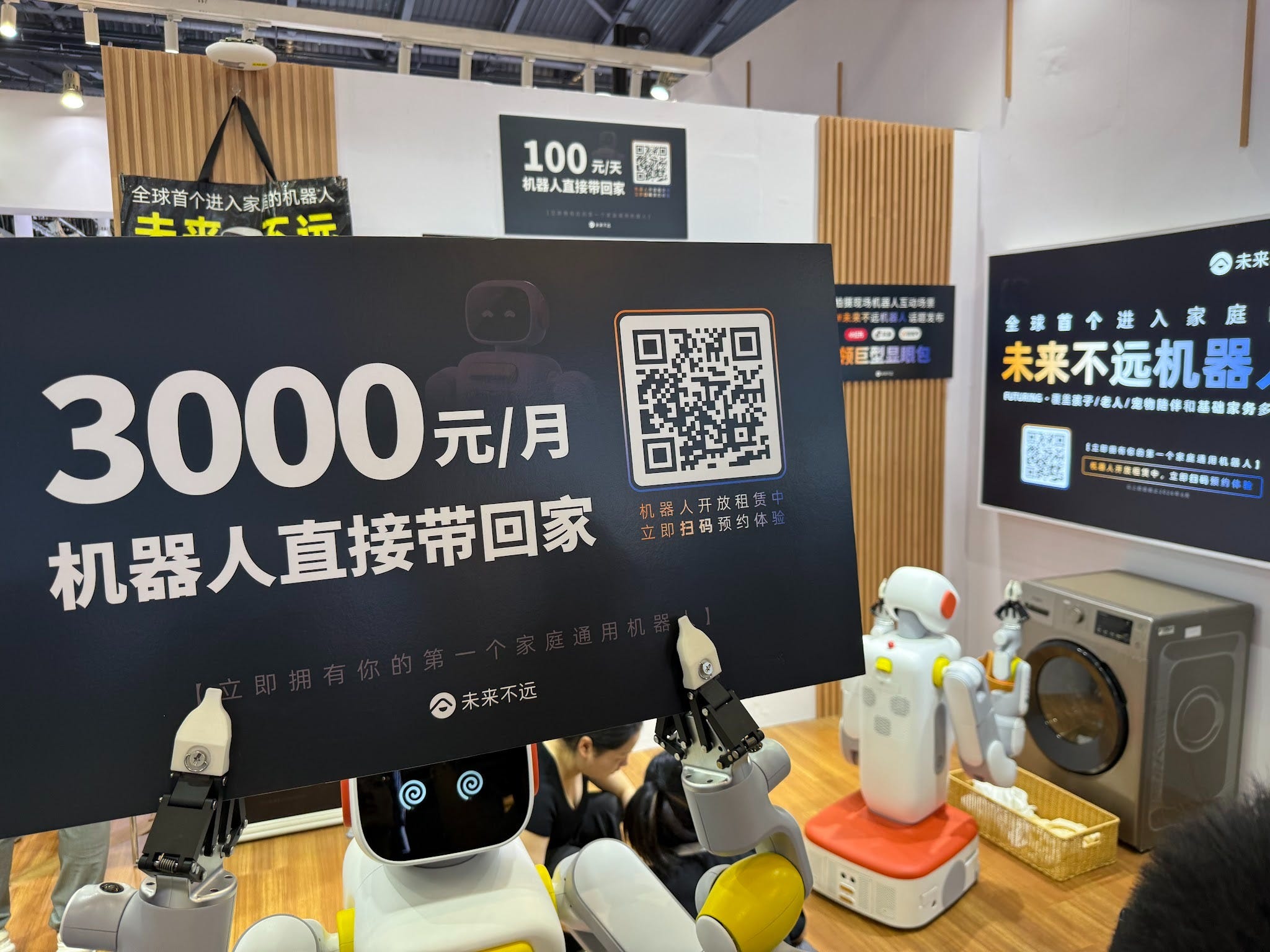
As my associate put it: who wants to rent a hen that cannot yet lay eggs in the hope that it eventually will?
Over time, the strongest robotics companies may not be those with the broadest demonstrations. They may be those with privileged access to specific operating environments and the expertise to turn that data into reliable products.
[G: This one is absolutely outrageous. Tell me what we need a centaurbot for?]
This connects with another argument we have made at AI Proem: companies should protect what makes them distinctive, namely their proprietary data, workflows and industry know-how. The model itself may become increasingly accessible. The harder asset to replicate is the closed loop between an installed base, operational data and the product improvements that follow.
That makes the idea of a single industry-wide robot-training dataset somewhat unrealistic and thus very different from the colossal amount of data that is used for LLM training. Companies see their data as a moat and have limited incentive to share it. We may therefore see many strong vertical robotic models before we see genuinely general robotic intelligence.


Compute is another constraint. A robot must continuously combine visual input, depth, geometry, movement, force, sound, and its own physical position. It must predict what happens next, choose an action, and adjust immediately when reality differs from its expectations.
That is a much more demanding inference loop than generating text or even an image.
Useful robots will require substantial onboard or nearby compute, low latency, reliable connectivity, cooling and sufficient battery life. Adding more processors increases cost, weight, heat and energy consumption. At scale, millions of embodied-AI devices would also place significant demands on data centers, electricity networks and communications infrastructure.
China’s investments in power, computing infrastructure and domestic chips may eventually become an important advantage. But infrastructure alone will not solve the problem. Embodied AI will also require more efficient models, purpose-built chips and better decisions about which calculations happen locally and which can be handled in the cloud. It is also not to dismiss that hardware costs are falling, suppliers are proliferating, and physical iteration is accelerating.
The fair takeaway, as my buddy said, is that neither that humanoid robots are about to enter every home nor that the entire industry is hype.
And with that long monologue, let me pass it to Rachel…
Rachel and I met years ago when I was trying to get some help with a personal project. What I remembered was how thoughtful she is and how strong a writer she is. (A CUNY grad who has written for Vice and WIRED). I knew that Rachel is not immersed in the AI industry, and therefore notices things regular technology observers may overlook. And as there is enough information about the technicals, I thought letting her cover WAIC this year would be really interesting — a fresh new perspective. It was such a pleasure working with her on this to flesh out the deeper questions we should be asking ourselves. See her Substack here.
btw, next year I plan to attend and maybe even host a small gathering of industry professionals and investors for a dinner, so stay tuned.
Rachel Zheng:
For those four days, the whole city tipped into a kind of citywide frenzy, something close to SXSW energy. Bars, hotels, even the subway were plastered with AI banners; the average person’s FOMO hit a peak I hadn’t seen before. But underneath it, there’s no denying the sheer volume of capital pouring in, backed by state policy; the whole thing had the sheen of an economy on the upswing, all of it happening under Shanghai’s brutal 40-plus-degree heat.
Embodied AI took up an entire floor on its own, making the case that robots are good for more than dancing; they can pour tea, stir-fry, and give shoulder massages, proving they have actual use value.
The industry is shifting from spectacle to substance. The humanoid robots still draw crowds, but the real investment is in the invisible: compute clusters, tactile sensors, and operating systems rebuilt for agents. The question that kept coming up wasn’t “what can AI do?” but “what should AI do?” and that’s a question about values, not just technology.
How does an AI product tell a human story?
WAIC 2026
For the past few years, I’ve been reporting primarily on art and culture. My only real encounter with AI has been using DeepSeek occasionally for editing and research. And so much of the media narrative around AI is that it will take human jobs, presented in a very black-and-white manner. I wanted to understand AI better, maybe this time not just technically but also how it really is in relation to us humans.
Just a week ago, a design studio founder told me that he finds joy in extracting brand stories out of AI company founders. In his conversations with them, what interests him most is the process of defining what’s human and what constitutes humanity through their products. That interview was a lightbulb moment for me: how does an AI product tell a human story?
Across more than 3,000 exhibits, it was impossible to see everything. I found myself drawn less to the largest models or fastest chips than to products that made me reconsider abilities humans barely notice: seeing, touching, moving, and deciding.
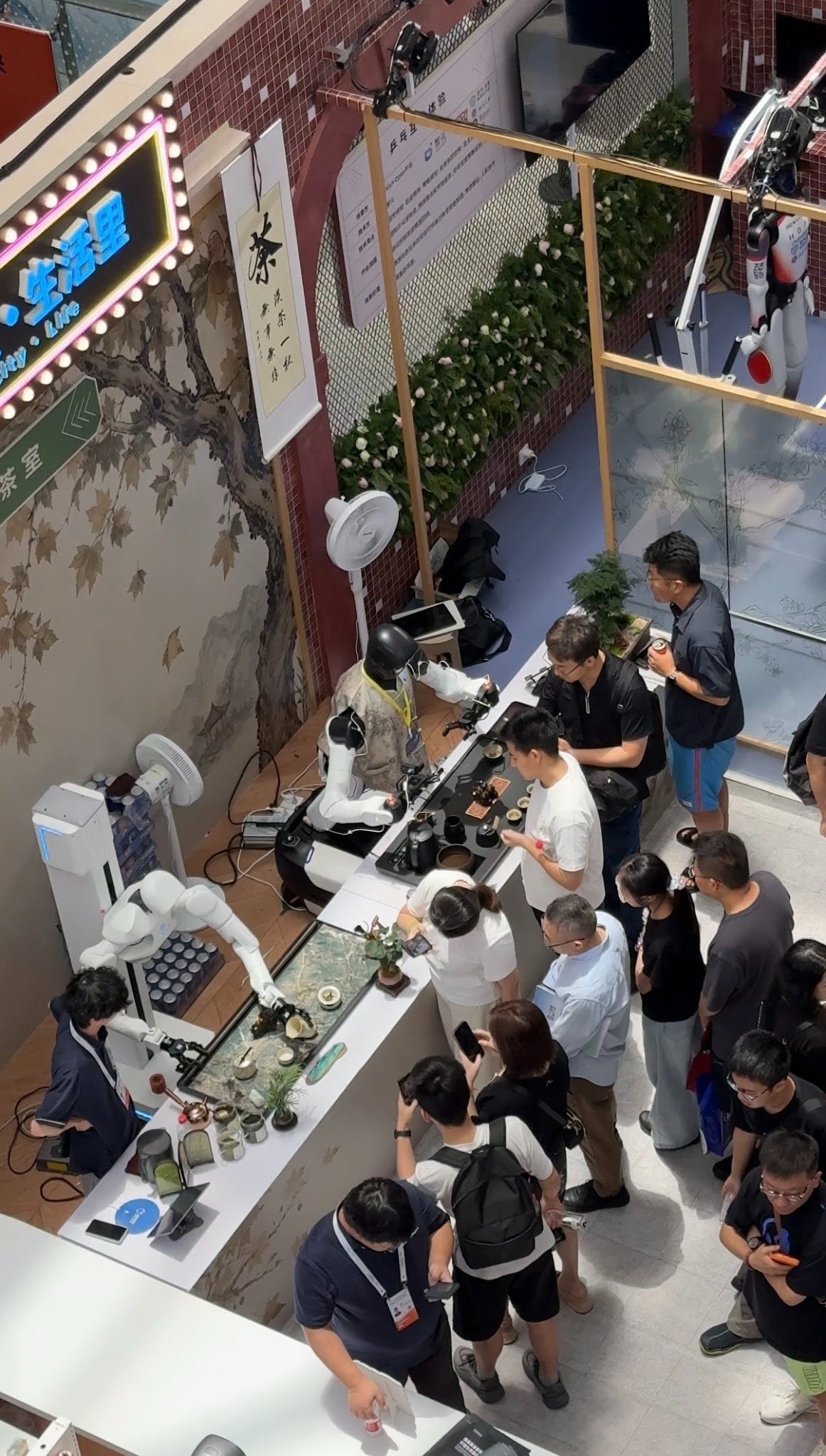
What I found most revealing was that the most revealing AI products were not necessarily those that looked most human. They were the ones that exposed how difficult ordinary human capabilities are to reproduce, or helped restore capabilities that people had lost.
The Popular, the Practical, the Precautious
The official gem of this year “镇馆之宝” centered on ten flagship exhibits, telling their own story about what the industry in China considers important right now. By my count, eight of the ten sit squarely on the “brain” side: compute clusters, LLM-powered agents, chip architecture. Among the rest are Ant Group’s robotic pharmacy and Zhiyuan’s Expedition A3 Ultra humanoid, both of which tackle the harder problem of fine-grained perception and physical interaction at the system level.
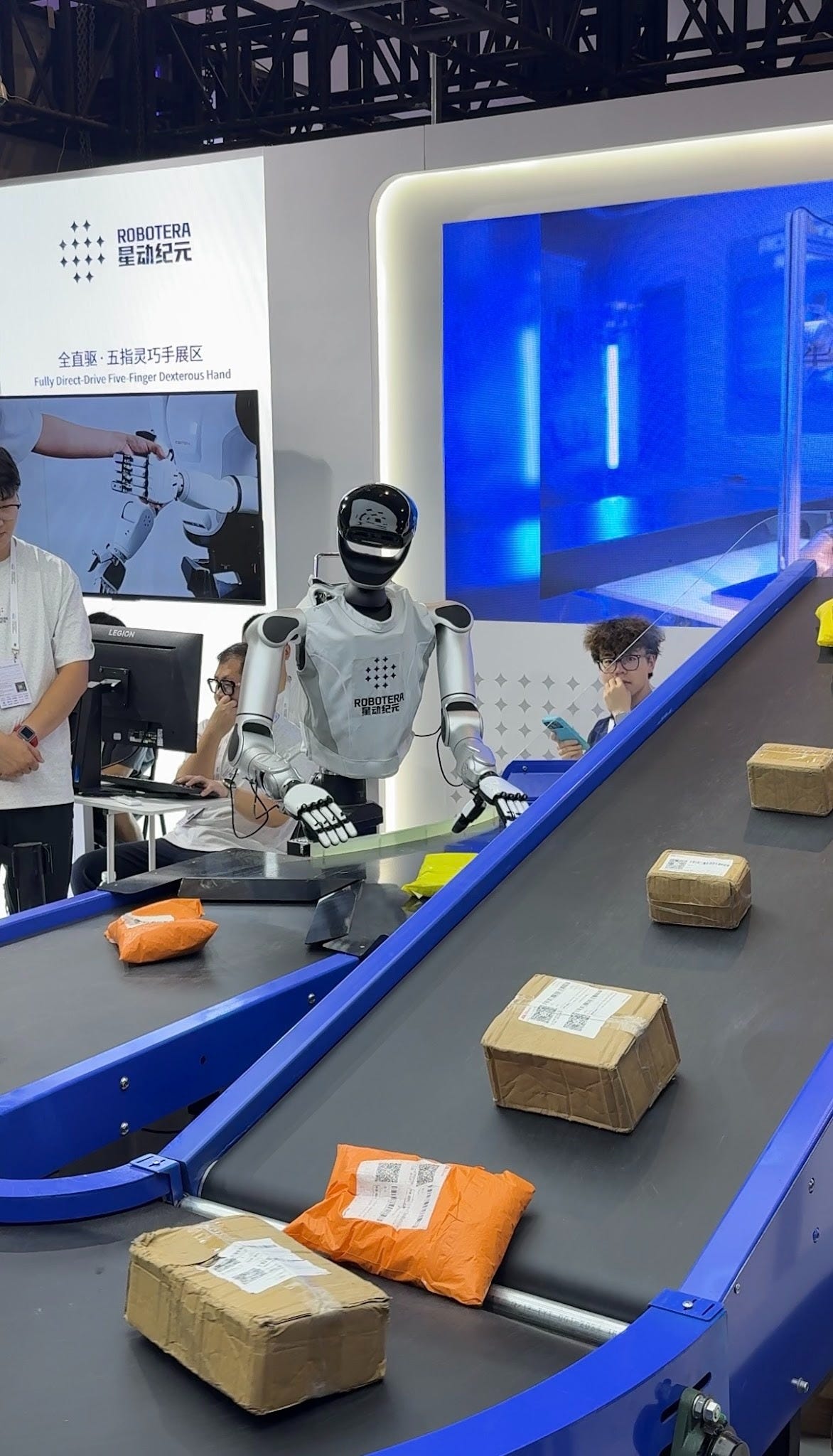
Humanoids produced many of the conference’s most photogenic moments, but the official selection told a more sober story. Only one of the ten flagship exhibits was a humanoid robot; much of the industry’s attention remains on the less visible infrastructure, models and systems underneath.
Those systems may ultimately prove more economically important than the machines drawing crowds. But I kept returning to products operating at the boundary between software and the human body.
Btw, there were also a number of local-government cases using AI for energy management, grid optimization, load forecasting, that kind of thing. A lot of what’s on display right now centers on infrastructure being laid underneath everything else.
The conference’s ten official flagship exhibits leaned heavily toward the infrastructure and intelligence beneath AI: compute systems, agents and industry models. Those may prove more economically important than the machines drawing crowds. But the products I kept returning to were the ones operating at the boundary between software and the human body.
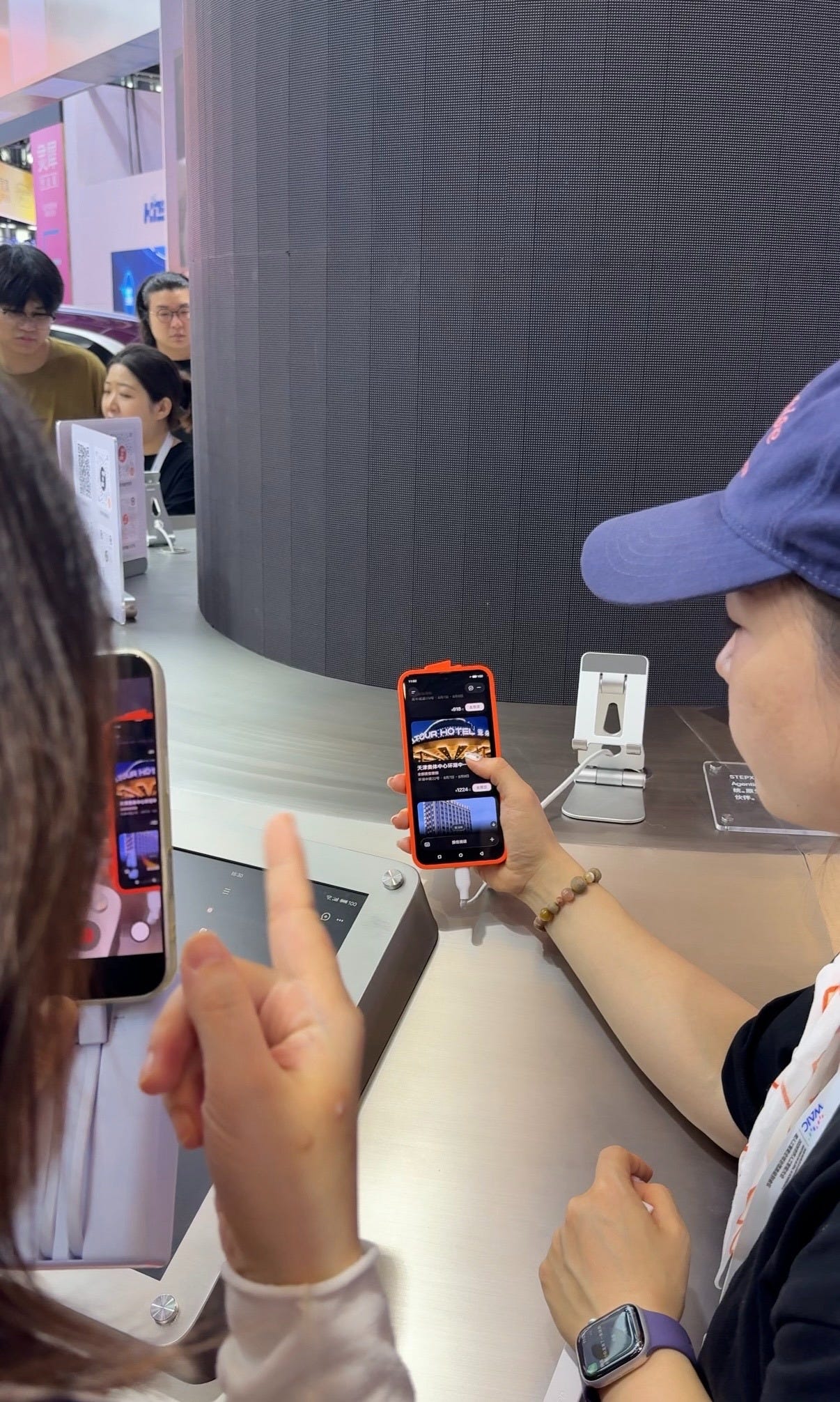
For consumers, the concept still getting the most attention is the AI phone. At StepFun’s STEPX Neo booth (Tencent is among its investors), I watched an elderly man stop one of the staff and said he’d come all this way just to see this particular phone. He asked question after question, most of them about data security. The staff explained that STEPX Neo had already partnered with major apps: Alipay, Ctrip, and others (though notably not WeChat), and that each time it needed data, it would ask the user for authorization; nothing gets uploaded to the cloud. What the phone is really trying to redefine is interaction itself: its Step AOS rebuilds the operating system from the ground up.
That sentiment was echoed by Huang Xuanjing, a distinguished professor at Fudan University, who said everyone’s phone is becoming its own kind of intelligence, every major manufacturer is racing toward it, and this is likely what phones will look like in a couple of years.
I find that idea, an interface that behaves less like software and more like an agent you simply talk to, genuinely compelling, and intuitive to how we already behave. But traditional companies still rely on their own apps to access user data, and the promise of “never switching between apps” doesn’t obviously help them at all. So it remains to be seen how this actually plays out, whether the agentic phone becomes the new default, or just another feature layered on top of the old one.
Elsewhere, in the AI-for-science sector, one investor, Chen Jian, vice chairman of CCF and chairman of Paratera, made a blunt observation: AI for science stays small simply because the industry value is small.

A longtime healthcare industry veteran was cynical about Ant Group’s Afu body fat scale, a free scale (users pay a 9.9yuan shipping fee upfront, but get 30yuan cashback upon binding the app), but only works once you hand over your data to use it. What it’s really harvesting, he argued, isn’t body fat percentage but the user. He compared it to something almost generational: the way elderly people used to line up to open a bank credit card for a free carton of eggs. Made me think whether some products promise to understand the user better; the unanswered question is whether that understanding serves the person or the platform.
Against that backdrop of big companies quietly mining consumer data, Cao Peng, founder and CEO of Hangzhou Genlight Neurotech, was doing something almost defiantly unglamorous. Most people assume brain-computer interfaces are only about the brain, he told the audience, but neural signaling doesn’t stop there; the brain is just one part of the central nervous system. So his team turned toward a different, long-unsolved problem in medicine: helping patients with spinal cord injuries, some paralyzed, some effectively cut off from limbs that no longer answer them, recover the ability to move. The AI in his system’s case sits in the decoding: reading the faint, often garbled signals still traveling through a damaged nervous system, and translating them, in real time, into something a limb can act on.
His analogy was cynical, but the question left unanswered was: who is AI benefiting the most?
If there was one hall that felt the most alive with actual human use, it was H4 downstairs, the practical end of the spectrum, where high technology quietly trickles down into things closer to daily life: AI contract review tool, which cuts a three-day process down to thirty minutes; tools for identifying early cognitive risk; L’Oréal’s AI Coach, to train its own sales associates; even AI-driven marital legal tool…the sheer range of them was exciting to see, proof that the application layer of AI is no longer a handful of general-purpose products, but something closer to an ecosystem in bloom, each tool built to answer a need specific enough that you’d never have thought to ask for it.
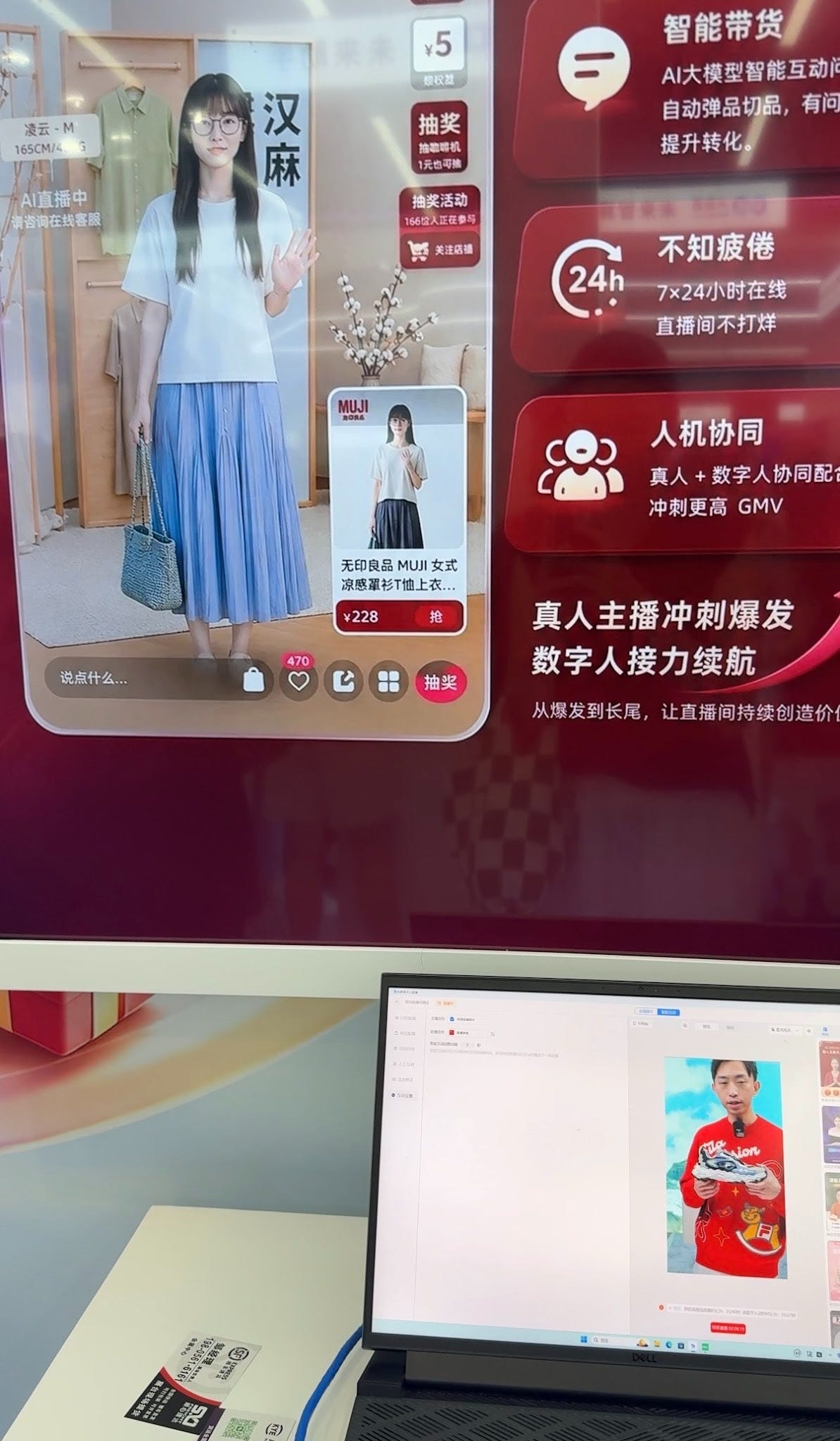
Embodied AI — How to study robots as if they were humans
As a human, ha, I found some of these robots offering comical relief too. I stood by the shoelace-tying robot for a full minute, watching it pull the thread from one direction to another. I learned it takes five to ten minutes to finish the whole task, and almost next to every robot, there’s still a human standing by to monitor it. If anything, the day we actually employ one for ourselves at home still feels very very far away.
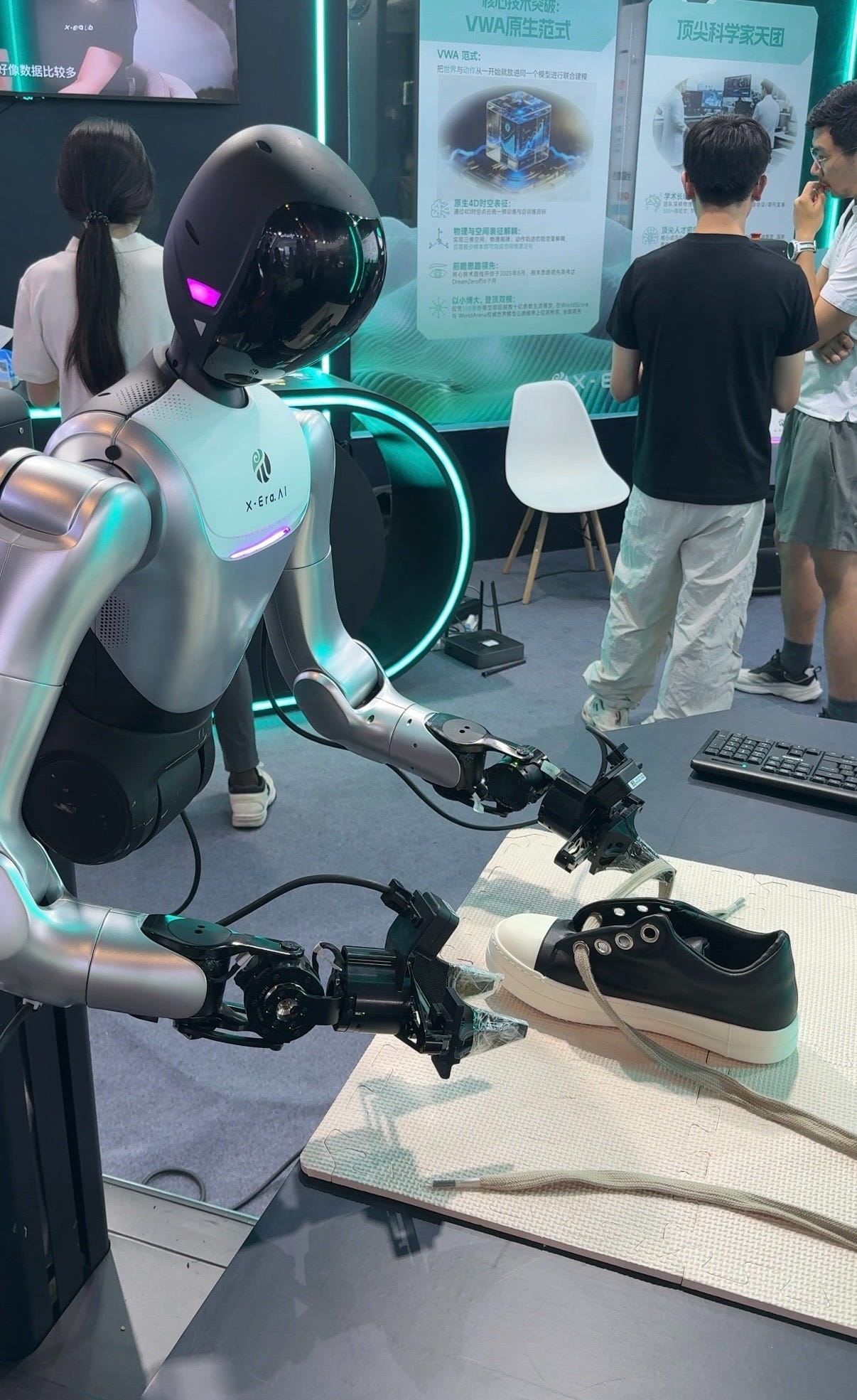
However, watching how difficult it is for a robot to do something as simple as tying shoelaces made me marvel at what an extraordinarily complex machine the human body is.
The robot has to read the thread’s position and orientation from a camera feed, under whatever lighting happens to be in the room, and that visual read has to update continuously as the shoelace moves, the light shifts, or a shadow falls across it.
A human hand does this without thinking; we barely register how much visual recalibration is happening in real time as we bring the lace from one hole to another. For the robot, each of those micro-adjustments is a full perception-and-decision cycle, done far slower and far less gracefully than the human eye and hand collaborating unconsciously.

My brilliant friend Wency Chen, senior tech reporter at SCMP, described teaching robots these most basic movements as a natural stage in the progression of the technology.
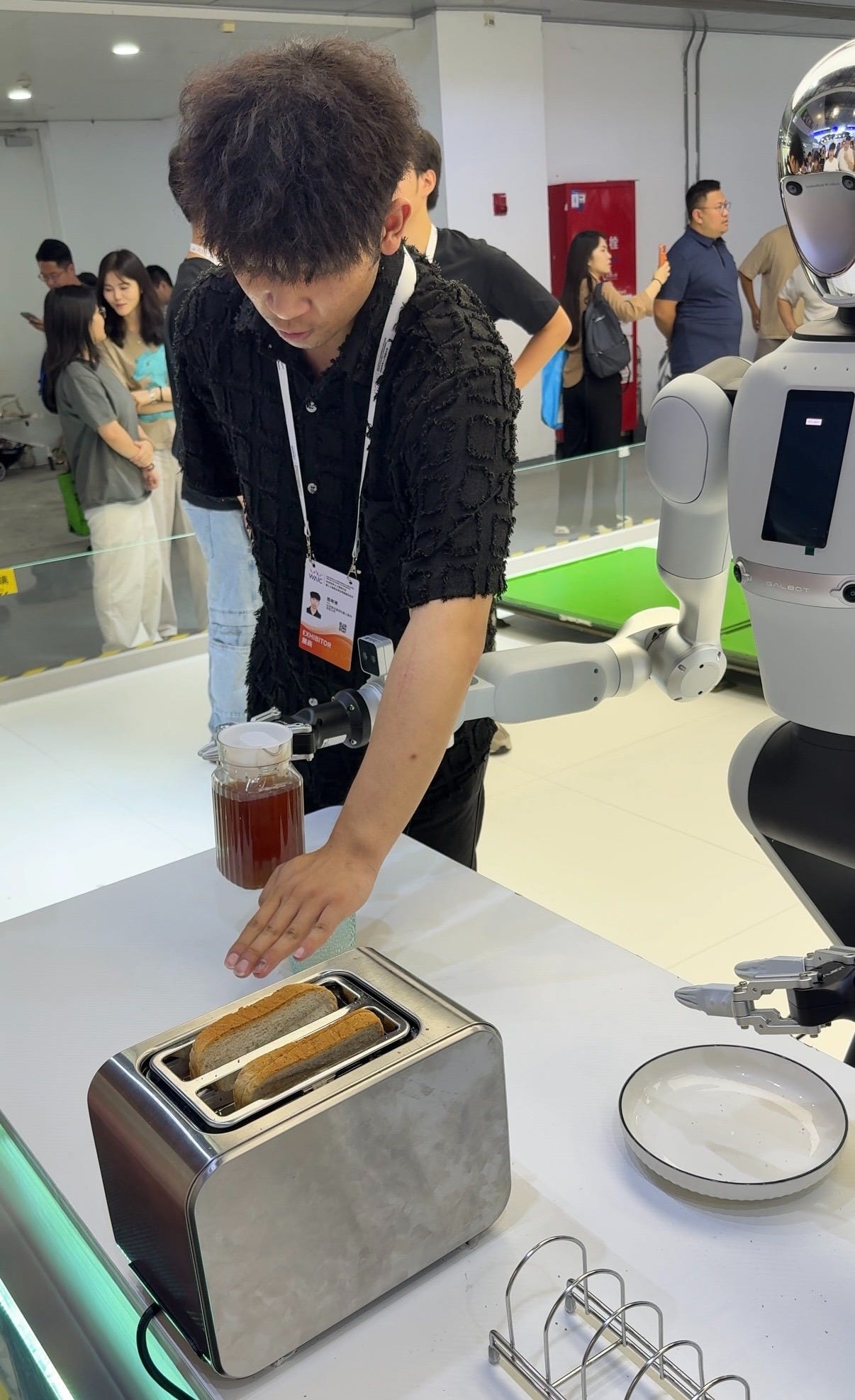
Embodied AI is moving toward completing the human loop of “perception - planning - action”; the ability to plan is important. At a booth showing a robot pouring tea, in order to test its real-world adaptability, the staff will move the cup around or put their hands over the lid, actually to see whether or not it can judge before acting.
The important human point is that action is not simply movement. It requires continuously updating one’s understanding of the world, in this case: where the cup is, whether something is blocking it, and whether the planned action is still safe.
As humans, we learn that kind of context through trying and doing as babies; now the robots are doing the same through repeated interaction and feedback - training.
The robot did not make human-level dexterity feel imminent; it made human dexterity feel extraordinary.
Touch — A language that the physical world writes for AI
If perception is the first half of that loop, I kept wondering where it actually comes from: how does a machine feel the world enough to decide what to do with it.
Talk to anyone in embodied AI this year, and the conversation almost always turns to the “brain”: large models, visual perception, task planning, language understanding. These matter, of course. But they answer the question of what to do, and how to do it. The question of how well it’s done is a different one entirely, and it lives in the fineness of perception itself.
Whether the action is done well depends on something more basic: the fineness of the machine’s perception.
Li Rui, founder and CEO of Shanghai ViTai Technology, opened his talk with an experiment that had nothing to do with robots. Numb a person’s fingertip with anesthesia, he said, and something as simple as picking up a matchstick becomes impossible, because touch is the thing that makes the hand capable of acting on the world at all. His talk was titled, plainly, “I Spent Fifteen Years Teaching a Robot How to Pick.”
Touch, he said, is the language the physical world speaks to AI, the one channel through which weight, texture, and pressure actually get through.
Fifteen years ago, as a PhD student at MIT, he and his advisor, Edward Adelson, found themselves circling a question that sounded almost absurd: if a camera can see an object, could it also be made to see contact?
They built a sensor with eleven pads of soft, elastic skin, each backed by a tiny embedded camera. When the skin touched something, it deformed, and the camera caught the deformation. Run through a chain of algorithms, that footage could be worked backward into data: a vision-based tactile sensor, touch translated into sight, with a resolution finer than a human fingertip’s own.
They called it GelSight.
On screen, you could see fingerprint ridges, the faint slide of a surface, changes at the point of contact too small to name. Li Rui said that was the moment he understood touch could actually be seen.
Thanks to this academic breakthrough, from what’s publicly known, ViTai appears to be the only Chinese company so far to have taken vision-based tactile sensors to industrial-grade mass production, running on mainstream dexterous-hand platforms, and it certainly has laid important grounding work for the development of embodied AI in China.
Closing thoughts
I went to WAIC on its last day (Monday), the only day still available when I brought my ticket, and it happened to be the public day when children under twelve could attend. I remember watching a child in front of a Unitree robot on the floor. Unlike the adults around him, who seemed determined to exhaust every function the machine had, he wasn’t trying to test its limits at all. He just wanted it to dance, and kept dancing with it, unbothered by whatever else the machine could do. Taking a step back, you realize adults tested what the robot could do, but the child simply cared about what he could do with it.
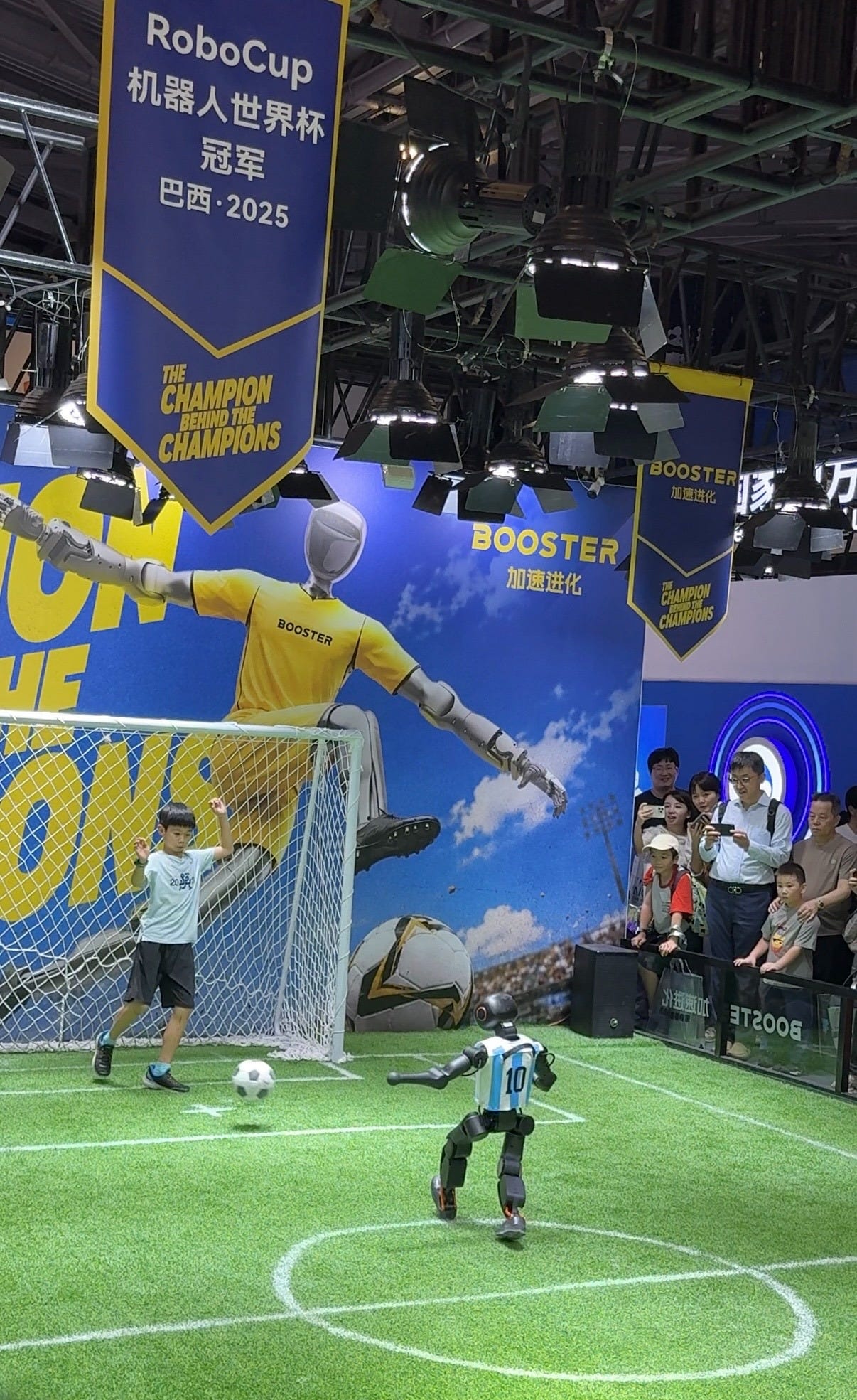
On the final day of the World Cup, the final match, a robot from Booster Robotics in an Argentina jersey faced off against a human child.
It reminded me of something a brain-computer interface patient had said, in a completely different context, about pain. For most people, pain simply means something is wrong. But for someone who had spent years losing sensation, he said, pain in his leg meant his body was sending a signal again, a neural pathway, answering back, because of AI.
Ultimately, the challenge may be not to make a machine appear more human, and the most useful applications were often the least theatrical.
I thought going to WAIC would get me AGI pilled; instead, I walked away from the conference hoping that AI is helping people feel, more clearly, what it means to be human. Both the joy of it, and the pain.