

Hi everyone, joining me today is Chim Lee, Senior Analyst at the Economist Intelligence Unit. He works in EIU’s China and Asia teams, and is based in the company’s Beijing and Hong Kong offices.
He leads EIU’s research on China’s advanced technologies, Climate change, Energy, Semiconductors, and Artificial intelligence, and also covers how China’s industrial policies link up with the broader diplomatic and macroeconomic dynamics.
Our conversation starts with China’s newly announced 15th Five-Year Plan proposal, which reveals the country's next priority and how it may impact its economy, society, and trade relations with the rest of the world.
We then dove into the current involution 内卷 issue, particularly zooming in on the solar and EV sectors. Then we look at the data center build-out driven by the AI boom and how local and regional governments are making sure involution does not hamper this sector.
Finally, Chim reflects on his work and his analysis of China’s economic planning and innovation direction.
In today’s world, there’s no shortage of information. Knowledge is abundant, perspectives are everywhere. But true insight doesn’t come from access alone—it comes from differentiated understanding. It’s the ability to piece together scattered signals, cut through the noise and clutter, and form a clear, original perspective on a situation, a trend, a business, or a person. That’s what makes understanding powerful.
Every episode, I bring in a guest with a unique point of view on a critical matter, phenomenon, or business trend—someone who can help us see things differently.
For more information on the podcast series, see here.
In this conversation, Grace and Chim delve into the strategic priorities outlined in the newly announced five-year plan proposal, including self-reliance in technology, maintaining manufacturing dominance, and the role of private and public sectors in driving economic growth. The conversation also touches on the challenges of overcapacity and the evolving landscape of China’s international cooperation.
China’s Five-Year Plan signals strategic priorities.
Focus on self-reliance in technology and innovation.
Maintaining manufacturing dominance is crucial.
Private sector plays a key role in economic growth.
Overcapacity remains a challenge in various sectors.
International cooperation is evolving in China’s strategy.
AI and new energy are critical emerging industries.
China’s economic planning involves both public and private sectors.
The plan addresses geopolitical tensions and trade flows.
China’s approach to technology is both strategic and adaptive.
[Disclaimer: AI generated transcript, typos may appear]
Grace Shao (00:02)
Hey, Chim thank you so much for joining us today.
Chim Lee (00:06)
Thanks for having me.
Grace Shao (00:07)
Yeah, ⁓ Chim, you’re with the Economist Intelligence Unit and this is something that’s not really too consumer-facing, more to be, right? But it has a relationship with the Economist magazine. Could you tell us a bit about the organization and more importantly, what is it that you do there, your coverage, your expertise and the experience?
Chim Lee (00:29)
Yeah, of course. So ⁓ the way I tend to describe it is that if you think about the Economist magazine as a subscription for the public, think we, the Economist Intelligence Unit is a subscription for the private sector, institutional decision makers. So we tend to forecast and model each country’s, know, in the world’s trajectory, politically, economically. So anything from, you know, how fast GDP is going to grow in China to like election outcome in Thailand and Japan to like what China’s AI investment means for the economy.
So all these sort of things we do analysis ⁓ and forecasting and modeling. So as for myself, I tend to look at China a bit more. So particularly in terms of how China’s technology landscape evolves, energy landscape evolves, and in turn how it’s linked up with domestic context and economic context, but also geopolitically, what does it mean for the world?
Grace Shao (01:21)
Yeah, and I think on that note, the biggest ⁓ kind of backdrop that we should probably address today is the five-year plan announcement or the proposal for the next five-year plan. To start off with, just some context for everyone, the Central Committee of China’s ruling Communist Party has officially announced its proposal for the 15th five-year plan. So this is a 15th five-year plan. ⁓ And this is a nation’s grand plan announced every five years to convey its political, economic priorities to society.
And the impact is not usually just on the domestic businesses, policies and society, and even how the future of innovation and technological entrepreneurship goes towards, but it also has implications for economies and diplomacy around the world. So I think let’s start big today. ⁓ Tell us about what even is this? What is the news? Why is it so important? And start with why it’s important for China.
and it’s new and changes, then let’s go into why it’s important for the rest of the world.
Chim Lee (02:24)
Yeah, so I think we can start with like a little bit of headline takeaways. ⁓ And I think in the interest of time, probably share just three things I found quite helpful for the audience. I think the very first thing is that is sort of know what it means to have a five-year plan. This is not something that I think people in the West tend to understand. But I think these sort of plans in the Chinese ⁓ governance system is very important for signaling. So these sort of plans is not just drafted by center. So what we have seen
⁓ is a proposal for the next five-year plan and over the next few months, we’ll see everyone important in every ministry, in every central state enterprises and some of the private enterprises as well. They will be involved in or at least advising the government in drafting the actual five-year plan, which will be released in early 2026. And this is really to outline sort of where China think it is currently and also where China wants the country to be at like over the next five years.
So a lot of the things that were said this last week is really to actually, they will be put into actionable items and goals that we’ll see coming out in early 2026. So I think this is very important for signaling to the public in China where China is trying to focus at. So that’s the very first thing. And I think the second takeaway there, from what we can see from this latest proposal compared to the previous five-year plan proposals, I think...
One thing that really stood out to me is just the very stern language on like on very ⁓ result oriented approach to science and technology and innovation. So I think one of the biggest differences there is really to say to feel that the policymakers feel that they need to sort of break the technological choke points. So where China remains very dependent on foreign supply. So
⁓ I think the wordings are quite interesting in this context where they say that they would take extraordinary measures to achieve quote unquote decisive progress in areas like semiconductors, in software and advanced materials. And these are all areas where if you look at China’s import basket, ⁓ both in terms of like products and also services, those are very much like dependent ⁓ on imports. And I think even beyond these areas, like we can see the language suggest more result oriented approach to other things as well.
There is an implied logic there where science and technology and the developments should be serving industrial development and also other state objectives as well. I think one final takeaway there is how China absolutely wants to maintain its edge in manufacturing. So in the context of how we have seen a lot of discussions around industrial policy around the world these days, there is a very interesting
estimate coming from the IMF recently saying that China actually spent about 4 % 4 to 5 % of its GDP on industrial policy. So we don’t really see that changing over the next five years. And I think there is a very strong sense from China that they see a value in maintaining the manufacturing sector in to certain extent, even a little bit of redundancy as well as we’ve seen recently in China’s over capacity problem. So as compared that to the risk of like industrial hollowing out, know, they’re
this is sort of the less of two evils in some ways. So I think all of this is really looking at like how China is seeing itself in terms of like technology, innovation and also industrial policy, which does see very strong signals coming out to sort of where China’s headed for the next five years.
Grace Shao (05:52)
Yeah, I think we definitely want double click on the overcapacity and evolution conversation later. But ⁓ I just want to kind of go back to your comment on like the focus on science, technology, and really, there’s a lot of, I guess, headlines per se on the focus on self reliance and technology. ⁓ I think I found a quote here that the government will continue channeling resources towards strategic emerging industries such as AI, new energy, new materials, advancing manufacturing and future industries.
like brain computer interfaces. On that particular kind of phrasing, is that something that’s changed over the years or is that quite similar to China’s previous five-year plan?
Chim Lee (06:35)
Yeah, it is very interesting to see sort of how language evolved over the last decade or two. So technological self-reliance, is definitely not new in the Chinese context. If you go way back to the People’s Republic’s founding, we have seen how those languages appear very early on. And in those times, of course, it’s a bit different. We’re talking about military technology mostly. ⁓ And then I think what has changed over the last few decades is that we have seen ⁓ over time, science and technology was a sign more of a
of like economic development. So I think particularly in the 90s and 2000s, the emphasis there is like, so ⁓ whatever technology and innovation you can find, so whether it is absorbing foreign technology or actually like integrating different kinds of technologies or actually our original innovation, know, it doesn’t matter as to like sort of the approach as long as like they are serving economic development goals. I think what we’ve seen here is that that logic has sort of shift back a little bit. So of course we’re not just talking about military technology.
It’s a very different times compared to the 50s and 60s 70s. But we are looking at how the emphasis of self-reliance is quite critical in today’s world when we’re talking about a lot of geopolitical uncertainty, a lot of tensions with the West. So from China’s policy makers’ angles, they’re really looking at it from that, we really need to actually ramp this up. Don’t get me wrong. So I think from the language, we actually can see that China is actually quite
quite satisfied with the progress that they have seen over the last decade or so. We have seen China making a lot of technological breakthroughs, but I think from the policy makers’ angle, they’re also seeing it as that, we need to particularly focus on areas that we still have these choke points.
Grace Shao (08:22)
Yeah. And how does this actually relate to the global economy? Like, why is this such a big deal? This policy, this proposal?
Chim Lee (08:32)
Yeah, I tend to look at it from the trade flow and investment flow angle. I think we can look at it from how, I would say it would affect, first of all, the global trade flow. So when we talk about China very much still emphasizing manufacturing, that means that when we talk about overcapacity problems, these are not necessarily problems that we will see very dramatic ⁓ solutions, so to speak. So a gradual approach means that a lot of the...
discussions around China’s lower export prices and competitors globally. I think that is still going to be a very major topic over the next few years. Even lower, I think, like in terms of like China’s comfort, Chinese products competition, not just in the West, but also in some emerging markets as well. And then I think we’re also looking at global trade in technology and energy as well. So I think on the flip side, when we while we see like more Chinese exports in terms of like sort of
manufactured goods, but we’re also looking perhaps like sort of reduce imports when it comes to advanced technology products where China would like to see utilization of more of its own production. So I think in this context, we have already seen discussions coming out from Nvidia saying how their market share has plunged. ⁓ And these sort of dynamics will be a major theme for the next few years too. And I think one area that people tend to offer log as well is also global training energy. So the planet itself did actually mention like
China’s plans to peak is oil consumption over the next five years. This is not something new. think a lot of the market forecasts have been saying that. But it also points to how China is also thinking about in terms of hydrocarbon imports, how it’s trying to cut it back. And at the same time, China is actually exporting lot of the new energy products. So we talk about EVs and solars and wind turbines and batteries. These are all very critical for everyone’s energy transition.
So I think in this context, we see this sort of trade flows like very much like reorganizing.
Grace Shao (10:31)
Right. ⁓ So I think quite a few of the critical sectors you just mentioned, like EVs, renewables, technology, these are essentially continue to be the sectors that the Chinese government will put critical resources into. ⁓ But what we’re seeing is something you mentioned as well as over capacity issue. Right now, we’re seeing a lot of the private sector, private players are creating a price war domestically. They’re really heavily relying on the export right now. But if there is continued export,
constraints to certain sectors such as the EV sector, you know, they have to find the demand domestically. And that’s been an issue, right? What we’re seeing is, you know, the insane domestic price war is driving out a lot of the players to shut down or go bankrupt and essentially local governments have to clean them up. And this leads me to the next topic, which is essentially the rise of the term involution. Everyone’s talking about it. I think from my parenting, like
like group chats, everyone’s talking about needs with education, you know, to, you know, like these business conversations, everyone’s talking about the major end of ⁓ again, the EV sector, energy sector, even AI, right? So, yeah, you just recently released a seven part series in China’s over capacity issue. And you basically cover everything we just talked about all these different sectors, you break them down. Can you actually tell us what is the main issue with involution right now? And then we’ll go deeper into
your seventh part series, especially focusing on the EV sector and the energy sector.
Chim Lee (12:04)
Yeah, think involution comes from a very interesting social context, right? I think, like, initially, it was very much describing, like, like, if you are leaving work at, 5 p.m., then I should leave work 6 p.m. just to show that my boss, you know, that I’m working, working very well. And ⁓ so these sort of have been put into, like, the industrial sector and the in terms of, like, how across a lot of the sectors we actually see, like, very destructive competition behaviors.
So I think in terms of like the statistics, we are thinking about like profit margin shrinking very significantly. In fact, if you look at China’s manufacturing sector, the profit margin has been some of the lowest points like since around 2000. And ⁓ I think we are looking at the same time, we’re also looking at like producer prices, know, plunging as well. So we have seen, so this is really, as you said, like the manifestation of the price war we saw over quite a lot of sectors. ⁓ But I think like if we take a step back to think about
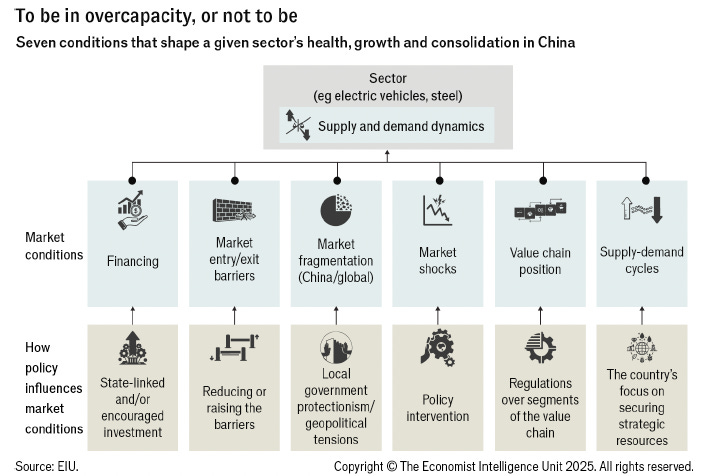
all of this, it is really sort of a, it is somewhat by design at a very high level in China. So what we tend to see over a lot of different sectors is that demand can shoot up. and this could be due to like market or policy reasons in particular sector. So think EV, for example, like, so in the 2000s, we have seen like very strong signals like, okay, China wants to develop an EV sector.
Then you see that and given the child’s market size, it’s very easy and very natural for anyone who is interested in this sector to think like, wow, there’s such a huge market there, then I should think about investing in it. So then you see lots of speculative behaviors, a lot of investment ⁓ from actual, from proper investors as well, from those who are actually involved in the automotive sector or the battery sector to think about investing in it. And then once you see that spectacular growth in terms of supply.
⁓ Over time, what you tend to see is that you do have a lot of players that are actually not particularly good. They probably joined because of a speculative wave. And then that is where you see that overcapacity problem coming in. ⁓ And I think given China, the size of China’s and size of China’s industrial sector, we tend to see these problems played out in a very dramatic manner. I think we have seen that play out many times in the past.
So if you took a look at the 2000s, we have seen the home appliance sector being one major area and pushing a lot of like Korean or other Asian marketplace out. And then I think in the 2010s, we have seen a wave of like solar overcapacity already. But I think what makes it really different this time is that China’s manufacturing sector has grown so much that, and it is affecting such large.
number of sectors that ⁓ it is very politically, is politically and economically painful for both for both China and its trading partners as well. So I think it is in this context where we see a major difference emerging.
Grace Shao (14:58)
And how is the government actually like dealing with this issue then? Like, because surely you did mention like part of it, the initial start of the evolution was top down plan in some perspective, you know, they wanted a competition, they wanted more ⁓ competitive players in the market. But now that’s gone overboard. What do we do now? Are we going to see another like, you know, crackdown on certain sectors? Or what is the right way to go forward, I guess, to help these companies?
Chim Lee (15:20)
You
Yeah, so I think we can think about this in a few ways, right? So of course you can have like a shock therapy. So I think that is what happened in the mid 2010s when the so-called supply side reform, we’ve seen like a massive scale down in terms of like the steel production capacity, coal sector’s production capacity. And I think like quite quickly after that, within one year or two, you see like probably much improving, we see like production in a much, much healthier manner, know, ⁓ pollution also gone down as well.
⁓ But then we don’t really quite see that happening this time. And rather we tend to see like a more gradual approach to the things. And so at least our baseline view is that based on our assessment of a wide range of different sectors, we feel that the consolidation process is gonna take quite a while. it is already happening, this restructuring and this consolidation is happening, but it’s gonna extend well into 2026, if not beyond. And I think the government’s role here is that, ⁓
you cannot really expect the government to intervene in every single sector in a very one size fits all manner. So we talk about sectors like EVs and solar and steel and coal and all these, they all have very different dynamics and they all have somewhat different mechanisms that make them very prone to overcapacity. And so the way to address them will be very different. And so what we tend to see
⁓ The central government doing is to see okay What are some of the steps that we can take for like on a on a holistic level? So for example, like we’ve seen amendments on the pricing laws, know trying to like reduce the power of some of the Monopoly monopoly players like in certain supply chains, for example in the automotive supply chain They want to make sure the automakers don’t go against their suppliers too much ⁓ but that but I think
Grace Shao (17:07)
Mm-hmm.
Chim Lee (17:15)
Outside of this very holistic approach, think individual sectors, in a certain way, they would need to work themselves out compared to the past where we see very dramatic measures of government-ordained shutdowns of capacity. So, yeah, it is going to be quite painful, unfortunately.
Grace Shao (17:34)
I actually think it’s really interesting to bring up the coal energy source kind of regulation back then. think because when you look back at it, the government really steps in a lot more aggressively when it really affects the public health or the big public wellbeing versus the current sectors we’re looking at in many ways is actually like a still consumer facing issue with EVs and whatnot. ⁓ So it’s not really like a public wellbeing issue right now.
and not like the education sector either, right? So actually, you know, what we’ve been talking about is that there’s been this invisible hand, but you know, there’s also this visible hand that really kind of, you know, tugs and tweaks China’s economy. How do we understand China’s ⁓ government role in this economic planning and how, I guess, policies work with or work to regulate the private sector?
Chim Lee (18:27)
Yeah, I think to start with is that we have to understand China has an enormous invisible hand mechanism there, right? So when we talk about sectors like solar and batteries and EVs too, the leading players are all like private companies and they are not like, at least not in a traditional sense, what we would call state-owned enterprises. So a lot of this innovation and technology, they really come from the private sector. ⁓
Grace Shao (18:46)
Mm-hmm.
Chim Lee (18:56)
What we tend to see the government’s role here is that I think depends on sector, but like I think for sectors where you do see very strong private presence, what we tend to see is that the government would adjust the levers, the levers to make, sort of at a different stage of development. So at the very beginning, you know, if we’re talking about very nascent industry, then of course you actually need, you would like to have support for like on both the supply side and the demand side, right? So.
On the supply side, the government is really involved in like, maybe we can lower the entry barriers. So for example, like we can invest more in the technology development so that like we can help entrepreneurs to actually take advantage of these technologies to roll them out quicker. And then we can also think about like, oh, how can we actually invest in those companies? So we have seen like several investment vehicles and also that instruments designed for entrepreneurs. On the demand side, then we can also see like, okay, so in the EV sector we have...
purchase subsidies, have lower tax, tax, value added tax for automotives and whatnot. So I think in that context, we have seen how the government is involved in actually sort of reducing the barriers of this market, like, know, maturing. But at the same time, once we got to a stage where we see today, when it comes to like, okay, the sector is at a stage where we would like to see consolidation, but not too disruptive, but we do want to see gradual consolidation.
Then we can also see the government reversing some of these approaches. So I think in the solar sector, we have already seen some of the financing access has been scaled back. So it’s not as easy for a solar company to list on the stock market compared to before. We have seen how the regulations in terms of ⁓ building up new steel mills like that has been tightened. So it’s not very easy for anyone involved to actually build one necessarily.
Grace Shao (20:32)
Mm-hmm.
Chim Lee (20:49)
So in this context, like we can see these mechanisms being adjusted to fit what the market needs and also what, least in the government, to like what the market needs.
Grace Shao (21:01)
I think it’s something you touched on from the very beginning, which is like you said these innovative companies are actually not SOEs. And I think this is something that a lot of Western investors, since I don’t fully understand and I get the question a lot, it’s always like, okay, if this is part of a strategic industry, if this is deemed a strategic by the government, they must be backed by the government. What does it mean to be a private? Like, ⁓ what does it mean to be receiving strategic support?
but not be SOE. And this is the part where like, think the West just thinks China is either run by government and private sector like is so small and just mom and pop shops from selling coffee or whatnot, right? That there’s an understand that all strategic level businesses are basically government control. And that’s just not the case. So I think I want to throw it back to you. The question is just like, how do we understand strategic industries? And when we talk about there being strategically supported by the government, what does it mean?
Then I want to ask, you know, what is the dynamic between these private sector players and public sector players within these same industries?
Chim Lee (22:11)
Yeah, I think this really depends on the industry we tend to be talking about, right? So for sectors where you see as a very beginning of like, of sort of the technology development ⁓ cycle. know, technologies that are very far away from commercialization, then you will see like much stronger state involvement. And it is context often not even stay on enterprises. We’re talking about universities, we’re talking about research institutions in China, and they do receive a lot of funding. ⁓
Grace Shao (22:16)
Mm.
Chim Lee (22:39)
just from the government in many ways similar to what in the West you will see from public research organizations and universities receiving funding from respective governments. this is where we ⁓ see some of the leading similar technologies that China developed in the past, like that sort of came out of those two. And then when we talk about sort of technologies closer to commercialization. So I think over the last few decades, that would be batteries, that would be EVs like
then we are seeing like very different sets of incentives like put into place. So we mentioned a little bit early in terms of like how China would put in supply and demand measures to actually facilitate the development of the market. And I think in this context, like then we can see where in a given sector, whether we do see ⁓ stronger private sort of involvement or public sector involvement. So I think for some of the sort of legacy industry, so particularly in say automotive, that you do have like
a very, very strong presence of the state sector. And I think that really influenced actually how the sector has been evolving over the last few decades. And in turn, that also really affects market entry and exit mechanisms. ⁓ But we do see in several sectors where ⁓ the private sector is really the main driver. The solar sector is a very prime example of that. And I think when you look at
many of China’s consumer electronics sectors and electronics players and also in terms of ⁓ areas that are looking more into ⁓ export-oriented sectors. I think these are all areas where you see very, very strong private presence. And I think from the government perspective, if you bring it back to how they work together, we do see, I think the government is trying to move towards a mold ⁓ where there can be more collaboration.
⁓ I was reading some of the research coming from, I believe, UC San Diego, coming from Professor Barry Norton. his team was describing this sort of whole of nation approach. often it comes in a consortium structure. in a certain way, you can see ⁓ a government set a particular target. So we want to develop this technology.
And then we’ll let’s assemble the best team for that. So it can be say enterprises, can be universities, it can be private sector. ⁓ And so this consortium will be involved from the very beginning in terms of how to actually conduct research in that technology to how to actually manifest ⁓ its commercialization or usage ⁓ in a broader society. And so these are some of the dynamics we see ⁓ emerging as well when it comes to how the public and private sector.
can work with the other to some extent.
Grace Shao (25:26)
It’s really a good explanation of how that works, because I think people just kind of misunderstand and assumes that whenever an industry is deemed strategic, the state just backs all the companies or all the companies are state drivers. ⁓ So I think on the topic of strategic industries, ⁓ let’s talk about AI and data centers, because right now that is the hottest topic, right? And I think in the case of China, actually, there are state players in the data center space and they are private players. So
Right now, you seeing like data center? First of all, let’s go step back. Who are the major players in data center build out? And what are the kind of choke points they have right now? Is it kind of similar to what US companies are facing, which is like land permits, know, energy, or is China kind of facing a different kind of set of or challenges with data center build out?
Chim Lee (26:20)
Yeah, we see quite a wide range of actors involved in the data center space. So historically, we have seen very big telecom plays in China. So China’s telecom sector is dominated by three players, as day-on players. So they have been heavily involved in this space simply because of the fact that they are the one in the telecom space. But I think over the last few decades, gradually, what we have seen
in terms of these data and telecom and internet spaces, that we see a huge growth of private sector involvement as well. So Alibaba and Baidu in a these are some of the biggest players when it comes to data centers, and largely because they have a huge business when it comes to the tech industry. And a lot of that is consumer facing and business facing, and where they do need a lot of data centers to process them. And then gradually, you also see involvement from sort
Grace Shao (27:03)
Mm-hmm.
Chim Lee (27:16)
are the players as well. So Huawei being one example there. And then at the same time, across different parts of the supply chain, you see contractors, you see cheap suppliers, and then going further downstream in terms of system solutions, how can we actually integrate all the systems together. So we see a quite a wide range of actors being involved in this. Though, course, the most visible things are we’re looking at the investments.
So like these actual built up. So the money involved in that is quite significant. So I think these are some of the actors that we see involving. I think one final one I would act, which is not like enterprise players would be all the both the central government and local governments. So I think this is seen by a lot of government entities as like an investment. Right. So I think a very important part is like how does it actually contribute to life, for example, local economic output in terms of like how
Grace Shao (27:57)
Mm-hmm.
Chim Lee (28:11)
as a how can actually facilitate some of the ⁓ digitization within the local economy, that sort of thing. So I think we see a whole ecosystem of actors being involved in that.
Grace Shao (28:25)
Yeah, and I think on that note, you know, we worked on a piece together. I helped you with some research on the East data West compute piece ⁓ for EIU earlier this year. And what was fascinating to learn was that, like you mentioned, there’s these top down, ⁓ kind of mandates per se or incentives, but then there’s also very localized, ⁓ like mandates from local governments to build up data centers and, know, to optimize what they have. in areas where they have more people.
they have more ability to provide the compute bit. And for areas where they have more land and more people scarce, they might provide the space and the actual land resource to build up the data centers. so on that note, why don’t you tell us a bit about EDWC, which is East Data West Compute. What is this and how does it all work together from a government top level to the provincial level?
Chim Lee (29:19)
Yeah, it is a very interesting move because I think this is like way before, you know, all the recent AI wave, right? So like we’ve seen this initiative like being rolled out over the last few years, in fact. And so in this context, like what we have seen is that ⁓ from the government’s angle, there is a very strong imbalance. So I think for the also not necessarily very familiar with China’s geography, everything, you know, China’s the most developed parts of China are on the East Coast of the country.
Grace Shao (29:26)
Mm-hmm.
Chim Lee (29:49)
So like this is where you have Shanghai, Beijing, have like Shenzhen and they are very densely populated. Whereas like if you look at the Western part of China, they are very scarcely populated. They’re very mountainous. The weather is a little cooler. so from the government’s angle, from a high-level economics side of things, we are already looking at very huge imbalance in terms of like how the East has always had much richer than the Western part of China. And so...
At the same time, they also see the resource differences. So the eastern part of China is very constrained in terms of land, in terms of like they need to, and at the same time, they just don’t have that ⁓ capabilities to have massive build out of energy facilities where it can support these data centers. Whereas on the western part of China, we have seen how some of these,
there’s much more land available. And at the same time, given the terrain of the region, it’s actually not that hard to build out renewables. is actually quite strong renewables potential over there. In fact, actually, China has been building up massively already. So it is in this context where China does see a possibility where you can actually move some of these massive data centers to the Western Front and to alleviate some of the...
the capacity constraints that you can see on the eastern side of China. So I think this is largely what we have seen played out over the last, ⁓ I think, last five years or so. It’s not without challenges. I think when we think about how ⁓ these sort of built out, you still have very much to think about market supply and demand, right? And you don’t want your web search results to actually have very long latency.
So in this context, there has been some concerns around like, whether this build out in the Western part of China would actually be a good idea. But I think over time, we do see how some of the incentive mechanisms like the government has set up ⁓ gradually promote a rational build out of these things as well. And I think especially in the context of AI, now that we see a massive need for data centers, then think the risk of that overcapacity has come down a little
Grace Shao (32:10)
Yeah, and think it’s really interesting to see how all the engineering of different parts of the economy, different demands all come together because there’s such centralized kind of overview of the whole economy versus when it’s completely private market driven. Sometimes you have, you know, different sectors grow at different pace and it can’t meet at the middle. And that’s what we’re seeing right now in the U.S. where there’s AI boom, there’s data set in demand, there’s not enough energy supply, there’s not enough, you know, ⁓ like land license out.
So it’s really interesting how China has had this slow engineering in the background for years and that’s how they can kind of stage the appetite right now. I think on this, let’s kind of double click on and zoom in on the future planning and innovation of innovation, right? We talked about how China’s kind of an engineering state and it’s been planning a lot of different moving parts for many years. That’s how right now it’s all coming together. With AI.
Do we see this as like a new strategic
Or is this kind of years of planning coming together?
Chim Lee (33:14)
Yeah, I think this is a very interesting part where ⁓ China certainly has been planning a lot of the investment in, well, not just in AI really, like you talk about STEM more generally. ⁓ We’ve seen the education system has emphasized that, I think, especially over the last decade. And AI has been mentioned numerous times over the last decade’s policy documents as well. there has always been this evolution.
sort of evolving relationship between sort of what what China thinks should be developed versus like what starts to come into the horizon. So I think AI is one of these technologies where like it was already something that the country was quite aware of, I think very early on. And then I think as we see developments coming out from the West, then like China said, OK, so we might want to think about that and how we can actually putting it into China as well. So I think if you look at the plan that
came out a few days ago. There was a very strong emphasis on both on the upstream research part of theories and in terms of the models and also in terms of the downstream part in terms of applications. I think we’re at a very early stage in terms of how AI is deployed. So I think the government’s attitude right now is really like, let’s just try it out. Let’s just see what can be done.
So we have seen a lot of interesting applications already. And I think quite a few of you guessed already discussed some of those too. And here is where we see, I think we’re at a stage where China is not necessarily very concerned about potential overcapacity in the AI space compared to say like other sectors. I think it is currently at a very early stage where it’s allowing everyone to experiment a little bit to see what is actually possible. I think...
the government has set a few red lines, like for example, in terms of how it has to be compatible with certain regulations, particularly in terms of data and privacy, and also in terms of China’s ⁓ governance philosophy and these sort of things. So I think in this context, we’re seeing quite a permissive attitude in terms of ⁓ how it is being rolled out.
Grace Shao (35:28)
And like you mentioned, there were a lot of speculative players during the AEV era. Do you think right now there’s a lot of players that are kind of just joining the crowd to kind of try to get a lock with a pot of gold or it’s just too early to tell?
Chim Lee (35:43)
Yeah, well, I think the bubble question is something that we’ve seen everywhere, Definitely not just in China. ⁓ Unfortunately, this is sort of like a necessary byproduct, I suppose. Whenever you have a technology that is very ⁓ strong potential, then you certainly would have speculated behavior. And I think this is a process where China, again, I think for the time being, is all right with it. ⁓
once you got into the territory of like the misallocation of resources or corruption, that is where it gets like that China will be paying a bit more attention to that. So we have seen in the past, like in many times, ⁓ where some of the enterprises like they could be involved in like, know, involved in like certain strategic sectors and they have been implicated in corruption scandals and whatnot, and China would be cracking down on those. So I think these sort of things will happen as well. ⁓
Grace Shao (36:37)
Mm-hmm.
Chim Lee (36:41)
But I think for the time being, what we tend to see is how China is trying to make sure that, OK, even if we do maybe have all the capacity problems in certain areas, let us just make sure that they will be beneficial for the economy in the long run. So for example, there is a lot of investment going into AI chips. How can we actually think about, OK, even if like
Turns out the market is not as great as we thought. Then at the very least, we can think about, OK, all of these people that are involved in developing, can it work on some other things? So there is, think, this is not necessarily very evident in the plans. But I think there is a subtle attitude in terms of this is all part of a much broader set of technologies that can change China and change how China’s economy evolves. So I think this sort of coordination is happening too.
Grace Shao (37:35)
Yeah, and I think on the topic of how AI is driving the future of the economy and how it’s becoming a huge growth driver of the economy, I wrote about this thesis, which is how Shenzhen, GBA area, Guangdong, then Hong Kong has heavily relied on just their manufacturing capabilities. And that’s why they’ve been able to lead in a lot of the embodied AI products from as early as the DJI’s and the sense times of the world.
So I think for you, my question is that, you you covered China’s technology, you covered the EV sector, you covered the renewable sector. All of this is ⁓ very heavily relied on, again, the manufacturing capabilities and the hardware capabilities that China has kind of gained from the last four decades, essentially being the manufacturer hub of the world. Right now, with the AI side of technological breakthrough, it’s very, very much focused on the, essentially, the software side of things, right? Well, not software, but,
the technological model frontier. ⁓ If you can build the best model, you can integrate into your product, you can maybe potentially have the best ⁓ embodied AI. So going forward, what is, guess, your prediction? Do you think China will still be more dominant or leading in hardware breakthrough, software hardware integration? Or do you think it actually worth seeing more more of a breakthrough in the software side or the application side?
language model side or whatnot.
Chim Lee (39:07)
Yeah, think ⁓ it is a very interesting question because I think when we think about, indeed, there has been a very strong emphasis on the manufacturing sector. So I ⁓ we mentioned at very beginning where China is very much emphasizing that there needs to be industrial sector. This is very important to China’s long-term economic well-being. So there will always be this emphasis on the manufacturing side and by extension, course, manufacture products. ⁓
technological products, hardwares, and so on and so forth. I think on the software side, it has always been a very interesting part of things. So on one hand, we have seen very interesting innovation coming out of China. So if you look at mobile payment systems, a lot of these consumer-facing applications, and these are not even just app planning within China at this point. A lot of these players are now very involved in these applications developed in it.
all the emerging markets like go down to Southeast Asia or go into Latin America, you see very strong expansion of some, or at least a very similar model when it comes to how they work. But I think what China is trying to do in the software space is really thinking about the industrial software and what you say earlier about the AI models, these sort of areas where the West has a very strong dominance.
like ⁓ in certain ways, it relates to technological capacity, but also relates to network defect as well. So I think one of the major things that China has highlighted in the 15-5G plan proposal is that it needs to break the choke points of foundational software. So I think over the next few years, we will see quite a strong push, I think, again, both on the supply side and the demand side. So in terms of how to actually improve the supply of these
Grace Shao (40:43)
Mm-hmm.
Chim Lee (40:53)
technologies to make sure that they are actually as good, even not better than like their foreign counterparts. And on the demand side, how can the government promote their use, ⁓ not just in the public sector, but also potentially in the private sector as well. So I think these are some of the things that we might tend to see. And I think ⁓ over the next few years, yeah, I do feel that there’s still going to be very strong emphasis on hardware, but I think software is certainly an area that China is definitely not missing it.
Grace Shao (41:23)
⁓ Thank you. think we’re going to go into the last bit of our interview, which is, what is something that you think people are actually missing or misunderstanding? You’ve been really covering this space for ⁓ well over a decade, really, even as a policy analyst. What are people kind of getting wrong about the big picture on China’s economic planning and development?
Chim Lee (41:48)
Yeah, I think when we think about China, one of the lessons I’ve learned very much is never underestimate Chinese policymakers and entrepreneurs, really. They’re very agile. They’re very, very agile. So we have seen how when it comes to the export controls imposed on, let’s say, Huawei, we have seen how it has bounced back from and tried to focus on areas where it still finds
advantages. And then we have seen how DeepSeek is a very notable example there, right? Working with all of these constraints, like when it comes to hardware, and try to work out a model that it would work in a Chinese context. and these are just the entrepreneurial side of things. I think policymakers as well, like they are quite adaptable. Like when they see that, okay, the situation, So some of the problems are of course, like very difficult.
Energy transition is a huge problem. It’s a huge challenge for everyone. and how China is doing and it’s all very gradual as a process. But that doesn’t mean that China is not is completely unable to do any of those things. So I think that is one of the major lessons I would I would say out there. And and I think in the medium term, what we tend to see is that, you know, terms of technology innovation space like
In the 55-year plan, are also seeing the mentioning of high-tech talent, ⁓ immigration scheme, well, not an immigration scheme, but a visa scheme. So in this context, it’s actively also attracting foreign talent. And this is quite a change when you think about China’s political economy, it has rarely emphasized the...
Of course, it would welcome overseas Chinese return needs, but I think in general, when it comes to foreign talent, it has been quite ⁓ careful when it comes to approaching that topic. So I think we have something to see also in terms of how China’s international cooperation is changing as well.
Grace Shao (43:46)
Yeah, I think that’s a really interesting takeaway. think China’s definitely shown like a really big shift in their in their way approach to foreign talent because I remember when I was trying to work in China or when I did work in China, ⁓ it was really difficult to actually obtain a visa, right? You have to have had at least two years of work experience abroad or anywhere else, not China. You have to had if you had obtained a higher degree in China, you get
bonus points and there was this ranking system of like class A, class B, class C, experts essentially. essentially, unless you were an expert that they can’t find a replacement for you in China, they had to prove that they would not give you a visa. And it was very hard for new fresh grads. And this new scheme is completely different, right? It’s actually attracting new ⁓ grads that studied STEM or any kind of technology innovation.
⁓ whether you’re in a technical side or the business side to kind of come in and actually work within the China ecosystem. So I think that that’s an interesting shift. ⁓ I have one last question for you, which is what is one contrarian or differentiated view you hold? And this could be about the work you do. It could be about the world. It could be about anything.
Chim Lee (45:04)
Yeah, I actually, think it would be actually good to expand on the very last point we discussed in terms of international cooperation. I think we all tend to look at like, you know, how China works with the West and like the US and Europe. And like in many ways, when you talk about science, technology and innovation, this is where we see like a lot of the challenges emerges as well, because like on both sides, essentially, we see very strong emphasis on national security. But I think one area that people often overlook is China’s
Grace Shao (45:09)
Mm.
Chim Lee (45:32)
interaction with the rest of the world. China Science Technology cooperation with a lot of the emerging markets have been growing enormously. If you are going to the universities in Beijing, you see an enormous amount of talent coming out from quote unquote the global south countries, ⁓ coming from Africa, coming from Southeast Asia, from South Asia. And all of them, they study in China for years and then they bring back
these solutions they see or these technologies they see in China bring back to their countries. And these are the connections that we are only starting to see the emergence of what they all mean, because we are looking at like how did these, you know, these relationships built over like five, six, seven years of PhD life. And these are very strong connections that will last them a lifetime. So we are looking at how they are going to evolve over the next few years, next few decades. In fact, I think that is one area that we see that I think.
Grace Shao (46:18)
Mm-hmm.
Chim Lee (46:28)
It’s definitely underreported and I would love to actually look into that a bit more.
Grace Shao (46:34)
Any thing else you want to touch on or share with us before we wrap up.
Chim Lee (46:40)
No, I think that’s about it. Thank you very much for having me.
Grace Shao (46:44)
Thank you, Chim


