

I have been trying to persuade the WorkBuddy team to join our podcast for a while now. wink. Whenever you’re ready, hola.*
In Part 1, we spent a lot of time with Yao Shunyu: why Tencent hired him/ why he joined Tencent, how the model layer was rebuilt around him, and why he was open-minded to court the products, and how he thinks about context and feedback when explaining what the next phase of AI would require.
During Tencent’s Q2 earnings call this week, President Martin Lau addressed the capex question head-on and explained the thinking behind where all this money is going.
One way to look at Tencent today is as two parallel groups of businesses, with the company increasingly trying to create links / find synergy between them. There are still the franchises we all know — games, advertising, payments, cloud — generating high-quality growth. Then there is this new AI-native cluster, where the economics run almost backwards. Tencent first has to buy the compute, train the models and build the applications; only later does inference demand arrive, and only after that does the company find out whether all this intelligence can actually generate a return.
That helps put the RMB52.8 billion of Q2 capex disclosed in Tencent’s latest results into context. Martin even made the opportunity cost unusually explicit. Tencent could rent some of its compute to third parties and earn a perfectly respectable near-term return. Instead, it is deliberately allocating a substantial portion to building its own models toward state-of-the-art capability and pushing its own AI applications toward market leadership. The bet is that owning both the intelligence and the application produces a better long-term return than simply becoming a landlord for GPUs.
Management then mapped out for investors where that compute is actually going.
Training the next, larger Hunyuan (HY) model sits at the top of Tencent’s AI compute priorities. WorkBuddy inference, running HY alongside DeepSeek and other external models, comes immediately behind it. James Mitchell also said that once Tencent concluded WorkBuddy was breaking out, the company shifted resources decisively toward it while lowering the priority of some other new AI projects. Management did not name which ones, so I won’t either. 卫夕指北’s detailed analysis of the call is worth reading for those who want to go deeper.
Agents have moved from one of many Tencent AI experiments to a central part of how the company intends to turn all that model and compute spending into something users actually consume.
And WorkBuddy, six months ago essentially a small-team project built on top of a coding tool, suddenly sits very close to the middle of it.
From CodeBuddy to the AI night-watchman
To understand WorkBuddy, you have to start with CodeBuddy.
CodeBuddy began as Tencent’s AI coding system across IDE, CLI and plug-in interfaces. According to the material I gathered for this piece, more than 90% of Tencent engineers use it internally. WorkBuddy inherited the infrastructure and Agent SDK underneath it, so this was not a team starting again from zero.
In Shangjing’s interview with WorkBuddy’s first product manager Jason Wang, Jason described the problem that kept bothering him. His team had spent years making developers more productive, but much of what they had built remained inaccessible if you did not code. That is also one reason coding agents have historically struggled to break out much beyond technical users.
His realization was that the work done by someone in marketing, finance or research is not necessarily less complicated than programming. You still need vertical knowledge, planning and a process. The problem is that communicating all of that to a coding agent through an IDE is hardly intuitive if you have never written a line of code.
So Jason and a small team built a proof of concept for the rest of us — the non-technicals. Tencent’s 总办, the executive office, gave it the green light, and internal usage quickly crossed 2,000 people.
Its internal positioning was AI 打更人, the AI night-watchman.
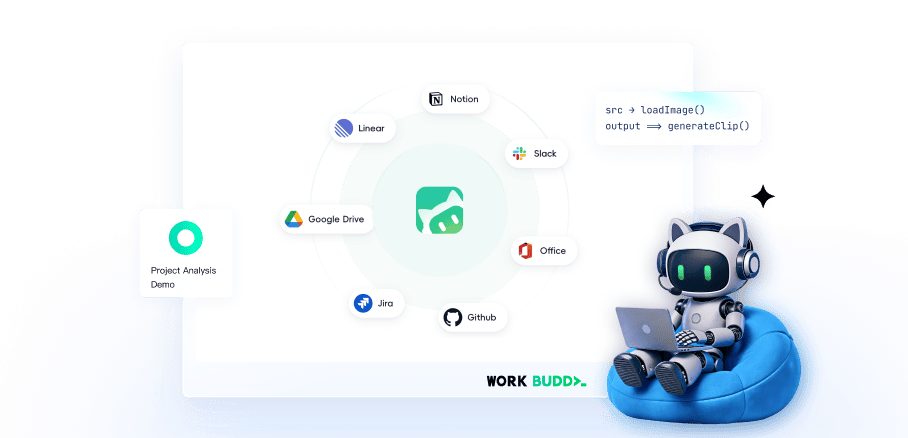
I love that name. A night-watchman is hardly the superhero version of AI Silicon Valley likes to sell us. He does not know everything and he is not trying to replace everyone. The idea is closer to an agent quietly helping 小白 users get tedious things done in the background while they go off and do something else, or perhaps get some sleep.
WorkBuddy also grew out of years of CodeBuddy engineering rather than being built as a wrapper around OpenClaw, a distinction Jason was keen to make in his conversation with Shangjing. Tencent certainly embraced the lobster craze elsewhere, as we have written about before, but WorkBuddy’s lineage is its own.
Once usage started moving, resources followed. As we discussed in Part 1, Tencent is remarkably bottom-up for a company of its size: build something that works and suddenly you earn more brownie points, compute, engineers and money. Docs, Cloud Drive and other Tencent services started connecting into WorkBuddy. This happened alongside the broader agent movement described in LatePost’s reporting and podcast on Tencent’s AI reset, as products initially built across different corners of the organization gradually began to look more like a coherent agent strategy.
Designed for the ‘little whites’ - office workers
Jason said some of WorkBuddy’s biggest use cases are PowerPoints and Deep Research. It can ingest long WeChat articles, work through documents and carry out multi-step knowledge tasks.
Underneath this is an argument he kept returning to: software is layered. The upper business layer can become much more accessible to someone who does not code, while the deeper layers still require engineering precision. His phrase was that the bottom has to be thick so the top can iterate fast.
I have been using WorkBuddy while writing this piece. WeChat articles go into it, transcripts, conversation notes, earnings materials — basically the pile of information that accumulates when you are trying to understand a company from too many directions at once. As a 小白 - a colloquial term for ‘office workers who wear white collars’/ non-technical when it comes to coding, honestly, it is already good enough for much of what I need. My usage behavior is not particularly different from how I use Claude Cowork.
This may say very little about its usefulness to developers, but it helped me understand why Tencent thinks the product can break out beyond them.
The feature I find more compelling than PPT generation is memory. Jason described a system where, after completing a task, WorkBuddy writes something resembling a diary of what happened. When another task arrives, it retrieves the relevant entries rather than trying to stuff the user’s entire life into one enormous context window. His metaphor was a library: you do not reread every book you have ever written whenever someone asks you a question; you pull out the few that matter.
Jason gets almost moralistic on this point, in a way I rather like. AI has vastly more general knowledge than any one of us, but it does not automatically have your history, judgment or the things you have spent twenty years learning the hard way. His rule is that you should remain the teacher and AI the disciple. It has a very WeChat-ish feel to it: restrained, personal, less obsessed with replacing the user than quietly building around them.
If you blindly follow AI into fields you do not understand, eventually its ceiling becomes yours. If instead you keep teaching it what only you know, it becomes closer to a digital extension of you than a substitute for you.
And that philosophy helps explain why WorkBuddy does not necessarily need to own — or always route to — the world’s best foundation model. If the product remembers my context, understands how I work and can consistently complete the task, the underlying model can change depending on what happens to be best suited to the job.
HY still has to earn the default
WorkBuddy was designed as a multi-model product. My own product notes showed its automatic routing using GLM-5.2, Kimi K3, DeepSeek V4 and other models rather than simply forcing every task through Tencent’s own.
HY3 has since been integrated deeply across WorkBuddy and other Tencent products. Tencent’s official HY3 announcement describes the model as having gone through a cycle of infrastructure rebuilding, product feedback and model improvement, with WorkBuddy among the applications already using it.
But even as HY has improved, WorkBuddy has remained open.
On the Q2 call, Martin’s framing was that HY can become WorkBuddy’s primary model if it can solve the majority of user problems cost-effectively, but it does not have to be the only one. That is why users still see GLM, Kimi and others available alongside it.
There is a healthy tension embedded in that structure, and I think it also says something about Yao’s confidence. He was the one pushing the HY team to work more closely with Tencent’s product organizations and create a stronger feedback loop. WorkBuddy, meanwhile, is judged on whether the user gets the work done. HY therefore has to deserve more of that workload rather than receive it simply because it has a Tencent label.
If DeepSeek is cheaper for one class of tasks, use DeepSeek. If another model works better elsewhere, route there. HY gains more share when its capability and cost make that choice obvious.
The openness that once exposed HY’s weakness can now become a useful source of discipline.
Where Yao’s feedback loop becomes real
Yao’s argument in Part 1 was that as foundation models get better, and the distance between the frontier and the next-best alternatives narrows for more tasks, the environment around the model becomes increasingly valuable: the tools through which people deploy it, the products in which it acts, and the proprietary context generated by real people doing real work.
An office agent gives Tencent exactly that sort of environment.
WorkBuddy can show whether an agent completed a workflow, where it became stuck, which skill it selected, whether the user corrected the answer, whether another model solved the same task more cheaply and, ultimately, whether the experience was useful enough for the person to come back.
This is how I interpret Martin’s discussion of “model-product co-design” on the earnings call. Tencent’s HY3 announcement ,describes a similar process, with real-world product feedback flowing back toward the model.
If WorkBuddy develops meaningful scale, Yao’s team gets a much richer map of where models succeed and fail in actual work. Those signals can feed post-training and evaluation, while improvements in HY can in turn make WorkBuddy either better or cheaper. More useful software should generate more usage, which produces more feedback for the model.
I increasingly think that is why WorkBuddy may matter strategically beyond whatever standalone subscription revenue it generates today. It gives Tencent a way to build an AI-native product around its existing ecosystem without first having to force WeChat itself to become the company’s “super app + AI.”
Twenty million visits. Now show me retention.
The market has certainly been willing to try it. According to Analysys, China’s major desktop AI-native office-agent platforms together exceeded 60 million visits in June. WorkBuddy was the clear leader.
Economic Observer, citing the same data, put WorkBuddy at 20.97 million monthly visits, ahead of ByteDance’s TRAE IDE domestic version and Alibaba’s QoderWork combined.
The important word there is visits though. That is the caveat. Not users, and certainly not paying users.
This is starting to look very familiar if you have watched enough Chinese internet competition: give away credits, get people through the door, build habit and hope enough of them stay once the subsidies disappear. We saw another extreme version of the same playbook during the recent food-delivery wars.
Economic Observer also reported users bouncing among competing agent products according to which platform was offering the most generous credits. ‘薅羊毛’, farming the perks, is alive and well in AI too.
So next quarter I care much more about retention, paid conversion and what happens when those credits run out. Do paying cohorts renew? Does usage expand? Those numbers will tell us far more about whether WorkBuddy is becoming a business than another record for traffic.
There are some early signs of monetization. Tencent discussed subscription revenue, paid developer skills and the potential to distribute WorkBuddy through existing enterprise relationships such as WeCom and Tencent Meeting. According to 卫夕指北’s analysis of management’s comments, paying-user economics also appear materially better than the subsidized blended user base.
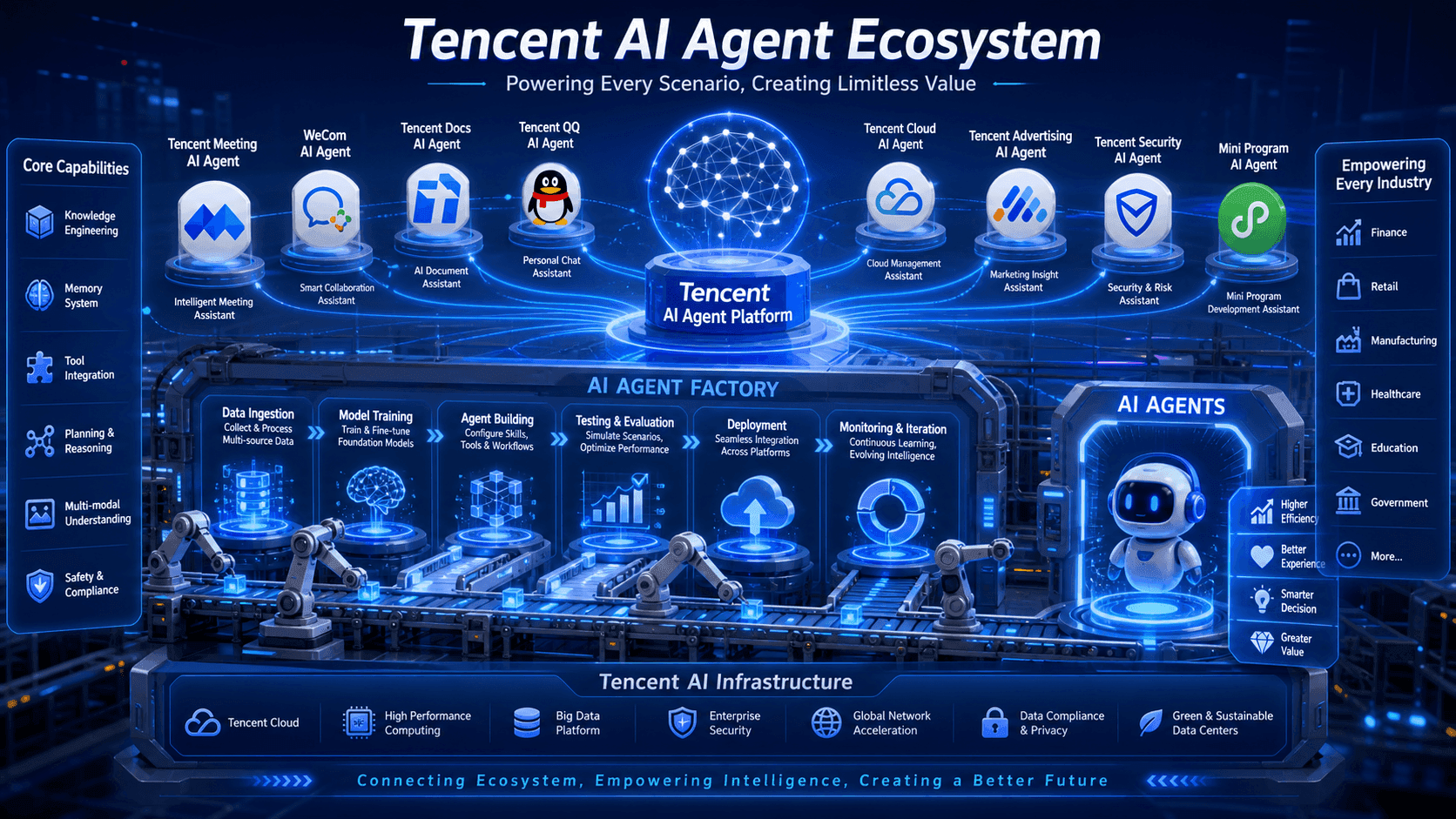
If that develops, WorkBuddy starts to look less like a single AI application and more like a workspace — perhaps even Tencent’s attempt at an AI-native super app. The user brings the task, WorkBuddy holds the context and orchestrates the workflow, different models provide the intelligence, developers contribute specialized skills, and Tencent sits in the middle trying to tie it together.
WeChat has a different problem
WorkBuddy shows what Tencent can do when it is allowed to move quickly. WeChat is a reminder of what happens when the incumbent has much more to protect. Its strength becomes its curse.
Xiaowei sits inside Allen Zhang’s WXG organization, separate from HY, and WorkBuddy does not get privileged access simply because both products belong to Tencent. Jason told Shangjing that WeChat treats WorkBuddy like everyone else because the ecosystem has to remain fair.
WeChat serves roughly 1.4 billion monthly active users across communications, payments, content, mini-programs and merchant services. Inference economics look completely different at that scale, and inserting an agent too aggressively into such a mature product could disrupt behavior that already works perfectly well.
When an AI-native startup breaks something, users complain. When WeChat breaks something, China notices.
On the Q2 call, an analyst asked whether a sufficiently capable Xiaowei might eventually reduce the high-margin impressions and clicks WeChat monetizes today. Martin answered with Tencent history: QQ dominated communication on the PC; WeChat arrived with mobile and vastly expanded the value of Tencent’s communications ecosystem. Management believes AI can create another generational expansion, first making WeChat AI-empowered and eventually more AI-first. But WeChat may not be the star of the future.
There is no real global homework for inserting an increasingly autonomous agent into something as sprawling as WeChat while preserving privacy, payments, developers, merchants and the muscle memory of more than a billion people.
What I want to see next
In Part 1, I asked whether WorkBuddy is here to save HK700 or Yao Shunyu is here to save it. After going through the products and the Q2 call, those stories are beginning to converge.
Part 1: Tencent's Return. Iron man Yao?

You know how Tony Stark sacrifices himself at the end of Avengers: Endgame, saves the universe, and seals his legacy? He is one of Marvel’s resident geniuses: eccentric, obsessively futuristic, forever building new technology because he believes he can save the world.
Yao’s bet was that Tencent’s products and proprietary context could become an AI advantage if the company learned how to feed them back into model development. WorkBuddy is the first place where enough pieces of that system are visible at once: a bottom-up product that found users, a multi-model architecture that forces HY to compete for its workload, real work that can feed post-training, and a path toward subscriptions, developer economics and enterprise distribution.
But none of that proves a sustainable flywheel yet.
If paying cohorts stay after subsidies fade, if usage deepens rather than bouncing toward whichever platform is cheapest that month, and if the feedback from those workflows visibly improves HY’s quality or economics, then Tencent will have built something much more defensible than another popular AI app. The model improves the product, the product teaches the model, and Tencent finds somewhere along that loop to make money.
But eventually, if those links do not materialize, twenty million visits and a subway full of ads will not mean very much. Yao’s job was to get Tencent moving again. Reinvigorated the team spirit. WorkBuddy will now have to prove that the movement compounds.