

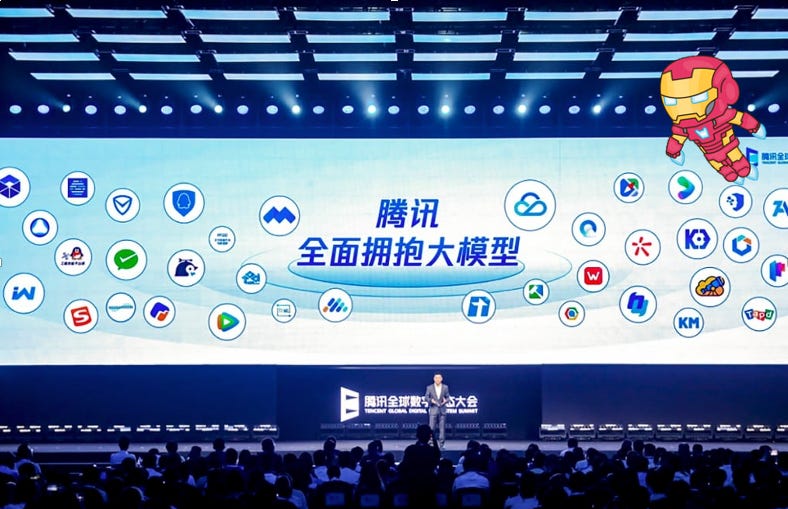
You know how Tony Stark sacrifices himself at the end of Avengers: Endgame, saves the universe, and seals his legacy? He is one of Marvel’s resident geniuses: eccentric, obsessively futuristic, forever building new technology because he believes he can save the world.
Okay, today’s protagonist is not Tony Stark, and I am not suggesting he is sacrificing himself for Tencent. But on a recent LatePost (晚点) podcast, the reporter who has covered Tencent for years described Yao Shunyu as surprisingly commercially minded and fluent in corporate politics for someone so young. He is apparently willing to offend when needed and put the target on his own back if that is what Tencent’s LLM effort requires. Maybe he is more noble and willing to sacrifice himself than others are giving him credit for. So, the Iron Man arc is not entirely fanciful.
And then there is his name. We first mentioned Yao Shunyu 姚顺雨 in January, through his comments on the bottlenecks to AI diffusion. He is not to be confused with Google DeepMind’s Shunyu Yao; Tencent’s Yao is the not-yet-30-year-old now leading its LLM effort.
And his name is frankly kind of badass. 姚顺雨 (which means last name Yao, smooth riding/ success, rain) is a homophone of 尧舜禹 — Yao, Shun, and Yu — three legendary rulers from early Chinese mythology (like Chinese Homer's Odyssey). Yao represents virtue and diligence, Shun filial piety and moral character, and Yu leadership and courage. I do not know who his parents are, but boy did they know how to pick a name.
The struggle
Okay, back to Tencent.
Gaming, number one. Cloud, respectable, top four. WeChat, hands down, is the most omnipresent, ubiquitous super-app ever made. Strong ecosystem, low-key management, little public scrutiny or scandals, and usually happy flying under the radar. Seriously, Tencent has an almost absurdly strong collection of businesses and is positioned to be a market darling.
But that is also why its AI position in 2024 and 2025 was more embarrassing, because investors and users had high expectations. ByteDance led consumer chatbot MAU with Doubao. Alibaba’s Qwen was driving Chinese open-source models to international recognition. Independent labs were fighting for SOTA. Tencent had no convincing consumer product, integrated DeepSeek into WeChat, and was kinda picked at. Hunyuan supposedly been around, but within the industry it was becoming associated with older researchers whom Chinese netizens dismissed as 老登 — laodeng: once derogatory northern slang for a sleazy middle-aged man, now shorthand for older men seen as conservative, complacent and hopelessly out of date. Soz kinda rough.
Hunyuan was close to an industry punchline. Tencent’s awkward Yuanbao standalone app asked people to download another app to use what was, charitably, a tier-three model at that time. Though it feels like it isn’t doing that great, it is technically one of the top three Chinese chatbots by active user numbers, but it trails far behind ByteDance’s Doubao and DeepSeek.
There was a period when even the internal product teams did not want to use HY, but that has changed recently. Hunyuan 3 Preview completely shifted that narrative. It began posting better numbers. Benchmarks improved, and the whispers changed from “it’s over” to “wait, what just happened?” I would not call it frontier leadership.
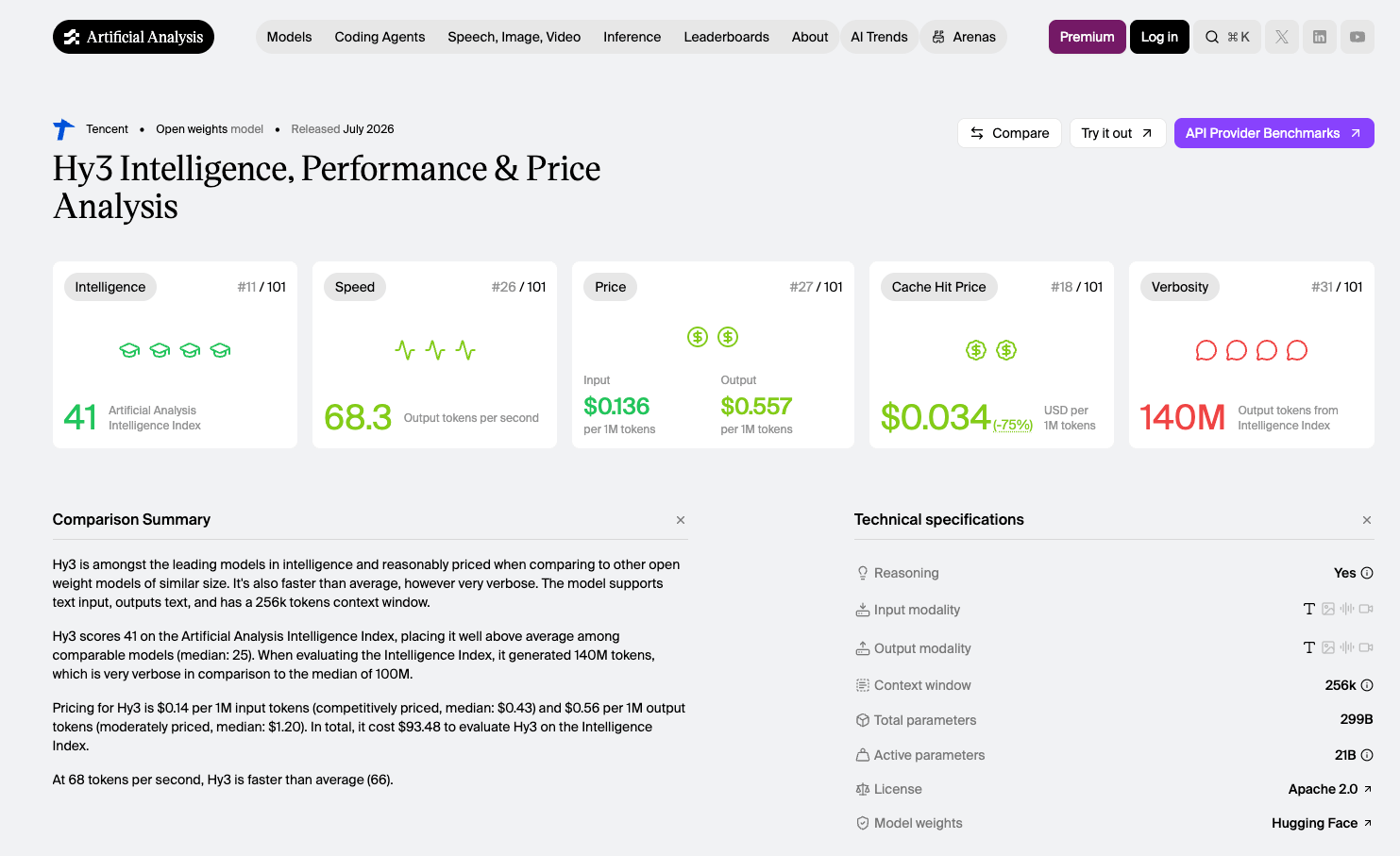
But HY3 has really shifted that sentiment. The strong early performance of Tencent’s latest Hunyuan model, Hy3, has also reinforced the company’s confidence in expanding WorkBuddy internationally. Within one week of launch, Hy3 ranked No. 1 globally on OpenRouter’s LLM usage leaderboard and recorded more than 68 times as many API calls as its predecessor, Hy2. This has all bolstered internal confidence, especially in Hy3’s adoption in the star workplace agent, Workbuddy (which we’ll go into further detail in Part 2). As stated on its own website, “Hunyuan 3 (Hunyuan 3.0) is Tencent Hunyuan’s most powerful open-source model. It is a 295B-parameter MoE architecture with 21B active parameters and 256K context window. Rebuilt from scratch in 90 days by the Hy team, built for real products like Yuanbao. “
And according to the independent evaluation platform Artificial Analysis, the latest HY3 is truly catching up, though not at the frontier, its cost per task is highly efficient. Propelling Tencent back into tier-one-ish.
It’s not just for optics or benchmark performance. It is said that Yao has since pushed the model team to work more closely with products such as Yuanbao and has reiterated the importance of rebuilding trust with internal stakeholders. It is deeply believed that a model in his eyes will only become strategically more useful when your own product teams are willing to bet on it.
The young hire expected to sink instead changed the current
Yao was born in 1997. In one sense, he arrived on a pedestal, recruited to symbolize a new generation of AI-native talent. He had all the gold stars on his resume: Princeton, OpenAI, sea turtle. At the same times, somepeople said expectations were also kinda low. He had spent only around a year at OpenAI, and Tencent is a fortress. Many assumed someone so young, seemingly green, perhaps academic, without the ‘sleeze"‘ or sophistication to navigate the bureaucracy and politics of a behemoth like Tencent. Some may have even low-key expected the expensive star hire not to deliver.
But leadership was firm on this necessary change, and at the time, he was their only hope. Tencent itself was unusually blunt about the generational change. In its earnings materials, it wrote: “HY: Completely rebuilt foundation model team with LLM-native researchers and engineers over the last 6 months; new team is young, energetic, and cohesive.” That is the company saying, with unusual directness: yes, we replaced the old guard.
During his PhD at Princeton, Yao co-authored ReAct and Tree of Thoughts, then worked on Operator and Deep Research at OpenAI.
Rumors have it that he was shopping around and spoke to quite a few labs in China before his return. Largely due to personal reasons, he just wanted to move back to China (likely for family reasons)
Ultimately, he joined Tencent in November 2025, and by July 2026, according to the reporting and internal descriptions, his remit covered core model R&D and had expanded from LLMs and AI infrastructure into multimodal models too.
As Chief AI Scientist in the CEO/President's Office, he reports directly to Martin Lau, but as the leader of the LLM team, he reports to Lu Shan, who is the head of TEG. As mentioned, TEG is the original R&D team. As he’s proven himself over the last year, he has been given more responsibilities. Beyond the LLM team and AI Infrastructure team, he’s now been appointed to oversee the multimodal team as well, which was previously under a different reporting line. So now he oversees the key ‘group-level’ models essentially (WeChat has its own model team; we’ll go into it in Part 2) and reports directly to Lu Shan.
Yao has Martin’s ear, figuratively and physically. His team is mainly in Shenzhen, but he is officially based in Hong Kong, with the corporate executives in its Admiralty office. It is not an unusual choice for top scientists and executives, though, for these big tech companies, given the tax advantages in Hong Kong.
Despite being the MVP, he is notably low-key. A Tencent source described him as 很低调 — very understated. He is no prima donna, nor does he have what Chinese people call 偶像包袱—the burden of being a celebrity. (em-dashes typed up by Grace)
A few personal anecdotes and tidbits do show that he really is chill. He plays basketball with researchers, a way to destress and be really part of the team. This was shared by the reporter on LatePost’s podcast. There is also a very Beijing-coded internal joke that people talk about. At one sharing session, Yao apparently opened by saying, “I’m not very familiar with Chaoyang. I’m usually in Haidian.”
For anyone who knows Beijing, it could be a low-key diss or just his genuineness coming out. Haidian is where academics and researchers congregate; it’s where the likes of Peking University, Tsinghua University, and the Beijing Institute of Technology are. It is also where the ancient ruins of Yuanmingyuan are, and where the emperor’s summer palace is.
Chaoyang, on the other hand, is where the MNCs, banks, SOEs, and anyone who’s close to money sit. (ps lowkey, there is also the financial district on the west side, but it’s literally just rows of Soviet-style buildings that house large SOEs and banks). The parks are modern and attached to strip malls. The stereotype is that if you say you live in Haidian, people assume you’re a scholar; if you say you live in Chaoyang, it usually means you’re in business.
Anyway, people around him describe him as down-to-earth and straightforward, but with high EQ, which really does tie it back to him outperforming in corporate politics more than many expected. His own team is consciously flat and meritocratic; according to some employees, and he even encourages competent interns to lead team visions.
The Chinese phrase I was given was that he changed the team’s 风气 — literally its “wind,” but really its ethos, energy, and invisible standard for how people behave. He reinvigorated the team, whether actively by sidelining Laodengs and hiring new blood, or by just bringing that hunger back. You can’t deny that he has helped restore the urgency and ambition of a model organization that had begun to look like a relic of Tencent’s previous era.
You can tell he is not really active on X (except for some recent recruiting tweets), does not work through PR, and feels strongly that the products and models should speak for themselves. Unlike many other star researchers, he does not want to become a public figure or become marketing itself. But his preppy looks and calm demeanor in his limited public sightings have led to some organic public interest (some for his capabilities, others for his delicate features).
But his only meaningful public-facing appearance as a Tencent employee was a June conversation with Dowson Tong. The head of CSIG, a man with some legacy in Tencent as well, an executive who joined Tencent from Oracle over a decade ago, oversees its cloud businesses.
Why he chose Tencent
As mentioned, Yao’s June conversation with Dowson is quite precious because it is the only time he has publicly explained why he chose Tencent. The following is translated from the supplied Chinese transcript; I have paraphrased for clarity and reserved quotation marks for language close to the original.
His first reason was that Tencent has “many good problems and many products.” As models improve, the question becomes where pre-training and post-training create real value. Products answer that. Agents also need an environment in which to act: without a food-delivery tool, an agent cannot order food; without access to the right systems, many tasks remain impossible regardless of how intelligent the model looks.
The deeper asset is context. Models are getting better at turning complex inputs into outputs, so the competitive barrier increasingly lies in possessing the original input: knowing what a person is doing or understanding the layers of information inside an enterprise. Tencent, with its products and ecosystems, has an obvious advantage.
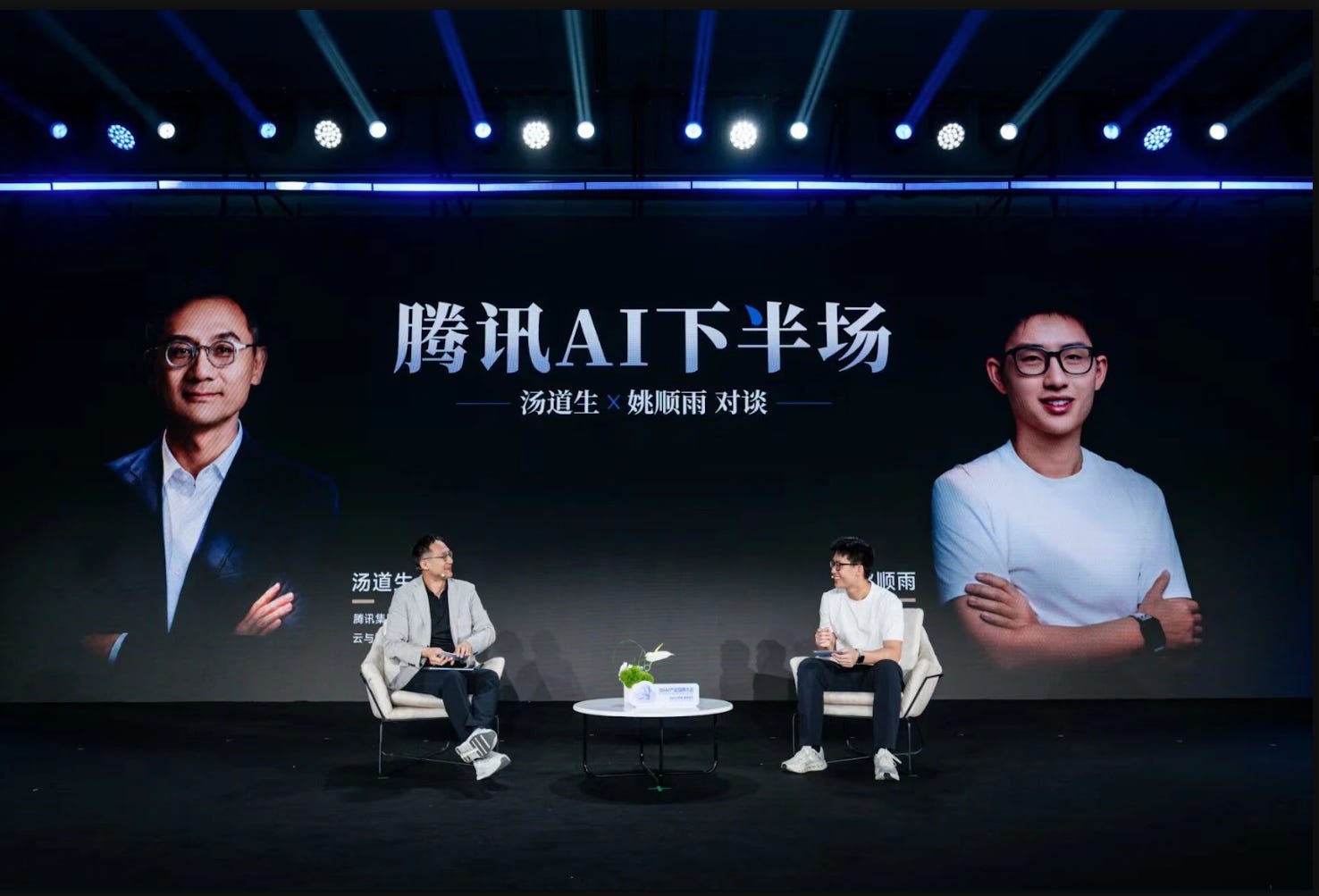
But Yao said that was only the second-biggest reason. The most important was culture. His first impression from conversations with Dowson and Tencent’s executive office was that people were unusually honest about what the company did well and badly. They were direct and did not try to cover things up.
He described Tencent as a company that runs on “trust rather than metrics,” with a low-ego, solid, and long-term culture. All seem to align with his personal mission and values. His ambition for AI’s “second half” is not simply to ship one model or viral product, but to build a durable AGI-oriented organization in China around a balanced triangle: a solid technical foundation, products that create real value, and frontier exploration of new research paradigms. His view was that China still does too little of the third.
This complicates the easy story that Yao joined Tencent simply for its data and distribution, or other claims that it was because he was offered the most here. Context mattered. Products mattered. But in his own account, the deciding factor was that Tencent could admit where it was weak and give him room to build.
As we wrote, before Yao arrived, Tencent’s own product teams had already delivered a fairly brutal verdict on Hunyuan: they often did not want to use it, and product teams often preferred outside models. There is no point in collecting feedback if the institution’s first instinct is to protect the model team from embarrassment or to force products to use an inferior model simply because it was built in-house.
Yao, in many ways, appreciated that the management team could reckon with its oversight and face its challenges head-on. His June comments challenged whether a big lab can “be real.” Can the organization admit that the model is not good enough? Can it listen when product teams say so? Can it change course without spending months defending the original decision? And once the model improves, can it rebuild enough trust for those same teams to try it again?
Tencent had already taken plenty of detours, or you could say, deliberated a late start. Yao’s argument was not that detours could be eliminated. The first time an organization attempts something genuinely new, the path is almost guaranteed to be winding. The more important question is whether it can face the evidence, absorb feedback, and remain patient enough to improve.
That is also where his emphasis on products and context becomes more than a philosophical observation.
A model by itself can be intelligent and still be unable to do very much. As Yao put it, an agent cannot order food if it has no food-delivery tool. It cannot complete work inside an enterprise if it cannot reach the systems where that work happens. Intelligence matters, but so does the environment in which intelligence is allowed to act.
Then there is context. As models become better at converting complicated inputs into useful outputs, the scarce asset increasingly becomes the input itself: knowing what a person is trying to accomplish, what an enterprise has done before, where the relevant information sits, and how a task moves through the organization.
Tencent has plenty of those raw ingredients. It has communications, payments, cloud infrastructure, games, documents, browsers, enterprise software, and an enormous collection of consumer and business products. But having the ingredients is not the same thing as turning them into a meal. Historically, many of those businesses sat inside their own organizational hilltops, each guarding its own product, data, users, and priorities.
Turning context into a feedback loop
I spent 90 minutes devouring LatePost’s recent podcast on Yao. LatePost’s reporting argues that he played an important role in pushing Tencent all-in on agents.
Separately, one Tencent insider told me that during a management meeting in the second half of 2025, Pony Ma said the company should pay more attention to coding and agents, and that was clearly prioritized in Hy3. Yao’s proposal was to build a group-level reinforcement-learning infrastructure through which different business units could train models on a shared platform, while feeding the lessons generated by real products and real tasks back into Hunyuan.
“Reinforcement-learning infrastructure” can sound abstract, so let me try to put it more simply.
Instead of every Tencent business building its own isolated AI system, imagine giving them a common training ground. CodeBuddy learns from coding tasks. WorkBuddy learns from office work. Yuanbao learns from consumer interactions. Other business units bring their own specialized problems. Each product can still serve a different user, but the underlying system gives Tencent a way to turn those experiences into better post-training, evaluations, and model behavior.
The flywheel, at least in theory, is straightforward:
Better products generate more real tasks and feedback.
That feedback improves the models.
Better models make the products more useful.
More useful products generate more usage, context, and feedback.
This is why Yao’s decision to join Tencent and his push into agents are really the same story. He did not choose Tencent because it already had the best foundation model. Plainly, it did not. He chose it because it possessed an unusually large collection of products, tools, and contexts that could become strategically valuable if someone could make the pieces talk to one another.
“From that point on, throughout the entire company, you could hear discussions about agents and reinforcement learning everywhere,” the Tencent insider told me.
When OpenClaw went viral in March, Tencent’s business units came out in force with agents of their own. We wrote about the company embracing OpenClaw so aggressively that it offered free installation help outside its Shenzhen office in Lobsters Everywhere: Tencent Did It. We also spoke with Shuyu Zhang, QClaw’s product lead, about QClaw going global.
Almost every agent initially belonged to a different business. CodeBuddy came from CSIG for developers before its team built WorkBuddy for white-collar workers. MIORA is a creative product from the CodeBuddy team — think Claude Design. Marvis came from the PCG, and the team was the same team that had previously worked on building the Android app store for Tencent games and software.
From outside, it looked as though Tencent had suddenly discovered a coordinated agent strategy. Inside, it was much more characteristically Tencent: many teams experimenting from the bottom up, often without a clean central blueprint.
What changed was not that Yao suddenly owned every product. He did not. It was that Tencent was beginning to construct a shared technical and organizational layer beneath them. Yao may not control the entire chessboard, but he had gained the ability to influence how many of its pieces learned.
That is the potentially important shift. Tencent’s old horse races produced separate winners and losers. Yao’s feedback-loop proposal offered the possibility that even the losing experiments could teach the common model something.
A caveat, though: “caught up” is still doing a lot of work here.
Maybe the murkiness is the strategy
The cultural backdrop matters. A few years ago, people joked that although Alibaba and Tencent employees still worked 996, much of the hustle had become theatre and couldn't compare to ByteDance. Much of it was managing up to show you’ve done the work, rather than actually shipping new innovation. That, as harsh as it sounds, has some truth to it until the AI revamp.
More recently, younger talent and open mockery of the 老登 (pronounced ‘lao dengs’, derogatory term for older staff who keep holding on to how things were done or refusing to embrace change) generation have pushed teams to reinvent themselves. RED posts describe flatter titles inside TEG and CSIG: less hierarchy, faster decisions, and less fear of offending the wrong person. Again, you cannot just manage up and call it a day. For context, TEG is the Technology Engineering Group that is responsible for the company’s R&D and AI infra. CSIG stands for Cloud and Smart Industries Group, which is responsible for promoting the company’s cloud business and related internet strategy and solutions built on top of it.
The thing is, even reading through public filings and speaking to employees and investors, I still have so many questions about Tencent’s AI strategy, and it doesn't look like anyone can answer them all. Maybe James Mitchell can join the pod and walk us through it all ;p. But overall, the company is known to like a bit of that ‘unclear’ness, as in their eyes it fosters more organic creativity and innovation instead of top-down driven directions at peers like Alibaba or ByteDance.
Tencent has long been associated with 山头主义: every hilltop or business unit fights for itself. It is bottom-up, autonomous, and fond of horse races. Apart from Allen Zhang, who runs WeChat as a distinctly opinionated leader, business-group leaders generally do not impose the same degree of personal will. A team builds something. If it sticks, it earns resources. If it fails, too bad, next. Much of the products we see coming out of Tencent are all bottom-up. Remember QClaw? It was built up by a few product marketing people; see the interview below. An investor put it bluntly to me too: ' How much is it anyway? Tencent is rich enough for a few trials and errors.’
Tencent's QClaw goes global, aims to serve the average consumer user, with PM Shuyu Zhang

Amid Anthropic’s success with coding products, many AI labs and companies have also tried to lean into that vertical. OpenAI has stepped back from courting consumers and shut down its video model division, Sora. Alibaba, meanwhile, has more recently begun releasing closed-weight proprietary models and is reportedly pushing the Qwen team to find clearer …
That is not always a weakness. In a new field, even Pony Ma may struggle to declare that Team A will definitely beat Team B and therefore Team B should die. Tencent gives several teams a budget and traffic, then compares the numbers and reactions from users. Five teams worked on Honor of Kings; Chengdu won, not Shenzhen headquarters. When Tencent Meeting was being developed, WeCom argued that its enterprise experience made it the obvious owner. Its product did not win either. WeChat, the most famous of them all, remains in Guangzhou, though only an hour away from HQ in Shenzhen.
But the lack of clarity can sometimes get further muddled in the whole lost-in-translation thing, as global investors are already frustrated by limited access to the executive vision of Chinese big tech. Yet they must keep a pulse on it, since launches can have global implications. As we try, we can only do our best to explain Tencent’s AI strategy here. Meanwhile, Chinese tech leaders remain wary of too much spotlight as geopolitical risks run deep. Meanwhile, American executives are everywhere, like literally podcasts, conferences, Twitter op-eds, you name it. So the imbalance of understanding is not only because of a lack of curiosity from the US side, but also a shortage of strong direct communication from Chinese tech firms
So to understand Chinese big tech, we sometimes need to take snippets from interviews, gossip through the vines, and read the org chart like tea leaves. And today’s post is really an attempt to string together various sources and analysis about Yao Shunyu and his vision = indirectly, the executives’ vision of how to build out AI within Tencent.
A not-yet-30-year-old returns from OpenAI, consolidates model R&D, pushes a group-level RL platform, and rebuilds trust between Hunyuan and Tencent’s products. Agents sprout across several business groups. WorkBuddy starts as a proof of concept on CodeBuddy’s infrastructure, gets approved by the executive office, is suddenly handed integrations and resources, and takes over the market share. WeChat, meanwhile, runs its own model on its own compute behind its own guardrails and is blessed and cursed at the same time to safeguard what makes it the top consumer product—its superior user experience.
Pony, Martin, James, if you’re reading this, this is the big nod to your genius. Let a hundred agents bloom and see which survives. In a market moving this quickly, a clean org chart can maybe become a liability.
Either way, what we can confidently say is that Yao Shunyu is a major reason Tencent is back in the AI conversation, and getting to know him, his story, and his vision is probably a lens into the future of Tencent’s AI strategy. Now, WorkBuddy might be evidence that something inside the company has changed in how it thinks about AI products. Is WorkBuddy here to save HK.700, or is Yao here to save it?
Stay tuned for part 2, our deep dive into the products, and a special zoom-in to WorkBuddy.
Thanks for these kinds of deep profiles. As you said, with info this scattered, it's hard to piece together otherwise. Really good piece.
the OpenRouter number is the one that stands out to me, number one on the usage leaderboard within a week and 68x Hy2's call volume is a real signal, not just a benchmark bump. we've been tracking DeepSeek's playbook all year, public price cuts and huge daily token throughput as the loudest way a Chinese lab announces it's caught up. Tencent doing it quietly through an internal reorg and a 90-day rebuild is a different route to the same place. curious whether WorkBuddy's product pull ends up mattering more for Hunyuan's trajectory than the benchmark story does.