

Hi all, a late update on this trend, as I was trying to watch where this frenzy would take us. Over the last two weeks, we saw Tencent installing OpenClaw for users outside its office, Alibaba rolling out JVS Claw, and Baidu launching DuClaw just days later. For long-term readers, you would know that I flip-flop from why is Tencent still kinda sh*te at AI to wow smart 2C move every few months. With this lobster craze, it’s my turn to be in awe of Tencent’s strategy again.
The hard part is not shipping the wrapper and owning the channel where people will actually use it. Which brings us back to Tencent’s one and only WeChat touch point and how they’ve ‘won’ again.
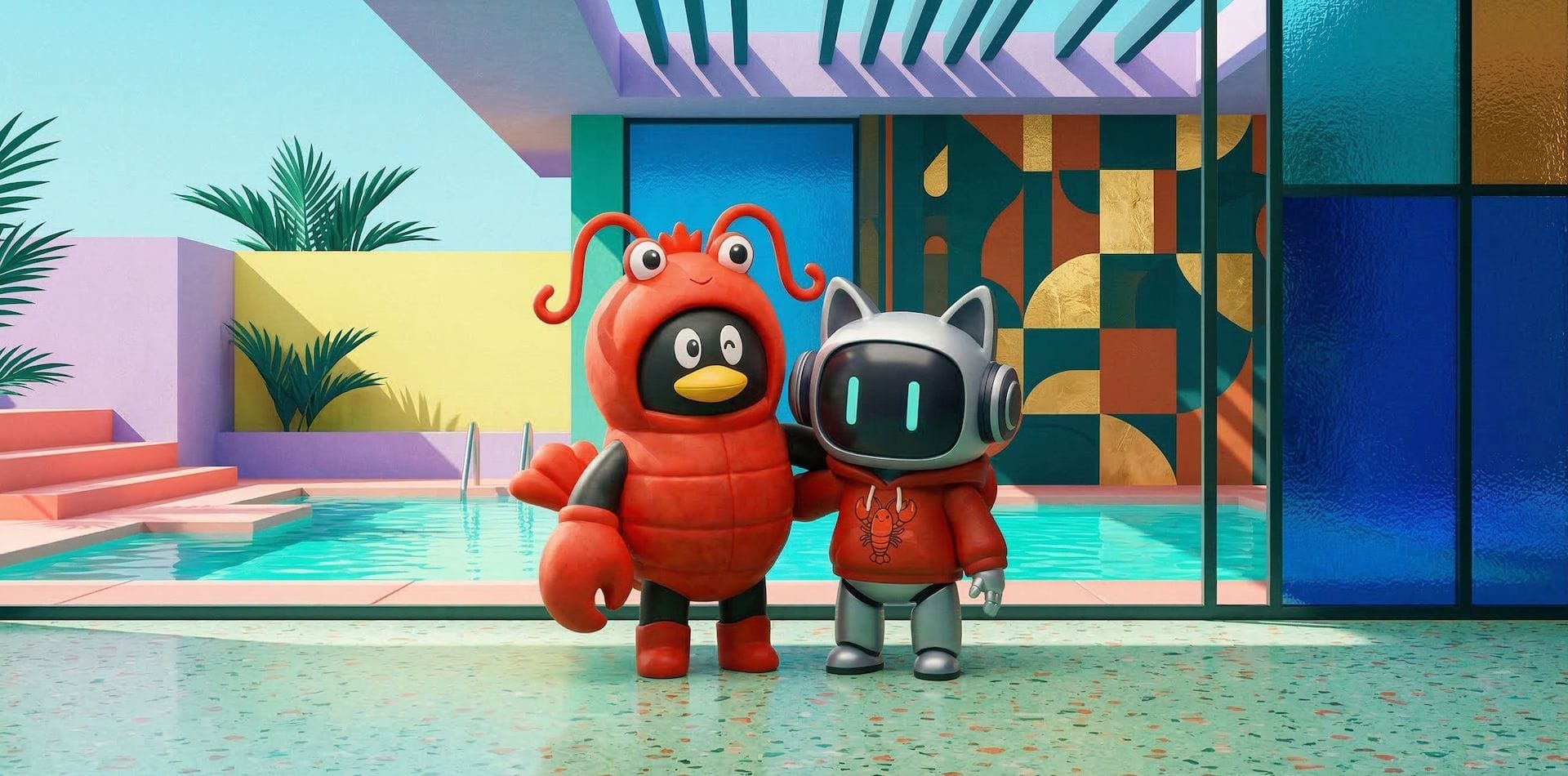
“Raising lobsters”
For the last two weeks, it felt like all of China was talking about 养龙虾 — “raising lobsters.” tphuang joked on X that OpenClaw’s marketing basically wrote itself because Chinese people already love (spicy) crayfish and the nickname did half the work. Reuters and CNA both captured the same surreal scene in Shenzhen: long lines outside Tencent’s setup event, with not just developers but also retirees and children showing up.
In my own circles, group chats and WeChat moments were full of install screenshots, side-hustle fantasies, and people asking whether this was the next internet gold rush. Lobsters were everywhere. My own mother called to ask if people were suddenly importing seafood as a sexy business, and that’s when you really know a technology story has escaped the tech bubble.


As Nicholas Gordon wrote in his latest article on Fortune, the craze has transformed China’s AI sector, pushing it to the mainstream. “If you’re in China, you can now pay someone to come help install OpenClaw on your device…and you can pay them to uninstall it too.” It was a serious hustle.
Now, despite headlines about the Wuxi government embracing OpenClaw and whatnot, I don’t think the original spread was top-down driven. With some official nods, it looked like a green light for enterprises to embrace it until federal regulators stepped in to warn of potential data risks.
But just as Kevin Xu wrote in his awesome long post about China’s Open Source history, “The government played a minimal role for much of open source’s history in China.” This time, the initiative felt organic again.
Headlines focused on the quick adoption, warm embrace, and municipal government endorsements, but they missed why a company like Tencent would lead in this open-source technology adoption and why. Today, let’s examine how it took off and why Tencent was quick to embrace someone else’s open source technology, again.
How did it take off in China?
Well, a large reason is the timing. DeepSeek did more than prove China could produce a strong model cheaply. It changed the public’s mental model of where cutting-edge AI could come from. It pushed low-cost, open-source models to the center of the conversation and made it much easier for users and developers to accept that the best capability might come from outside the biggest incumbent stack. Then came months of demos and products, with tech firms themselves teaching the public that AI was not just supposed to answer questions anymore. It was supposed to search, plan, use tools, and do work. Moonshot Kimi-Researcher is a good example of that shift: not a chatbot, but an autonomous system built for multi-step planning, reasoning, and tool use.
The other part is distribution. China is an unusually fertile ground for this kind of product because so much digital life is already compressed into a handful of interfaces. People are used to living in chat, paying in chat, ordering in chat, and moving across lightweight in-app services without thinking twice. And superapps as an infrastructure continue to play a critical role in the diffusion of AI in the 2C space in China.
And I wrote that this was the obvious next step…
Back in October 2025, when OpenAI rolled out its Apps SDK, I wrote in OpenAI Is Becoming an Operating System that the closest product blueprint was not an app store or a browser extension. It was WeChat mini programs. At a meeting with executives from the company in December, I did ask whether WeChat would roll out a native agentic function, and a nod and a smile were all I got.
ChatGPT made the ‘chatbox’ the home screen, but only as an entry point. Lightweight services sit underneath. Payments, identity, search, notifications, and distribution are already there. In that framework, the prize was never just a smarter chatbot. The prize was owning the surface where a user says what they want, and the system can actually get it done. The more you think about it, the more it looks like the WeChat interface with its millions of MiniPrograms that users can call on.
That is why the recent reporting about Tencent building a native WeChat agent does not feel surprising to me, even calling it “top secret” by The Information seems a bit dramatic. Now, what WeChat is doing is playing its own game better than everyone else.
If the teaser and summary are directionally correct, Tencent wants an AI agent that lives natively within WeChat and can call mini programs directly. That is much bigger than adding another AI tab. It means trying to turn WeChat from a place where AI answers questions into a place where AI completes tasks. And because WeChat already has roughly 1.4 billion users and a dense built-in service layer, Tencent does not need to teach consumers a new habit. It can slide the agent into an interface that people already open all day.
Tencent has now made the same strategic move twice
Remember when Tencent’s DeepSeek integration was a big deal at the time, but in some ways it was also an admission? Hunyuan was not leading the market, so Tencent stopped pretending that model loyalty mattered more than user experience. It integrated DeepSeek into Yuanbao and then into WeChat. I wrote in AI Integration at the Speed of Light that this mattered because WeChat’s reach, search behavior, closed content graph, and mini-program layer made distribution far more important than model purity once strong outside intelligence became available.
It is now borrowing OpenClaw-style agent momentum to move from answers toward action. The bet underlying both moves is still the same: if the user already lives inside WeChat and WeChat already contains the payment rail, the service layer, and the mini-program ecosystem, then Tencent does not need to win the model beauty contest. It needs to own the place where AI turns intent into action.

OpenClaw feels like the same instinct, caution and action again, but this time applied to agents.
I think we can intepret it has an out of neccessity move again. Tencent probably did not arrive here from a position of strength. It had spent heavily on AI infrastructure, talent but still was not setting the pace in consumer AI, largely lagging behind ByteDance and Alibaba’s efforts in LLM development as well as user courtship. This time, OpenClaw gave Tencent something brute-force capex could not: a way to change the terms of competition without first winning the model race.
And leveraging on someone else’s technology, Tencent was able to come out on top again.
What Tencent actually launched
OpenClaw is powerful because it gives large models hands and feet — the ability to become agentic. It can take over a computer’s keyboard and mouse and actually do things in the background. But its weakness is just as obvious: deployment and reach is painful.
For ordinary office workers, setting up environments and dealing with command lines is enough to kill adoption before the fun even starts (a true pain point even for myself). And Tencent saw that immediately, so it did not roll out one giant catch-all product. It split the market.
Lighthouse is the developer on-ramp. Tencent Cloud positioned it as a one-click OpenClaw deployment in the cloud, with stable online operation and control through QQ and WeCom. This is the easiest layer to understand economically. Tencent is selling the picks and shovels.
QClaw is the consumer-facing wrapper. It takes a messy open-source agent and turns it into something a normal person can install locally. Tencent’s own write-up describes it as a local AI assistant built on OpenClaw that can be controlled through WeChat conversation and used to remotely run tasks on your home computer. That is a very Tencent form of productization. It does not ask the user to learn a new interface. It turns WeChat into the remote control.
WorkBuddy is the office-facing version. It is a desktop AI agent for workplace tasks, locally installable, compatible with OpenClaw skills, and capable of automating tasks such as information retrieval, report generation, and content drafting. The more important point is that Tencent is not just wrapping OpenClaw and calling it a day. It is using OpenClaw to speed up adoption while building a more Tencent-native workflow layer around it.
Another subtle move is that Tencent pushed agent capabilities into its enterprise-facing WeCom workflows. Tencent is wiring the agent into the communication and workflow surfaces people already use. It is trying to make the agent truley mold into habit.
WeChat is still the real asset
The heart of the story for me is still an ecosystem story.
The real value here is not that Tencent wrapped a hot open-source project like everybody else. The real value is that WeChat already has what everyone else is still trying to assemble: trust, traffic, payments, search, merchants, mini programs (activity loops), and habit. And on top of that, another reminder that it has over 1.4 billion combined MAU, and products like Mini Programs, Weixin Search, and Weixin Pay all living inside the same surface - connected.
Lovable’s Head of Growth Elena Verna’s framing in her recent 20VC interview stated that software is increasingly competing on trust, and not just features. In her own blog, she pushes it one step further: once basic utility is there, products start competing on connection. That is exactly WeChat’s advantage over all the other clawbot-like products that got churned out this week. WeChat already has that connection with users. It has mindshare. It has functional adjacency. People already chat, search, pay, order, and move across services there.
And I think Tencent’s caution has been part of its success strategy too. WeChat has always been slow to push out major features until the product feels ready enough for a very broad user base. That can make Tencent look late, but it also means WeChat does everything it can to protect its trust from users. That matters much more in an agent world, where the product is not just answering a question but potentially touching payments, bookings, messages, documents, and other sensitive flows. This last point is an inference based on WeChat’s product history and the services already embedded in the app, rather than a direct quote from Tencent.
So now, if Tencent can connect a reliable enough agent to mini programs, then it has a direct path from ask to done that most AI apps still do not. A user would not just ask for restaurant suggestions or travel tips. The system could, in theory, book the ride, order the groceries, reserve the restaurant, route the payment, and handle the follow-up inside an environment where those services already exist. That is a very different proposition from just being another strong chatbot. Tencent does not need to convince users to go somewhere new. The whole advantage is that the user is already there. The WeChat layer in many ways become the real (deliberate or not) strategy.
Not all agentic activities are the same
I know I’m going on a little bit of a tangent but Alibaba’s push with Qwen obviously irked Tencent too and probably nudged them to go this direction quicker. However not all commerce is equally agent-friendly and not all agentic activity is the same.
Utility commerce is easy: groceries, socks, repeat purchases, bill pay, and simple travel changes. Discretionary spending is harder. Jewelry, fashion, gifts, and beauty are not just search problems; they are expressions of taste. Agents may win convenience first, long before they replace choice.
To me, the point is simple: Tencent is not trying to win AI by owning the best model or the best open-source agent. It is betting that WeChat’s distribution and service graph are still the scarcest asset in China's consumer AI.
And I think this first wave of craze may taper a bit in a few weeks. However, the ones that do stick around will evolve their habits, and we’ll see durable everyday behavior change.
That is another reason Tencent’s position made me realize it may have a stronger chance to win over user-habit. WeChat does not need to own all commerce for this strategy to work. It already has direct paths to MiniPrograms. It only needs to own the high-frequency, low-consideration flows where agents are most useful first: local services, repeat purchases, booking tasks, payments, and routine transactions. That wedge alone is already enormous.
Some of the demand is obviously real. OpenClaw can help with reports, coding, spreadsheets, slide decks, and repetitive desktop tasks. But how much of that is actually needed by the uncles and aunties who lined up to get it installed on their devices? Probably not much. There is also a lot of curiosity, status signaling, and plain FOMO mixed in. In the mentioned CNA report, it found that some users mostly installed it to understand the hype and did not even have a specific task in mind.
The hardest question is not adoption. It is trust.
How do we explain the others jumping on the bandwagon? Well, FOMO. Once OpenClaw became culturally hot, everyone wanted a consumer-friendly wrapper hence Alibaba and Baidu’s launches of their own versions of OpenClaw.
But that is exactly why Tencent’s position is different. Alibaba has commerce rails. Baidu has search and cloud. Tencent really, has WeChat. If the game shifts from “best standalone AI app” to “best place for AI to actually get things done,” Tencent is playing a different game from the others.
The pushback I take most seriously is this: if Tencent keeps outsourcing the hardest layer — first to DeepSeek at the model level and now to OpenClaw-style products that still rely on outside model quality for execution, what exactly is the moat? Why would users stay with Tencent instead of going directly to the best model provider?
My current thinking is that users will stay only if Tencent owns the experience of completion. Most 2C users do not care whose model sits underneath. They care whether the thing works, whether it feels safe, and whether it finishes the task inside apps they already trust.
If Tencent can make the agent feel native to WeChat, connect it to mini programs, keep permissions sane, and smooth over the rough edges of outside models, then yes, users may absolutely stay. But if Tencent ends up as little more than a glossy traffic distributor for other people’s intelligence, then it risks owning reach without owning the actual relationship.
And then there is a second trust problem, which may matter even more. There is a big difference between an AI that gives a bad answer and an AI that sends a message, moves money, books the wrong ticket, or mishandles sensitive data. The more these agents touch real services and real data, the more the permissions layer becomes the product. So in this contracdiction, Tencent has the most to gain and the most to lose. Ultimately, it cannot afford to break trust inside WeChat.
The monetization story is already visible
If you look at Tencent’s potential monetization of this all.
The first layer is straightforward. Lighthouse drives cloud usage. WorkBuddy can become paid workplace software. WeCom integrations create room for governance, admin controls, security wrappers, and workflow automation. Tencent is already monetizing the infrastructure and workflow layer around agents.
The bigger monetization story sits on top of WeChat’s service graph. In my mini-program piece, I argued that Tencent historically monetized the ecosystem less like a classic app store tax and more through ads, payments, and deeper integration across WeChat surfaces. If Tencent puts an agent on top of that service graph, the leverage increases: discovery, merchant routing, transaction flow, developer tools, and eventually the default place where commercial intent is expressed within WeChat. That is a much bigger business than charging a monthly fee for an assistant.
Once LLMs are commodities and their cost collapses, monetization has to focus on the end result. People will follow the brand they trust because the functionality may be commoditized. And who has better brand value/ recognition than the penguin company?
If this thinking holds, standalone AI apps will get squeezed first. If users can ask for something in WeChat and get it done there, the cost of switching to a separate AI destination increases. Mini-program developers may also lose some direct relationship with the end user. Today, users still know which app or mini program they are calling but in an agent world, the agent becomes the front door, and the merchant becomes the backend service. That changes discovery, brand loyalty, and pricing power but it also gives Tencent more leverage over routing, ranking, and eventually monetization.
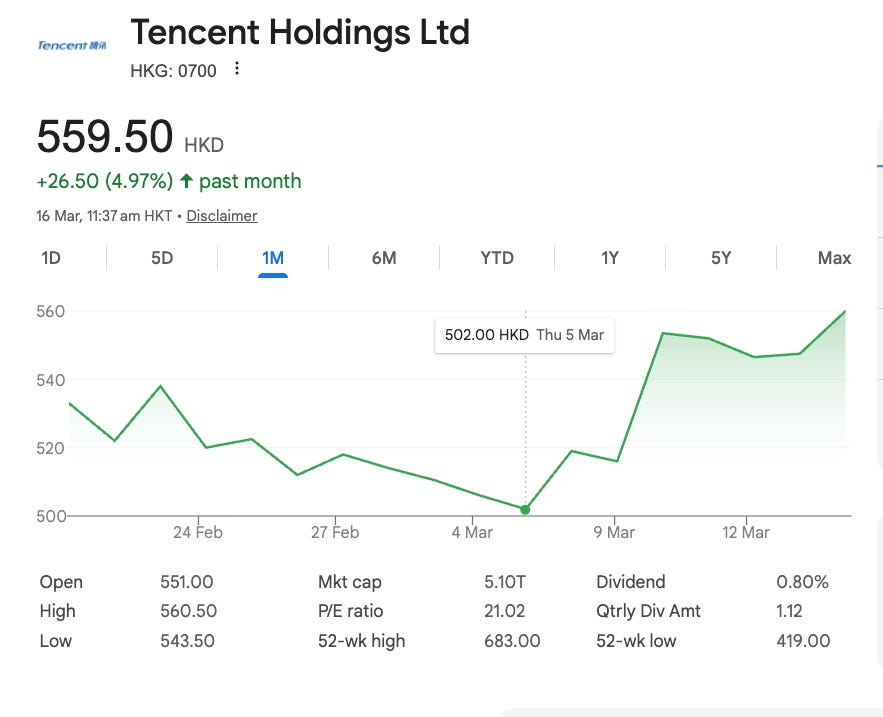
Looking at 0700 HK’s performance, it looks like investors may see the same story as I do. Or who knows, maybe they’re just punting some OpenClaw /China AI exposure.
FYI, And just a day before I pubbed, as expected, Tencent Cloud became an offical sponsor to the OpenClaw Community.
Hi Grace, Thank you for giving us a taste of the OpenClaw lobster bisque, of which TenCent (the penguin company) is clothed (or productized) by its ground-breaking agentic OpenClaw. I suppose that the current TRUST driver (being enjoyed by WeChat users) is shaping the consumers’ mindshare. However, I believe that whoever managed to be the DEFAULT point of entry will grab the lion’s share of the ROI resulting from the autonomous COMPLETION of jobs needed to fulfill the 2C communities’ routine and discretionary transactional requests. I also think that TenCent’s existing MOAT will be very difficult to defend, because any ingrained behaviors can be eventually converted and/or retrained, especially when a better-operated WeChat competitor comes along. Moreover, the risk of government intervention will always be there to promote competition and protect any unexpected data leak security issues. Within a year or two, it is plausible that TenCent’s delicious gourmet “open lobster claw” may be no match for those SUPER-AGENTS that are clothed (or productized) in a “multi-course French Cuisine” at a price you just cannot resist. In a nutshell, the possibilities of having the old mindshare and common behaviors re-trained and re-wired are inevitable in the AI world.