


Hi all,
I am so delighted to welcome Ella (EZ) to Substack and introduce you to her work. Ella is a good friend based out in the Bay Area. My husband and I always go and mooch off of her kitchen yumz/ she takes us to the best eats when we’re in town.
Ella is a former partner and investor at Sequoia’s hedge fund, focusing her time on all things China, physical AI, and software, among other things. She recently started writing to crystallize and share her thoughts on her favorite topics, as she spends time with her newborn humans.
This is an extremely information-rich and timely piece. Chinese robotics manufacturer Unitree Robotics made its blockbuster public stock market debut just yesterday on Shanghai's tech-focused STAR Market.
Somewhere in Beijing right now, a robot is running a convenience store with no human staff. Though it is still not very good at its job, there is obvious excitement around it. We believe you should give this primer a read to truly understand where the progress is and where the noise is.
I hope you find this piece as insightful and interesting as I found it.
Bodies are Cheap, Data is Not: A Mid-2026 Primer on Humanoids
The year robots stopped being a demo?
For over a decade, robotics ran as a demo economy. Every few months, a new video: a backflip, a parkour run, a robot folding a towel at the speed of continental drift. We clapped, we shared, nobody bought anything. This year, the question flipped. Investors stopped asking “can it backflip?” and started asking “can it work a shift?”
The numbers say the shift is real. Roughly 15,000 humanoids shipped globally in 2025 – about 80% of them from Chinese firms – and Morgan Stanley now expects China’s unit sales alone to quadruple to ~50,000 in 2026, a forecast it has already raised twice this year (14,000 -> 28,000 -> 50,000 in five months). Elon Musk promises a few thousand Optimus G3 units in 2026, tens of thousands in 2027, hundreds of thousands in 2028. And the capital has noticed: global robotics funding hit ~$14B in 2025, up from $8B in 2024 and past even the 2021 peak (all figures in USD).
Have we finally arrived at the golden age? Not quite.
The promise of this generation is generalizability over programmability: a robot that can execute a range of tasks it was never explicitly trained on. We are nowhere near that. Today’s shipments split roughly into two products: the cool accessory and the less efficient industrial robot. To be fair, the field has basically cracked locomotion – today’s humanoids walk, balance, even dunk. But generalized manipulation, or dexterously handling the endless variety of real objects in real places, remains a wall. And at the center of that wall sits one thing: data.
This primer digs into the three debates that will decide who gets over the wall – data, model architecture, and hardware – and tries to cut through the ever-evolving terminology, the buzzwords, and the hype.

The data problem, and its direction of travel
This brings me first to the most important topic – data. Every model or hardware debate is downstream of one brutal fact: there is no internet of robot actions. The web gave LLMs trillions of free tokens, but the most useful robot data starts from nearly zero.
The robotic data pyramid is a helpful framework: the quality of data is inversely proportional to its quantity – see below a chart I stole from Tanay Jaipuria. The cheapest, most abundant data sits at the base; the scarcest, highest-quality data sits at the apex. The very bottom layer is data that already exists: web-scale video, most of it shot from the wrong viewpoint with no hands clearly visible. Cheap, abundant, mostly ineffective. One rung up sits egocentric (or “ego”) data: made-to-order human data captured with head-mounted GoPros or other headsets, at near base-layer economics. Then simulation data belongs around this zipcode too (though I’d argue it should sit below ego data) – it can be generated in unlimited quantities via compute, but it pays a “reality tax”: simulated physics and pixels never quite match the real world, producing the sim-to-real gap. Above that, off-embodiment demonstrations: real world trajectories produced on similar, but not identical, hardware – basically from other robots. And at the apex, teleop data collected on the deployment robot itself – frequently used to bridge the “last mile” of dexterity, but with terrible economics that don’t scale.
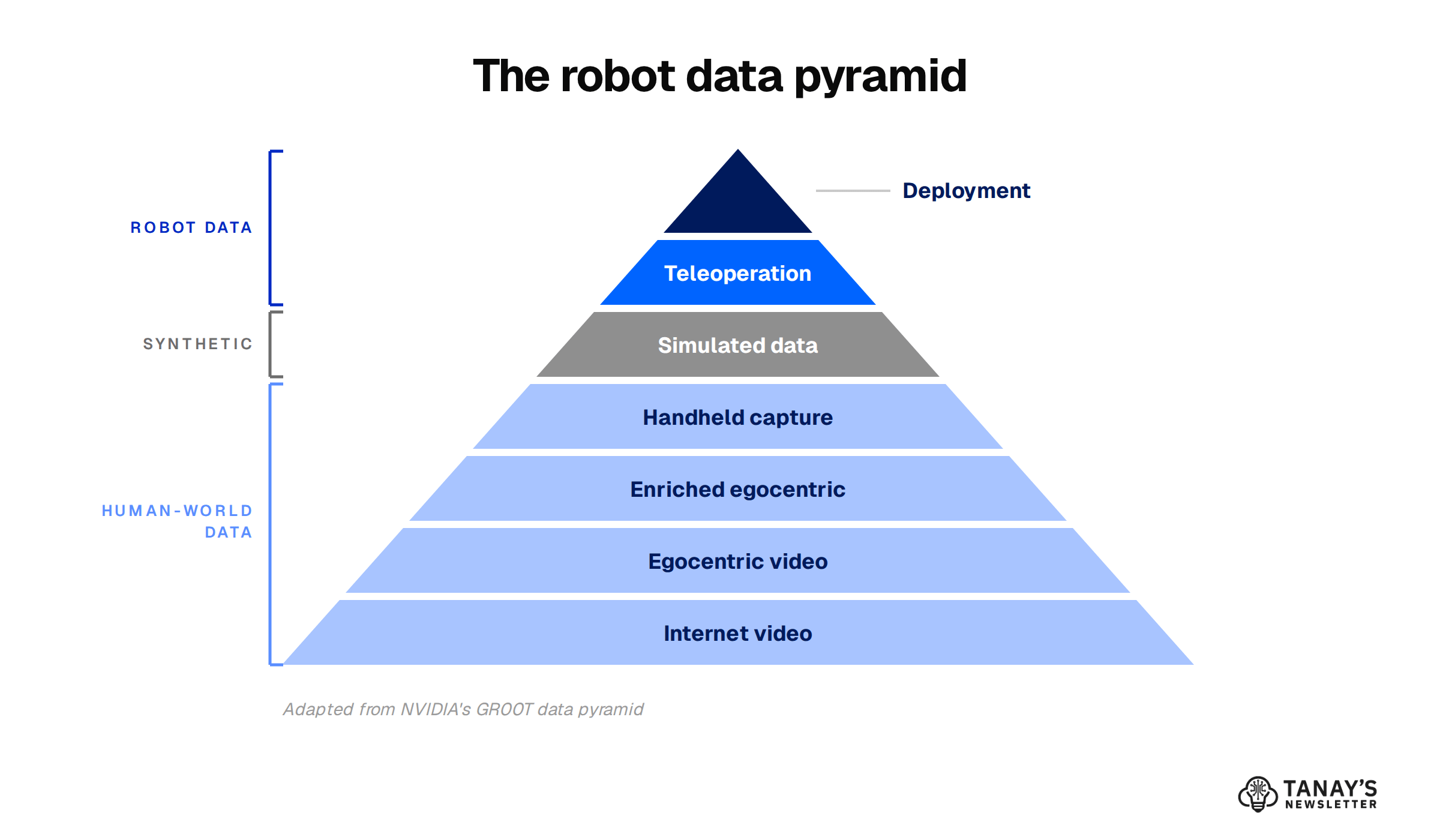
You might notice that I distinguished data by embodiment, that is, by what body produced it. This matters because the embodiment gap – the mismatch between the body that generated the data and the body that must execute the policy – is another dimension that dictates data effectiveness. The human-to-robot gap is a base-of-pyramid problem. A human hand has five fingers, ~27 degrees of freedom (“DoF”), tendon-driven dynamics, and a tactile skin; a robot can have anything from a two-finger gripper to a five-finger hand with completely different joint limits, strength, and reach. For human-generated data (web video and ego data), the mapping to the robot’s actuators is simply undefined: there are no action labels, and the viewpoints differ (e.g mostly third party). Then there’s the robot-to-robot gap (cross-embodiment): even between robots, data doesn’t transfer freely. A trajectory collected on a Franka arm doesn’t natively run on a UR5, let alone a humanoid or a robot dog – different joints, camera placements, gripper geometries, and even control frequencies.
Diving more into each data type:
Simulation – the locomotion pre-training backbone. A model that focuses on locomotion starts here. The goal is to create a digital twin of the real world where a specific robot learns movements at massive scale, and the data those simulators generate goes into pre-training. Players like Nvidia (Isaac Sim / Omniverse) have effectively converted robotics’ data shortage into a compute problem - synthetic data is cheap and parallelizable. It also works for the most part: teams at CMU and Stanford reportedly showed in 2026 that VLAs trained on 40% synthetic data matched 100%-real policies on held-out tasks. The sim-to-real gap, or robots discovering their joints don’t behave quite like in the simulator, is narrowing for locomotion as rendering and physics improve (locomotion capability is solved; locomotion reliability – uptime, falls, mean-time-between-failure over a shift – is engineering grind, not research), but it remains a serious problem for manipulation.
Egocentric videos – another pre-training corpus. If simulation manufactures pre-training data synthetically, egocentric human video theoretically harvests it from the one embodiment that already operates at internet scale: us. The bet is that passive first-person video of humans doing things is the closest thing robotics has to the “internet of tokens” that LLMs got for free. At Sequoia’s AI Ascent 2026 event in May, Nvidia’s Jim Fan (who runs the company’s embodied AI research) presented Nvidia’s EgoScale framework. EgoScale pre-trained a model on ~21k hours of in-the-wild egocentric human video with zero robot data, then anchored it to the robot with only ~50 hours of aligned mocap and teleop – under 0.1% of the total data mix. The trick that makes “zero robot data” possible is turning passive footage into something trainable: human hand motion is retargeted into the robot’s joint space, so the video yields action labels the robot can actually learn from. The headline result is impressive: scaling from 1,000 to 20,000 hours of human video more than doubled average task-completion rates, the first credible scaling law for robot dexterity that doesn’t require robots. The catch is that “internet scale” oversells how free this really is. A low-fidelity corpus of in-the-wild footage does exist, but the high-value videos - clean, hands in frame, minimized camera jitters - require instrumented capture (head-worn glasses / VR set) as well as cleansing and curation (including using UMI grippers to improve hand joint capture). Scaling it further means first getting and paying humans to wear that hardware and perform tasks, which is being collected by companies like Build.ai and Human Archive. Unlike FSD, where the driving happens anyway and the sensors are bolted to a car you were going to drive regardless, egocentric manipulation capture is a dedicated “collection job” and requires a carefully designed data pipeline. It captures great scene diversity (all kinds of factory and home scenarios), but it generates a larger embodiment gap given the human-to-robot crossing.
Teleoperation – from pre-training to fine-tuning and verification. Teleop produces gold-standard demonstrations: a human moves a replica arm, a VR controller, or a space mouse; the motion maps onto the robot’s joints and end-effectors; and the robot executes the action. Quality is high, but the economics and scaling are tough – like ego data, you pay humans by the hour for one trajectory at a time, except here you also need expensive hardware and skilled operators, and scene diversity is harder to come by (the rig doesn’t leave the lab). Early systems bootstrapped entire models this way (ALOHA, RT-1 in 2022), when models were so data-deprived that any high-quality input moved the needle, and some gold-standard models, like the π family, are still trained almost entirely on teleop. But teleop is too expensive to carry pre-training forever, so if the LLM parallels hold, its role shifts downstream. The first downstream job is fine-tuning: a curated teleop set layered on top of, say, an ego-pretrained model to sharpen specific tasks (though not to generalize). The second is correction: a human-in-the-loop, intervention-based approach (HG-DAgger) where the robot drives, the human grabs the controls at failure points, and the corrections feed back into training – this is what 1X’s remote operators are doing in people’s homes, and what teleop-assisted commercial deployments do in warehouses. Interventions scale better than raw demos, but they’re still gated on human supervision, task by task, so true scaling remains elusive. The third and newest job is verification: the robotics cousin of RLVR. Decompose a task into stages, train a small reward model to score progress through them from video, and you get an automated judge that can grade any trajectory – flagging which demos are actually good, which rollouts actually succeeded, and which simulated behaviors actually transfer. The early evidence says grading matters as much as collecting: one recent result from SARM took π0’s success on T-shirt folding from 8% to 83% using the identical 200-hour teleop dataset, just reweighted by a learned progress model. And that is the whole game for robotic data: not just how you collect it, but how you curate it and verify efficiently, reliably, and in the real world that your model is actually correct.
Tesla’s variant - “robot in the field.” Tesla attacks the same gap from the opposite end: put a good enough robot on the real assembly line and let it learn from errors, self-verifying task by task until it accumulates enough high-quality data. Being good enough requires a lot of data upfront to get up and running, so Tesla needs just as much data initially as everyone else. In theory this is the ultimate verifiable-reward loop - reality is the data generator (the FSD approach). The open question is TAM: it works where Tesla controls the environment (its own facilities), but generalizing to home care, precision manufacturing, and other high-variance settings is far harder.
Nearly every notable effort on the data side today centers around shrinking the gap-crossing costs from a lower rung of the pyramid to a higher one, towards your robot. For example, EgoScale’s retargeting pipeline attacks the human-to-robot crossing in software, converting passive ego video into robot-executable action labels. Wearables attack the same crossing in hardware: UMI-style grippers and exoskeletons like DexUMI force the human to move as if they were the robot, bridging the embodiment gap at collection time rather than bridging it afterward. Seen this way, the data pyramid is the map and the embodiment gap is the terrain, and the companies that do well will engineer the cheapest route from base to apex.
Robotic performance will continue to improve across the board as researchers find ways to feed data-hungry models. Just because everyone is improving does not mean everyone will get to the promised land. Pre-training data has genuinely come a long way, but to land the last mile of a task (particularly manipulation), you still need task-specific, embodiment specific, and often long-tail real-world RL data delivered with careful curation. Before anyone figures out robotic RL data scaling, it is too early to declare winners.
The model wars: VLA / WAM / world models
For the past few years since the “GPT moment”, VLA (Vision-Language-Action) had been the dominant model architecture that enabled the present humanoid wave. The recipe: take a pre-trained vision-language model (one that already knows what a coffee mug is and what “put it in the dishwasher” means, from internet-scale data), and bolt on an action head (usually a diffusion or flow-matching decoder), then train the whole thing end-to-end to map camera images plus a language instruction straight to motor commands. This lineage runs from Google’s RT-1 / RT-2 to Physical Intelligence’s π0, which layered a flow-matching architecture on top of a pre-trained VLM to inherit internet-scale semantic knowledge.
Nearly everyone ships a VLA today. The π family, Nvidia’s GR00T N-series models (dual-system, a vision-language module reads the scene, a diffusion-transformer module generates motor commands), Google’s Gemini Robotics models, Figure’s Helix (an 80M param “system 1” transformer for control plus a slower “system 2” for reasoning). Even Boston Dynamics runs a similar mechanic in what it calls the “large behavior model”, as far as I can tell.
The insurgency this year is World Action Models (WAM). Jim Fan presented his AI Ascend 2026 talk with the headline “VLAs are dead, long live World Action Models.“. His argument: swap the language-model backbone for a video world model, making vision and action first-class citizens instead of a bolt on. The intuition is genuinely compelling. Language is a lossy bottleneck for physics. “Pick up the dough” (yes I’ve been baking) doesn’t tell you how the dough drapes, whether there’s water or flour on the counter, or whether the bowl tips over. A model trained to predict the next seconds of video, by contrast, has to learn contact, deformation, friction, and dynamics – it can’t get the pixels right otherwise (good analysis on this from RoboCloud Hub’s Robotics End Game).
Exciting as it is, I don’t fully agree with the statement that “VLAs are dead”. The way I’d frame it is: VLA-the-product-architecture is alive and shipping; VLA-the-pretraining-philosophy is dying. VLA as a pretraining philosophy is a bet about where the knowledge comes from: internet text and images, not physics. This was great when semantic knowledge was the scarce ingredient, and physics could be picked up during fine-tuning on robot demonstrations. Language was the load-bearing substrate. As we discussed above, this bet appears to be a failing one given how challenging it has been to pick up the physics (“real-to-sim-to-real”). Pretraining on video prediction, which changes the data, not the architecture, is swapping the load-bearing backbone – this forces the model to internalize physical dynamics just to get the next frames right. VLA as the product architecture hasn’t changed – still a system that takes in language instructions + camera images, and outputs motor commands. Even the historically VLA shops agree by their actions: GR00T N1.6 moved to a Cosmos world-model-derived backbone, and recent academic work keeps grafting video-prediction objectives onto VLA action heads. If there’s interest, I’ll dive into JEPA in a follow-up, along with the broader attempts to combine autoregression / LLMs (high intelligence ceiling, coherent over long-horizon logic) and diffusion (speed and parallelism). But I also don’t think this is the most important debate in robotics right now (spoiler: it’s still data).
Hardware reality check
Hardware is commoditizing fast. When I visited the Zhejiang manufacturing hub in February 2025, the manufacturers jostling to get into the Tesla / Figure supply chain were all talking about qualification: “can we make this component”, “which samples are we sending in” and “ our Japanese and European competitors don’t have a defensible moat”. You could feel the commoditization already underway – four or five suppliers were chasing the same harmonic reducer or roller screw. Back then, the all-in cost of an Optimus-like humanoid ran $50-60k on low volume (a few thousand units), with line of sight to under $20k at 10x the volume. The caveat, then as now: the hand is the biggest cost item, and that number assumes a relatively simple design. More on this below.
A year later, Unitree is shipping its G1 humanoid for $18k and its Go2 Pro robotic dog for $4k (post tariffs) on Amazon, and the on-the-ground conversation has moved from “can we make it” to “whose capacity and costs are better”. It’s a brutal space for Chinese suppliers – many are building 100k-1M robot-equivalent capacity before large orders are confirmed or placed, betting that scale wins tier-1 status and market share. Sanhua’s Suzhou plant (500k units, live 2026) is sized for Optimus’s entire initial ramp on its own. Leaderdrive has scaled from 330k reducers (2022) to 800k+ (2026) and is raising money for another 1M. Suppliers are also trying to win modules over individual components (actuator assembly, joint modules, hand modules) and sell the integration as a cost advantage. I will skip the component-by-component tour, but it suffices to say no one is particularly worried about either hardware capability or cost anymore. The hands are an exception, but that’s also partly a design problem.
None of this should surprise anyone who has watched Tesla’s car supply chain evolve. It starts with a sole-source launch partner (Panasonic in 2011, for battery cells and packs). As volume ramps and Tesla legitimizes the component with a fast-expanding TAM, it introduces second and third sources (or even design-outs) and plays suppliers against each other (LG Energy, CATL in 2020, then BYD). Over time the field commoditizes: pack prices fell more than 90%, from ~$1,500 / kWh in 2010 to ~$100 / kWh in 2025, driven by scale, overcapacity, and Chinese competition. Needless to say, supplier margins collapsed. Same story with thermal components, autopilot compute etc. It wouldn’t take much for a pattern-recognizing investor to underwrite where humanoid hardware margins might land once Chinese competition matures: maybe single-digits or low-teens for assembly and commodity parts (bearings, encoders, cameras, motors) or mid-to-high-teens for the specialized stuff (harmonic and other reducers, batteries, coreless motors).
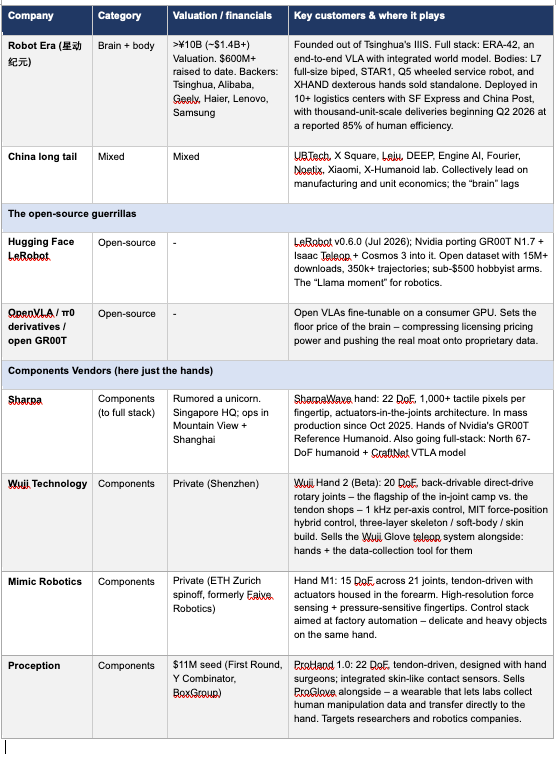
The cost exception, for now, is the hands – though even that is loosening. It has been genuinely hard to ship a hand that is simultaneously dexterous, durable, and cheap; you mostly get to pick two. Push for top-tier performance and the cost quickly explodes. One leading humanoid OEM (you probably have seen their ads) is currently shipping units where a single hand costs $100k+, against a robot selling for a fraction of that. This tracks with the gold standard research hand from Shadow at ~$110k, and Sharpa’s very impressive 20+ DoF design at ~$50k on low volumes. The core problem depends on which of two architectures you pick – the industry has split on where the motors live. Cable-driven hands (Tesla, 1X, Mimic, Proception, and the Shadow hand itself) house full-sized motors in the forearm and pull the fingers through tendons, just like humans: you get strength and slim, high-DoF fingers, but cables stretch and wear, and the springy transmission makes precise force control harder. Hands with actuators in the joints (Sharpa) invert the trade: control is precise and repeatable and there are no tendons to fray, but every degree of freedom now maps to a tiny motor-reducer-driver stack crammed into a finger or palm at precision levels that keep yields low and costs high. But this is already changing. LEAP (CMU, open-source) and Inspire (China) built capable 16-DoF hands in the motor-driven camp for a few thousand dollars. Hands are on the same commoditization curve as everything else, just a little behind because of the precision and density demanded.
Another challenge has been battery life. Most humanoids run only a handful of hours on current battery technology, requiring either auto-charging or hot-swap logistics built into any deployment. Still, I don’t expect this to become the bottleneck. Plenty of tasks can be done table-top or stationary with a plug-in, and those tasks hit the data wall long they hit the battery. Batteries do create real issues on factory floors, but keeps improving – likely faster than we can figure out the software (specifically, the data).
The players
Since this is a primer, I will try to be lighter on the technical details and heavier on the landscape. I’d be remiss not to include a landscape on the players vying for the biggest pieces of the pie.
The field has split into a few camps: the arms dealers, the brain sellers, the body builders, brain + body integrated, open-source, and components players. In a world where data sits at the center of the scaling wall, and the number of new players and new funding continues to go up and to the right, I’d place my bet on the arms dealers and the players building proprietary data flywheels.
Arms dealers get paid regardless of flag. With this many players and this much funding (~$14B into robotics in 2025 alone), and every camp racing down a different technical path, the only positions that pay out under every scenario are the ones selling inputs to all of them. Nvidia is running the most coherent strategy in the field – selling the compute (Jetson Thor), the simulation (Isaac / Omniverse), and the open models (GR00T) that nearly everyone else builds on. Its most revealing move is naming Unitree’s H2 Plus the reference body for its open GR00T humanoid platform: the American chip champion designating a Chinese robot as its standard hardware. Nvidia is taxed into the winner whether the winning body is built in Texas or Hangzhou, and whether the winning paradigm is VLA, world models, or something else not yet published (US-China geopolitics permitting). The picks-and-shovels layer is the only place in this market where you do not have to be right about the model architecture to be right about the investment – and it is really hard to call the architecture right now. Same argument for high-quality data vendors building the curation and reward-modeling layer like xDOF. For the lowest-variance exposure to humanoids, the arms dealer may be the better bet than any single body.
Traction is far rarer than valuation. Almost every name here has a demo reel and a mega-round; very few have verified, paid, multi-year commercial work. Agility is actually the frontrunner in the US – roughly $300M in booked revenue against about 1,000 Digit robots across nine customer sites (GXO, Schaeffler, Amazon, Toyota, Mercado Libre), which is why it can price a $2.5B public listing (CCXI SPAC) on fundamentals rather than narrative. Unitree is the other: a genuinely profitable, fast-growing, vertically integrated humanoid maker taking itself public, with 2025 revenue up 335%. Although at least today, Unitree is more in the “cool accessory” camp in its fast-growing DTC segment – more a Labubu than a helper. Against those two, most US body-builders remain pre-revenue at valuations an order of magnitude higher. On stage they hold all the advantages – but the sorting will happen on factory floors, not in keynote demos.
Open source sets the floor price of the brain. The quietest faction may end up setting everyone else’s prices. We may see this play out in foundation models as well. Hugging Face’s LeRobot – now backed by Nvidia, which is porting GR00T and its teleop stack into it – has put open, fine-tunable VLA models and sub-$500 arms within reach of anyone, the robotics equivalent of the Llama (or DeepSeek) moment. If a fine-tuned open model gets a customer to 80% of a licensed Gemini Robotics or Skild or Physical Intelligence model on their specific task, the brain-sellers’ pricing power will compress. Or it might play out like LLMs – a frontier model makes a leap, sets up months of premium pricing until open and fast-follower models catch up, then rinse and repeat. Either way, the eventual moat moves off the architecture and onto the proprietary data flywheel – the millions of real-world trajectories only a deployed fleet can generate (again, the robots have to be good enough to deploy first). I’d bet on players that can field a sizable fleet or a capture engine and dig a proprietary data moat before hardware completely commoditizes: Generalist if you believe in cross-embodiment, Agility in the factories, Dyna in its specific scenes (hotels / restaurants), RobotEra (China) in logistics warehouses (more in the appendix), and 1X at home. Don’t forget Tesla – its data is captive to its own factories, but controlled-environment data still compounds; factories are a big enough beachhead.
The demo economy is dying. The data economy has begun.
Focus time and capital on the picks-and-shovels players (high-quality data, compute, and players with potential data flywheel) rather than picking specific paradigm / architecture too early. Invest in the hardware layer discerningly and only if valuation supports the math.
Position accordingly. Don’t get caught in the momentum chase.
Meanwhile, that robot in Beijing is still on shift – not very good at its job yet, but learning from every order.
Grace: As mentioned previously, every once in a while I bring in a guest writer who will share a unique point of view or fill in an area where I do not have the domain expertise. This week, our special guest writer is Ella Zhang, former investor at Sequoia’s hedge fund. Check out her newly launched Substack at uncrowded!
Appendix
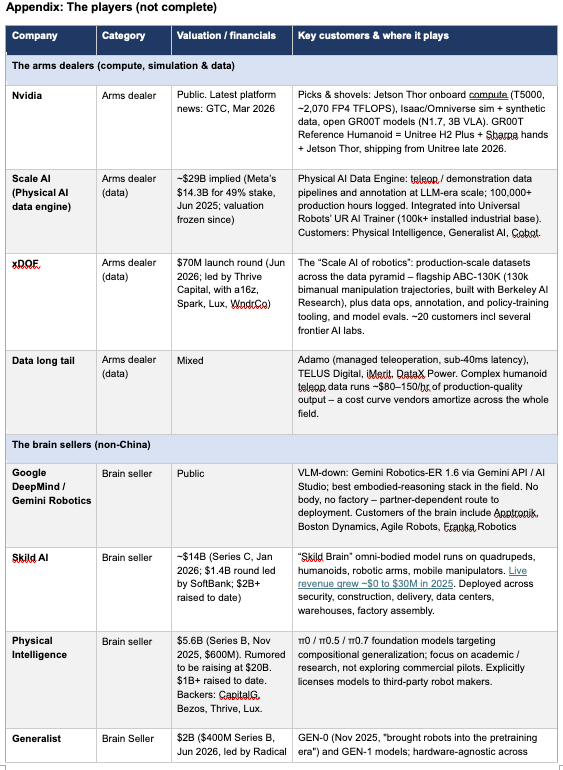
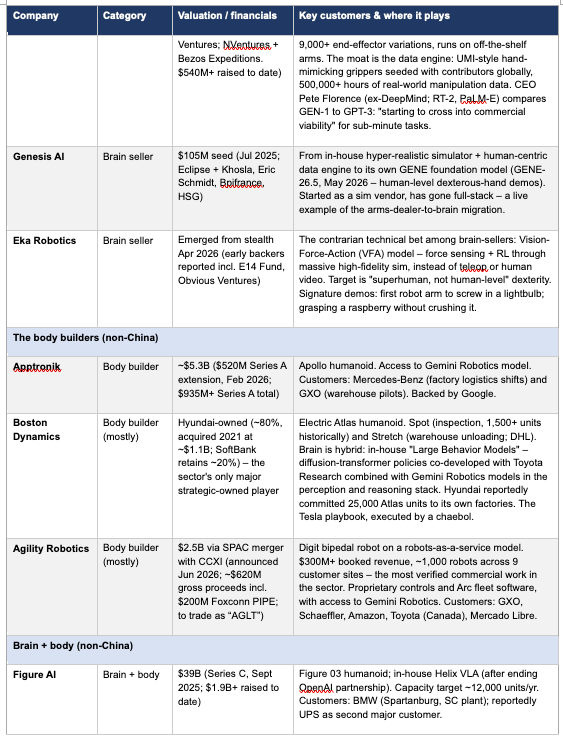
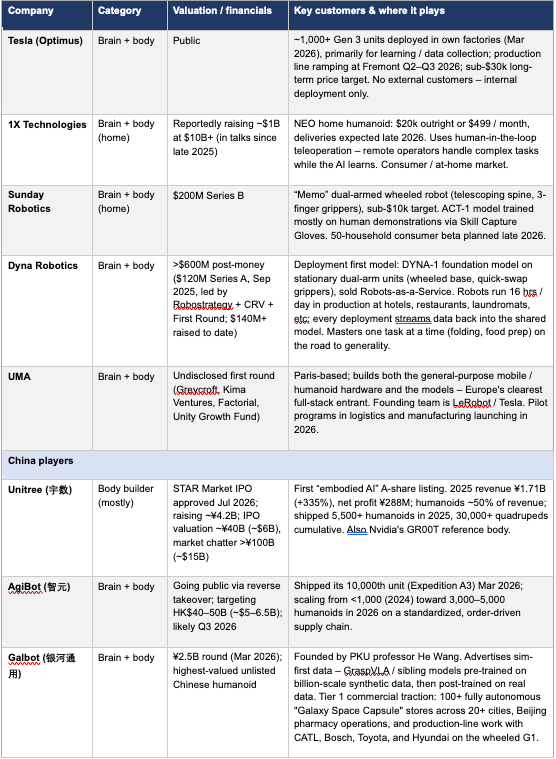
just wanna say that i really enjoyed reading some of your recent posts. great works!
Super helpful, thanks.