
AI Enhancing WeChat’s “Super App” Status
How WeChat Mini Programs and AI Redefine User Experience

Welcome back to AI Proem, and again with our regular guest contributor, Nico Finn. This time, we focus on a phenomenon that defines China’s mobile ecosystem: WeChat Mini Programs. [The draft was updated on Oct. 15 to reflect some updates]
If you’ve lived in China or worked with Chinese businesses, you’ve likely efficiently used them several times a day, ranging from ordering a coffee from Luckin (the Chinese version of Starbucks) to topping up your SIM card. If you haven’t heard of mini apps but want to find a good platform to deploy your AI-empowered services or content, then this is the article that you should read.
Tencent’s app, WeChat, is currently the only “super app” in China, with Alibaba’s AliPay perhaps being the only rival in certain functions. WeChat is not just a chat app like WhatsApp or Line. It not only encompasses Facebook’s multiple functions, but it is also widely used for functions that are core to Chinese daily life, essentially a Chinese version of posting photos, making payments, ride hailing, or even donating to charity, all in one.
And for context, WeChat has 1.34 billion monthly active users globally. Along with its ubiquitous e-wallet and jaw-dropping new functions, such as taxi hailing plug-in from DiDi, WeChat thrives on its mini programs—a core functionality of its digital ecosystem that strengthens WeChat’s number one “go to app” status in China.
What exactly are Mini Programs? Why are they so powerful? We’ll uncover what makes them tick and provide a practical guide for making sense of it all. We also discuss how this could relate to AI deployment in China, particularly in the context of customer service.
What Are WeChat Mini Programs? Apps within an app
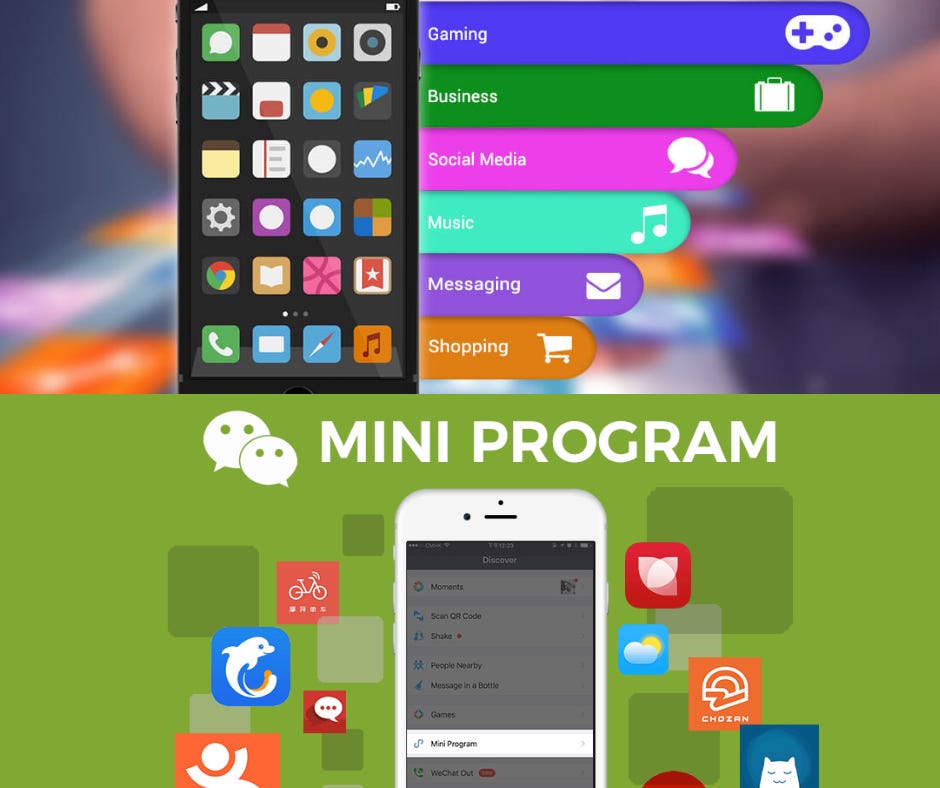
Forget about the idea of constantly adding and upgrading your Apps. Imagine this: no downloads, no installations, no storage space taken. You scan a QR code or simply do a keyword search within WeChat, and a fully functional, user-friendly page loads in seconds. Furthermore, you can leverage your social network and share these applications with your friends as you wish.
This is the WeChat mini program (微信小程序): It’s a lightweight application technology built by Tencent inside WeChat, its host platform. With over 1.2 billion monthly active users, it has completely reshaped how Chinese interact with the digital world. Mini programs were first created in 2017. The number of mini programs has grown very quickly, from 580,000 in 2017 to 4.3 million in 2023.
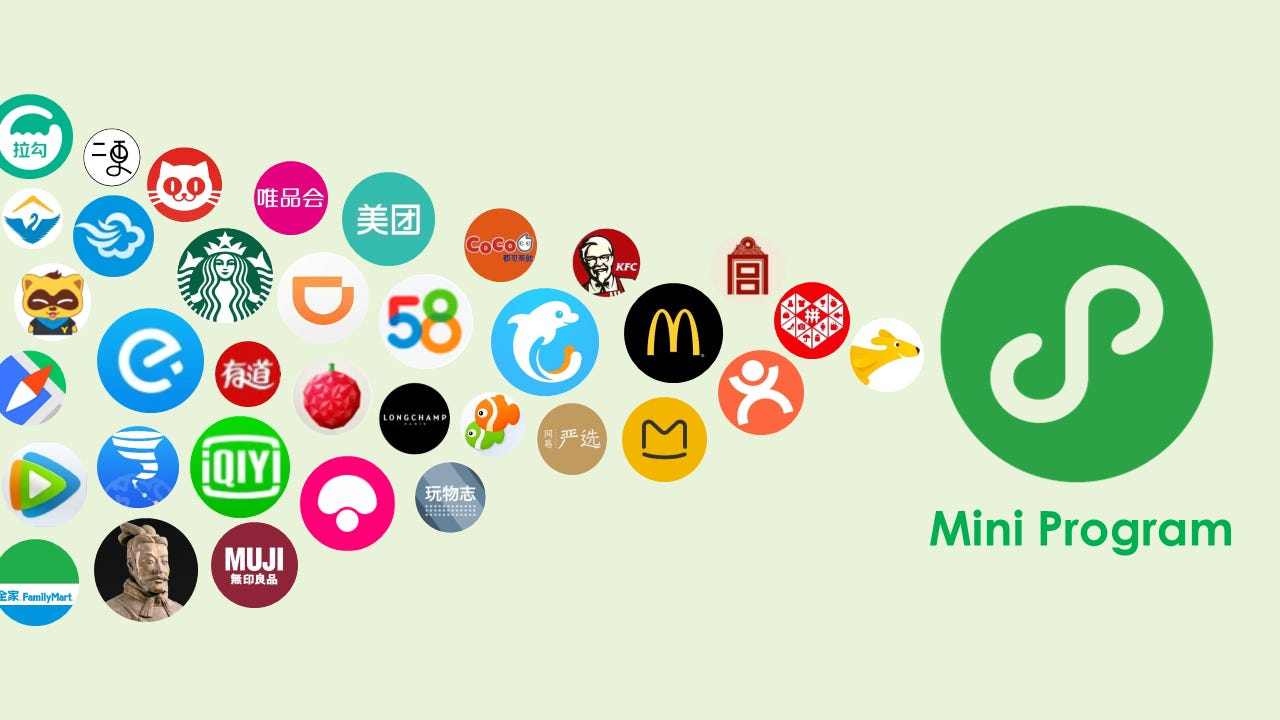
For users, its core appeal is ultimate convenience. Use it and leave it. Sharing is effortless, and integration with WeChat provides a seamless and secure (Tencent-moderated) experience.
For businesses, it is highly cost-effective. One codebase works on both iOS and Android. Customer acquisition is cheaper thanks to seamless access to WeChat’s social graph, search, and geo-location features. It also easily integrates critical functions like WeChat Pay, forming a perfect commercial closed loop.
From milk tea shops on street corners to giant e-commerce platforms like JD.com, mini programs have become an essential part of the digital infrastructure in daily life in China.
Who Are the Giants in the Mini Program World?
The technology itself is developed by Tencent, the creator and owner of WeChat. But who are the most important players thriving via the mini programs?
The answer isn’t a single name but a coalition of empires:
Internet giants: Like JD.com (occupying WeChat’s shopping sector), Pinduoduo (social e-commerce), Meituan (for within-the-day purchase and delivery services), Trips.com “(first Mini Program stock”). They use Mini Programs as extensions of their core businesses, capturing massive traffic and transactions.
Digitally transforming brands: Luckin Coffee and Heytea have perfectly blended offline ordering with online marketing through Mini Programs, redefining the consumer experience. All major brands, such as Nike and Uniqlo, also utilize Mini Programs for sales and membership management.
Tool and content kings: Like Tencent Docs and the viral photo book app Xiaoniangao, which dominate their specific verticals.
Government service platforms, including mini programs, are extremely successful also because many government agencies are now on them, which boast enormous user numbers and serve as key channels for China’s digital governance and daily transactions. Increasingly, city-level governments, official tourist sites, airports, and even some regions’ tax-filing services rely on mini programs on WeChat to deliver their social services.
Leveraging the social network of WeChat
WeChat mini programs are not just for the big players. They also create opportunities for SMEs and individuals (such as school students) to create their own projects. While living abroad, I did not have any immediate need to try the big players’ mini programs mentioned above. Instead, one day I received a friend’s invitation to take some fun personality tests, and this turned out to be how many of us got hooked into the ecosystem.
To take mini games and tests as a case study, these applications perfectly align with WeChat’s social nature and demonstrate how companies leverage the sharing feature as a key to expand business. Quizzes such as “Which character from Empresses in the Palace are you?” (one of the all-time favorite historical dramas in China) are light-hearted social currency for moments. Increasingly, there are also professional assessment-driven tests, developed by certified institutions, often paid for. They are used for professional career evaluations or mental health screenings (e.g., SCL-90 scale). These interactive mini apps can quickly capture the attention of the 1.3 billion daily active users on WeChat.
For smaller players, the key to their success is sharing. Test results act as personal badges, and users love sharing them to seek validation, spark conversations, or express identity. This viral mechanism drives incredibly low-cost traffic to mini programs.
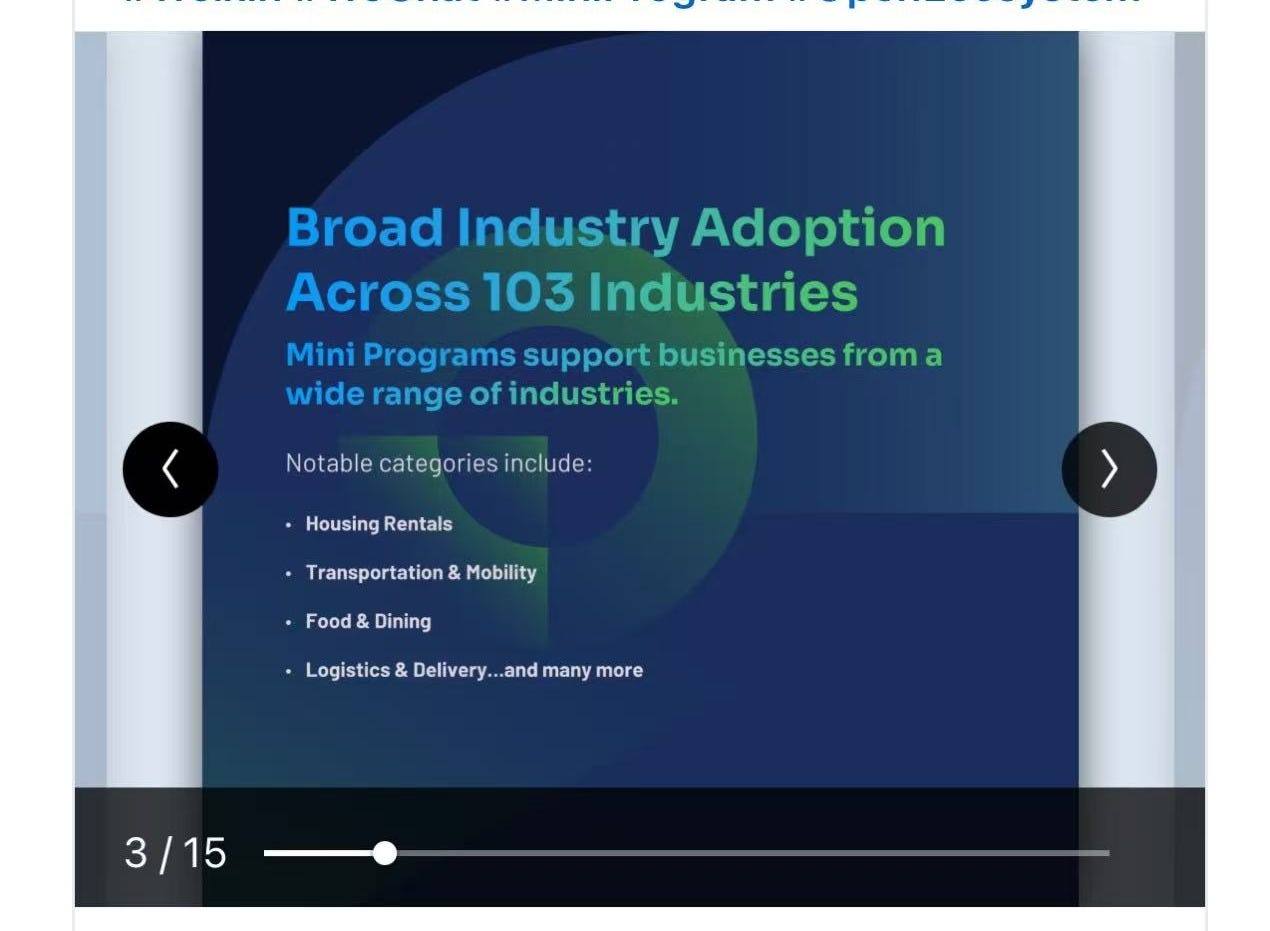
Mini programs have evolved from a feature into an ecosystem, an economy, and a lifestyle. Whether you’re a user, entrepreneur, or developer, the mini program universe is worth understanding. It’s not only a window into China’s digital society but also a blueprint that may define the future of mobile experience. And according to the company’s disclosure, mini programs are being used widely outside of China too, especially by businesses across housing rental, food and dining, transportation, logistics, and delivery services.
How WeChat Mini Programs and AI Redefine User Experience
WeChat mini programs have revolutionized the digital landscape in China by offering lightweight app-like functions without the need for download. In the age where digitalized service becomes essential, mini apps are rising in demand. And their power is further unlocked when they converge with an algorithm.
Many e-commerce and service-based mini programs integrate chatbots to handle customer inquiries, recommend products, and track orders 24/7. News and video mini programs use algorithms to analyze user behavior and serve personalized content feeds, thereby increasing engagement.
WeChat mini programs serve as readily available vehicles for AI, particularly in delivery customer service. Instead of a user manually searching for a product or service, AI empowers programs to anticipate needs and personalize the entire interface. For instance, the JD.com shopping mini program greets users with a homepage uniquely tailored to their past behavior, while a food delivery mini program like Meituan might proactively suggest your usual order at lunchtime. This creates an experience of discovery rather than search, where the AI acts as an intuitive guide, dramatically reducing the effort required from the user.
In the super app ecosystem, the goal of superior design is to make the technology feel invisible. The most successful implementations are those where the AI works so seamlessly in the background that the user simply feels smart and efficient, enjoying a service that is effortlessly personalized to their context and needs. This adaptation creates experiences that are not just functional but feel genuinely intuitive and responsive.
And here is a last note if you’d like to dig deeper–
How to Create Your Own Mini Program?
For developers, the Mini Program tech stack is friendly and well-documented:
Tool: The official WeChat Developer Tools is the all-in-one platform for coding, debugging, and uploading.
Process: Register an account → get an AppID → develop → test → submit for Tencent’s review → publish.
From what we learned, this could take as little as one day and as little as 300 RMB (or 42 USD).
 | A guest post by
|
Multiple factual inaccuracies in this post.
Mini programs are not apps and they are not built by Tencent like you say. Mini programs are web apps built in HTML (WXML), so websites with additional functionality for user accounts etc.
WeChat's positioning and usage in China is the same as that of Google Chrome; a browser with search capabilities.
If you want to better understand the history and evolution of so called super apps, my write up is here:
https://dilemmaworks.substack.com/p/why-super-apps-took-off-in-china